Where’s (the) Juice?
An update on the ESA’s Jupiter-bound probe
If you noticed a bright white, non-twinkling “star” in the northeast after dark, it’s Jupiter; the largest planet in our solar system. Seen a few hours after sunset this time of year, it should be high enough above your local horizon by 20:00 for you to spot it depending on where you are in Sweden. Rising earlier and earlier each day as we head into 2026, nowadays, at around 02:00 in the morning, this gas giant will be about due south (if you happen to be up that time of night).It will continue to be visible until disappearing in the morning dawn.
After observing our Moon, I would have to say Jupiter has been one of my favorite solar systems objects to observe via one of my telescopes. As a result, it has been of great interest to see how our understanding of this planet and its system of satellites has changed since first visited by unmanned spacecraft starting in the 1970s with Pioneers 10 and 11. These were followed up by Voyagers 1 and 2 in 1979, then Galileo starting in 1995.
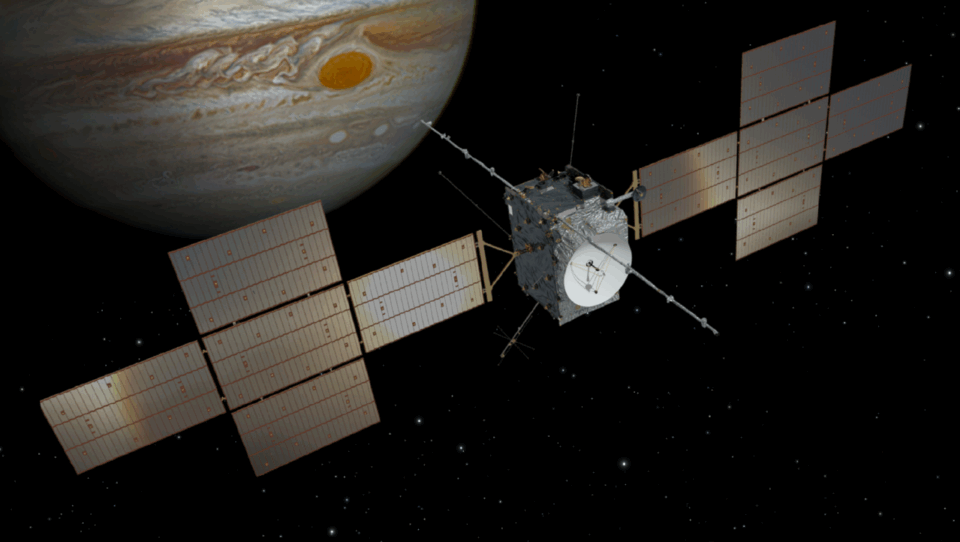
Juice, the ESA’s JUpiter ICy Moons Explorer, was launched from Guiana Space Centre on 14 April 2023. It’s a particularly interesting mission because it’s the first interplanetary spacecraft to the outer solar system not sent by the United States’ NASA. The probe’s main mission is to study Jupiter’s three largest icy moons, Europa, Ganymede, and Callisto. Late in the mission Juice will become the first to orbit around another solar system satellite, Ganymede, that’s not Earth’s own Moon. Scheduled to arrive at its destination in July 2031, what has it been up to in the last 960+ days?
One way to speed a satellite that far from Earth is to use other planets in the solar system to give them a gravitational assist. Each time they make such a close pass to a large body, they steal an infinitesimally small amount of their energy, which increases how fast the spacecraft is going. In Juice’s case, it will add up to four such “boosts” and eight years of traveling.
The first of this quartet of gravity assists happened back in August 2024, when Juice performed a flyby of the Earth-Moon system. What made this unique was this was the first time ever in which both the Moon (19 August) and Earth (20 August) were used for such a maneuver. This added double-boost sent the spacecraft on its way for a August 2025 close encounter with Venus, the second planet from the Sun.
Unfortunately, on 16 July, only a few weeks before this second critical flyby, the mission team monitoring the spacecraft had to solve a problem with its communications. For some unknown reason, Juice was silent; no telemetry data—containing, for example, readouts on the “health” of the probe—was being received. This was alarming as it could have meant Juice had on its own gone into survival mode.
This state, also known as safe mode, is an automated contingency for robotic spacecraft where non-essential systems are shut down to prioritize the vehicle’s survival during irregularities like loss of power, system failures, even interference from cosmic rays.
Airbus, Juice’s manufacturer, sprang into action and between them and ESA’s European Space Operations Centre (ESOC) in Germany, communications were returned within 20 hours. Part of this teamwork involved the Swedish Space Corporation (SSC), who also played a key role in both planning the flyby and the monitoring of the probe’s telemetry. As it turned out, the root cause of this anomaly was related to a scheduled restart of the spacecraft’s internal timer. Without resuming such contact with the spacecraft, this critical next assist by Earth’s so-called “twin” would have been in jeopardy.
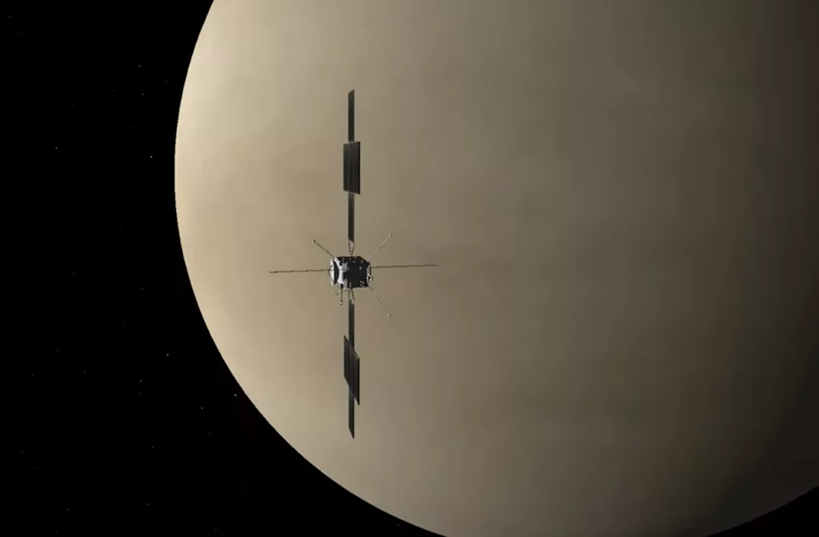
The 31 August 2025 flyby of Venus took place, with Juice’s passing just 5,088km from the cloud-covered planet’s surface. How close is this? If you take the official length of Sweden as 1,572 km from north to south, then this is about 3.2 times that distance.
This second gravitational assist via Venus increased Juice’s velocity by +5.1 km/s, sending the spacecraft on its way to the next encounter, its third, with Earth scheduled for September 2026.
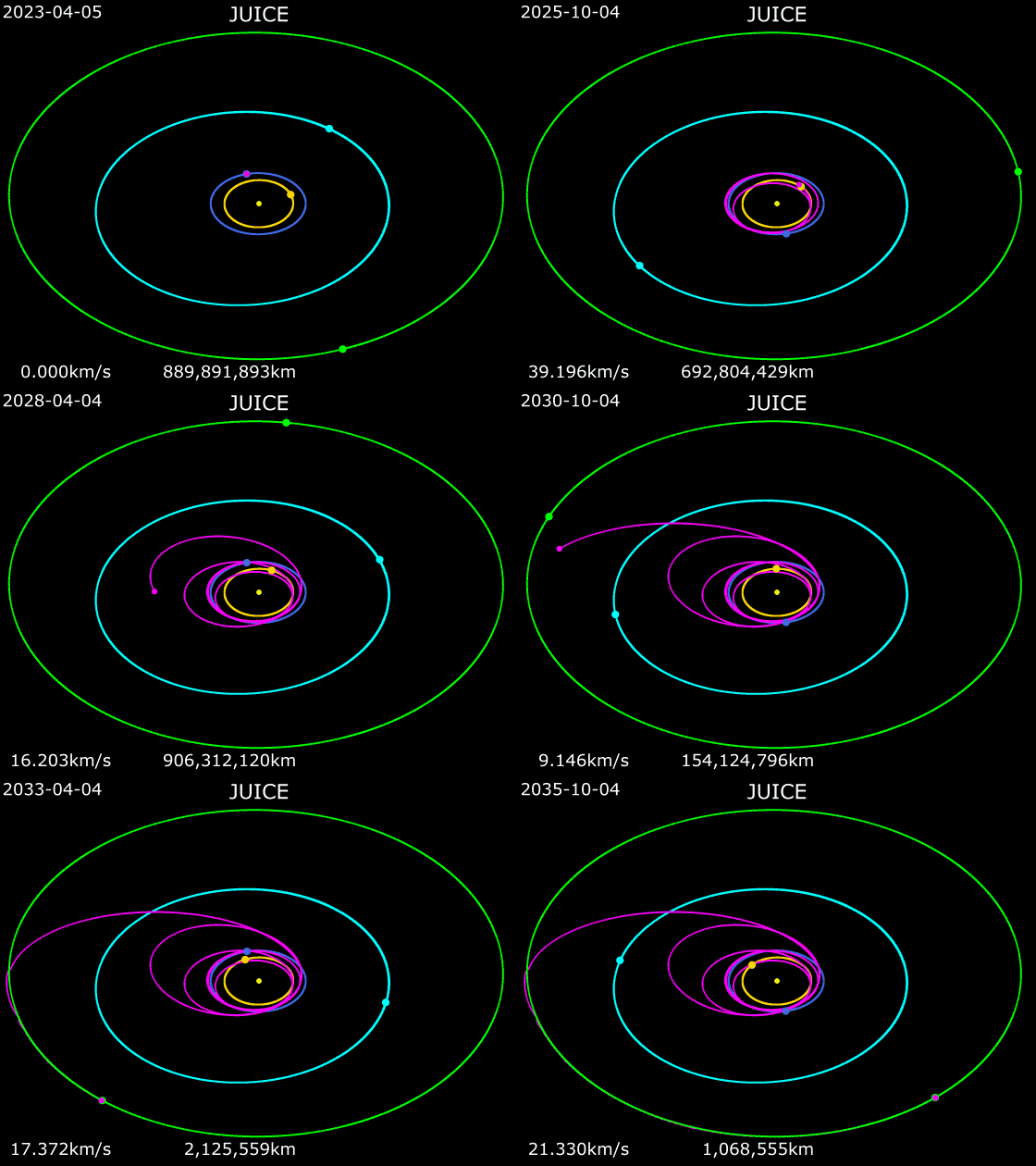
This animation, based on data from NASA’s JPL, covers Juice’s progress (the purple-colored orbit) through the solar system: from its launch in 2023 all the way to reaching Jupiter during 2031 and beginning its mission there.
If you want to read more information about Juice’s flyby of Venus, follow this link to the Swedish Space Corporation’s website.
By: Tom Callen