Egg-citing news from Hubble
HST captures a unique view of a star’s dying stages
When I first looked at the picture of the Egg Nebula associated with this week’s article, I will admit I was a little confused. What exactly was I looking at? It was almost as if two pictures got scrambled together into what looked more like art than science. Only after I started to read the Hubble Space Telescope (HST) press release coming with it was I able to put what I was seeing into some form of a pecking order.
I’ll take this opportunity to try and explain it in a different way, and like most things, we need to start at the beginning.
What makes this so important is that we’re looking at a star going through the last stages of its life, and is about to become what’s called a planetary nebula. In fact, this is the first time astronomers have been able to catch such an event at this stage of a star’s evolution, so you could call it a pre-planetary nebula. What are these kinds of objects once they’ve actually formed?
They were originally discovered via telescope back in the 18th century by people like William Herschel (1738 – 1822), the very same person who discovered the planet Uranus in 1781. To the astronomers of that time, they appeared to be like ghostly spheres. It is Herschel who first called them “planetary nebulae” because he thought they looked like a planet, and the name stuck.
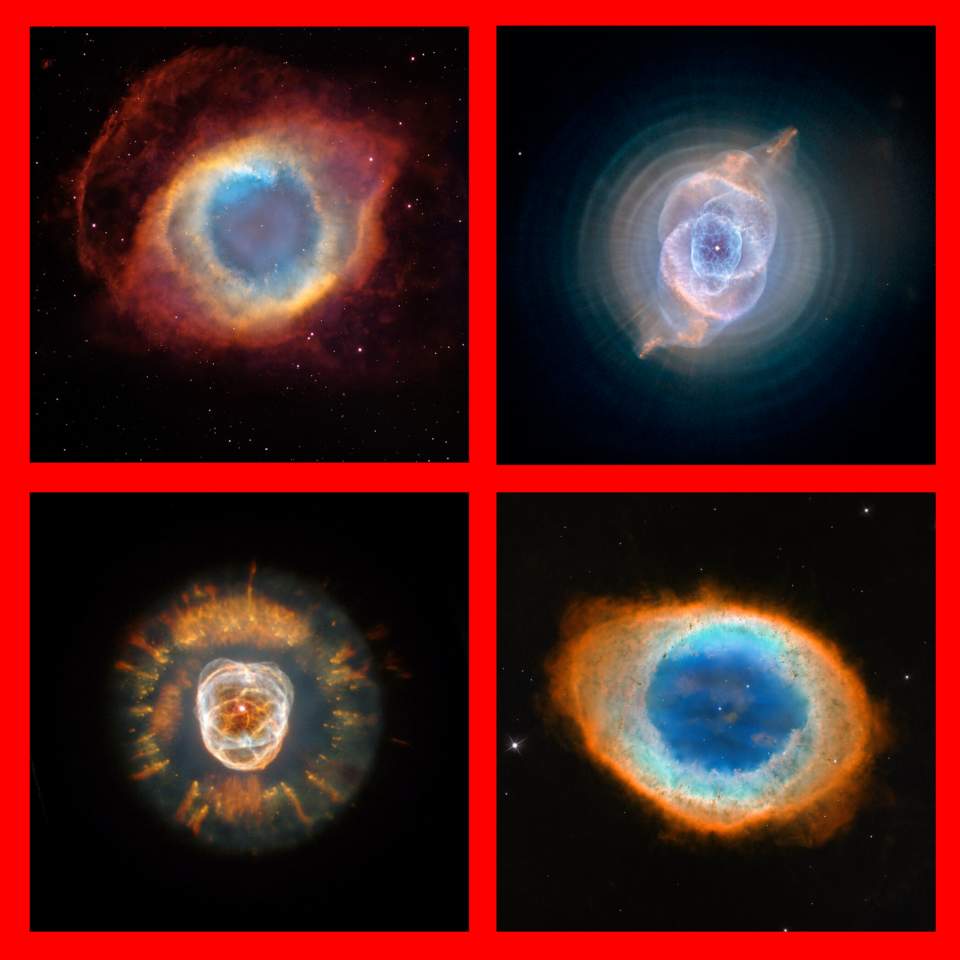
Here are four examples of planetary nebulae taken by space telescopes where they appear to look more like rings under the higher optical quality of today’s instruments. This is because we are seeing a sphere of gas. This ring-like appearance is the same as when you look at a round soap bubble hanging in the air. Its outer edges facing you look thicker because you’re looking through more of its soapy film, while the part in its center directly facing you is much thinner.
As we’ve seen in past articles, when a star, like the Sun, runs out of its nuclear fuel, it becomes unstable, which causes it to explode, giving off a shell of gas, which leaves its surface, more or less, in an expanding sphere. If you look carefully at the planetary nebulae above, you should see a star at the center of each, which is the original star undergoing this transformation. This too will happen to our own star in about 4½ billion years. *
So, what’s going on with this dying star, which was is so important after HST observed it? Let’s take the picture apart in four steps. For each one, I have made the original image in the background darker to emphasize the features we’re looking at. Note also that the four spikes seen coming out of brighter stars are the result of Hubble’s optics, and don’t exist in reality.
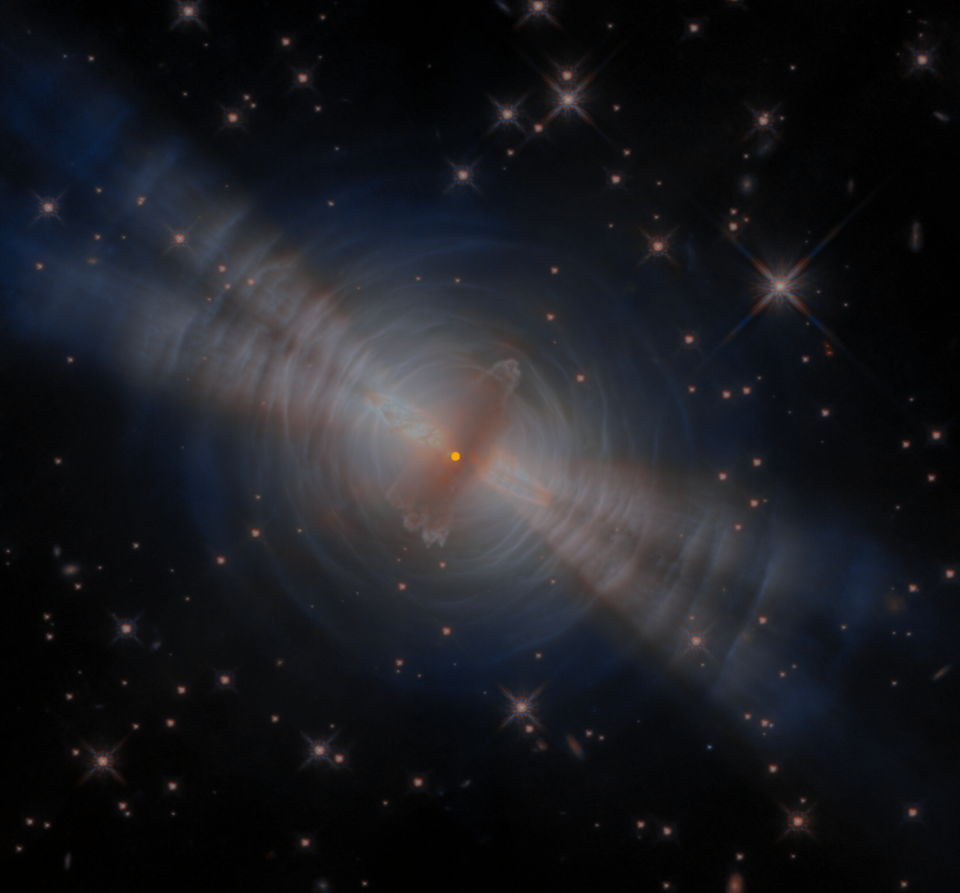
Hidden by the brownish-orange disk of material surrounding it is the dying star itself. While we can’t actually see it, I’ll mark its position with an orange-colored “star.” How do we know it’s really there? Because of our next step.
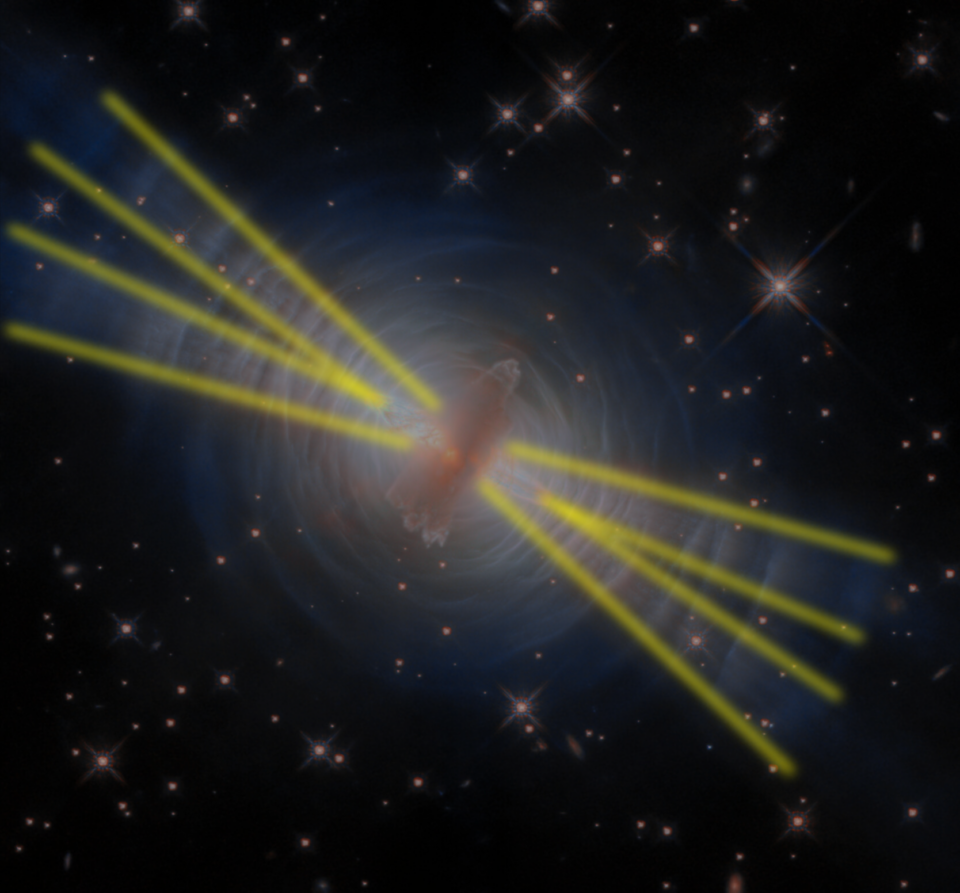
This V-shaped feature are rays of light being emitted from the star as it blasts its way through the dusty disk around it. Which is also a good thing as it’s helping to illuminate the object’s surroundings. Generally speaking, these pre-planetary nebulae are very dim and almost impossible to spot, and this one could be spotted by HST only because of these rays.
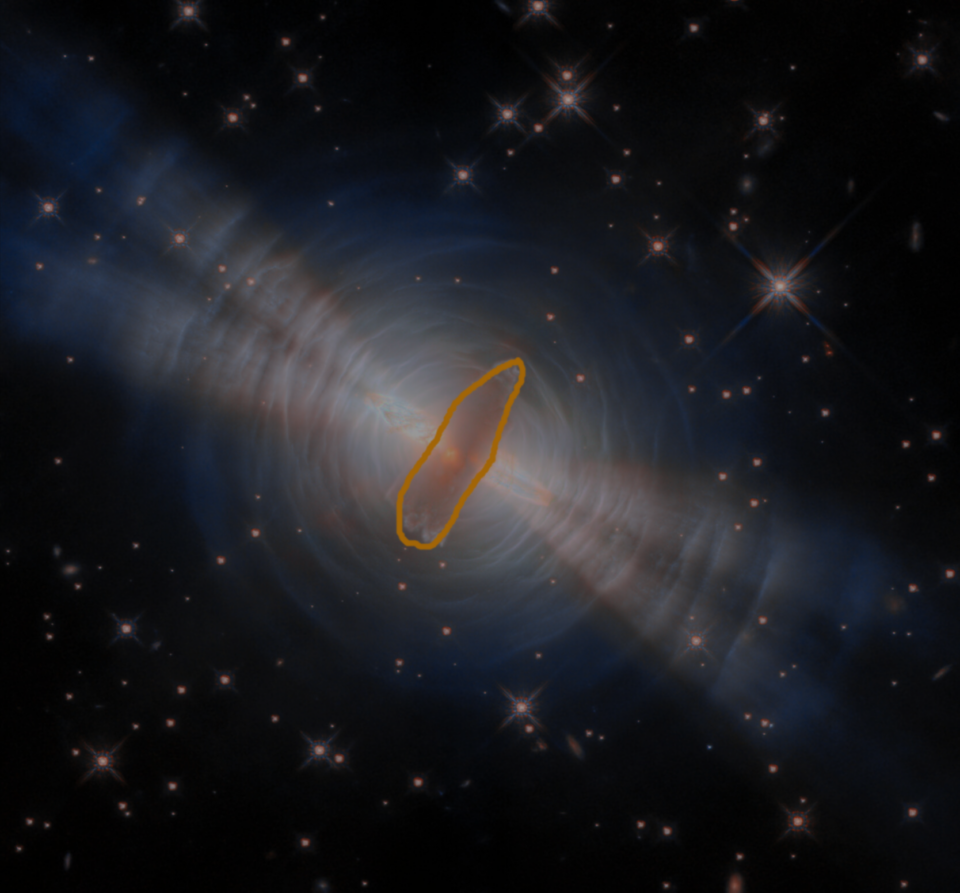
The brownish-orange disk itself, surrounding the dying star, is also visible because of the beams of light escaping from the star.
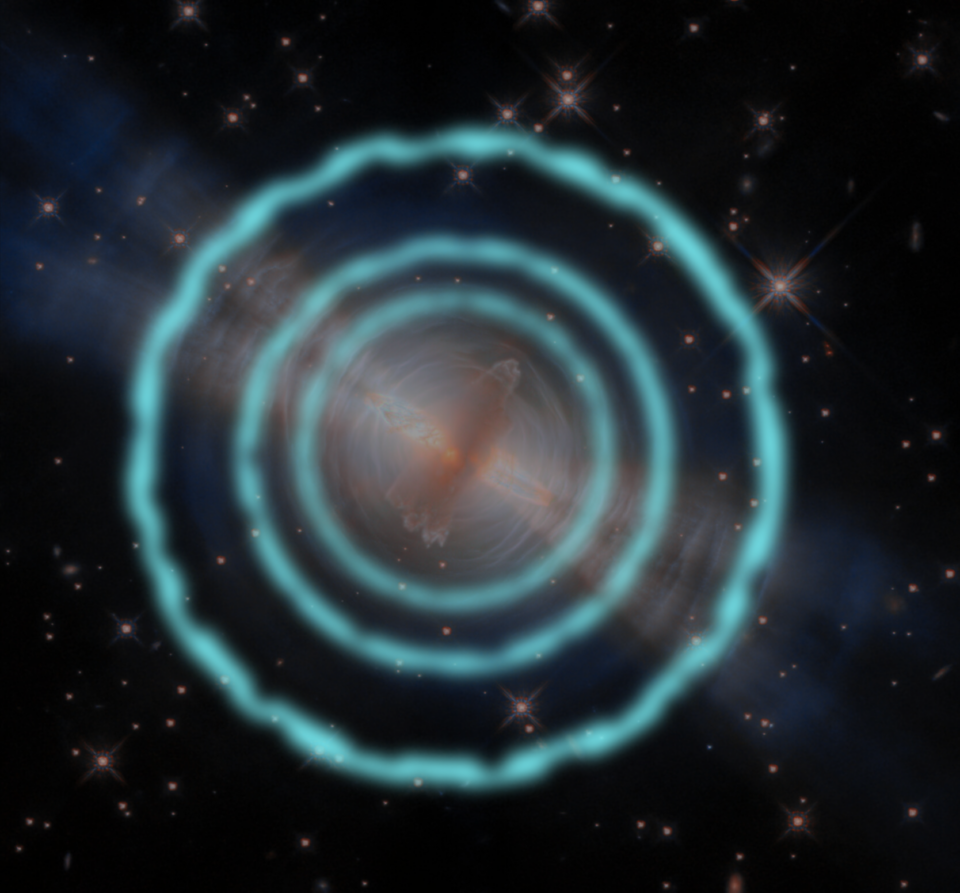
Not only are the rays of light streaming from the star making the disk seen, but they are also illuminating faint concentric shells of wispy gas the star was ejecting every couple of hundred years. Each faint shell—there are many more than the three I’ve shown—indicates such an outburst. The farther they are from the star, the further back in time they occurred.
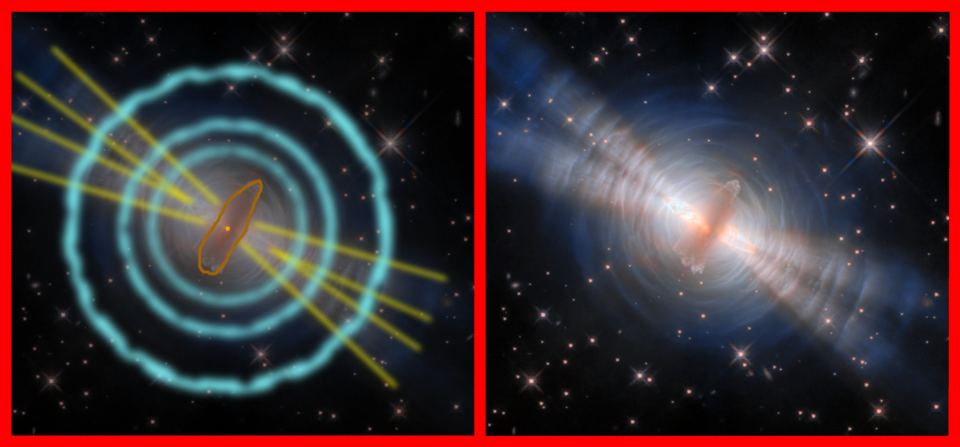
Last, but not least, let’s put all the steps together (left view) so that you can see how it all fits together alongside of the original image taken by Hubble.
It often happens we have to take some new information and break it down into its individual parts, then whisk them back together again before we can get a real understanding of what we’re looking at. And that’s egg-sactly the case with the Egg Nebula!
To read the ESA’s press release, follow this link.
By: Tom Callen