Seven years and counting
Is our Moon in the path of an asteroid?
There was a lot of leftover debris flying around in the early days of the solar system, which later merged into moons, comets, or asteroids. Some of it floating around can still be cause for some concern to us today.
One of the most obvious signs of this are on the face of the Moon, which is heavily cratered with the impacts of thousands upon thousands of asteroids of all sizes since its creation billions of years ago. And just because we can’t see from Earth, this doesn’t mean that the other side of our satellite isn’t as equally scarred. It has up to 30% more cratering than the side we familiar with as it always faces Earth.
Our world has also been hit in the past, including a collision with a Mars-sized body, which created the Moon itself. There are some examples of terrestrial craters still visible today, like Siljan’s Ring in Dalarna. The majority of them, though, are no longer seen due to our planet’s active weather system as well as their being buried under Earth’s surface by active geologic processes, such as plate tectonics. Had it not been for these, our world would have looked like its satellite, which has no appreciable atmosphere to cause crater erosion.
Back on 27 December 2024, a small asteroid (53 to 67 meters in size) was discovered by the Asteroid Terrestrial-impact Last Alert System’s (ATLAS) station in Rio Hurtado, Chile. Originally thought to have a higher than usual chance to collide with Earth, it was later eliminated of this happening. Our Moon, however, now stands a chance of being the target, which is much, much better because such a body hitting a densely populated area on our planet would have disastrous consequences.
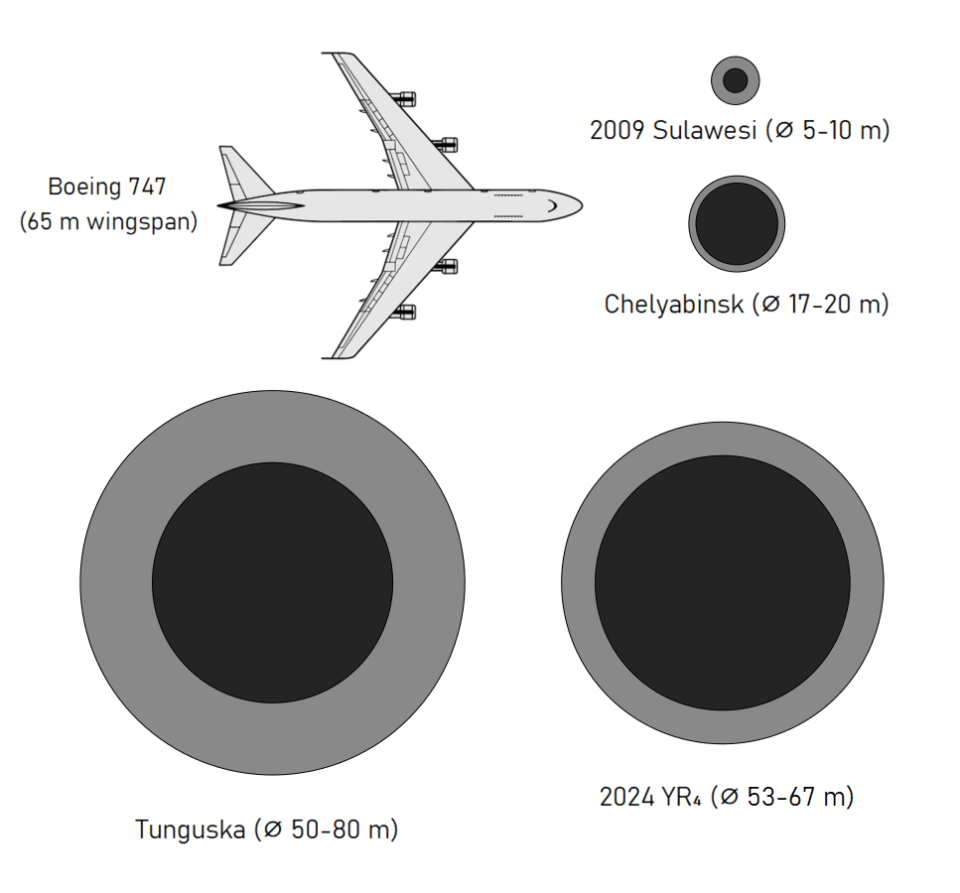
This artist’s view compares three other impacting bodies (2009 Sulawesi, Chelyabinsk, and Tunguska) with 2024 YR4 and a Boeing 747 jumbo jet. The darker circle shows their estimated minimum sizes, while the gray one is their estimated maximums.
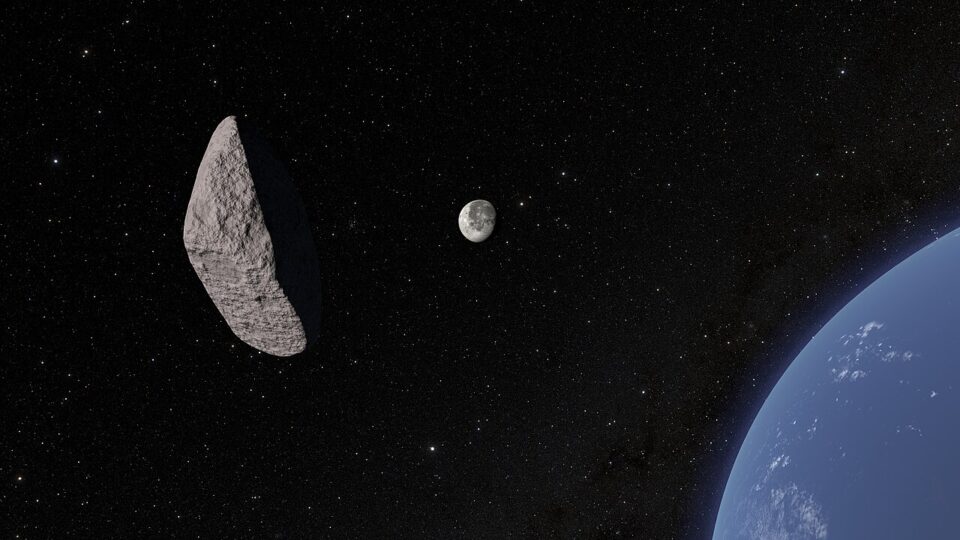
The predicted date of when it could strike the surface of our only natural satellite is on 22 December 2032, or a little over seven years from now. The closer we get to this date, the more accurate the predictions of when it could happen as well as increasing or decreasing the odds. An artist’s impression, seen here, gives a preview of what 2024 YR4 might look like on its way to its “moment of destiny” with the Moon.
This event also presents a potentially interesting opportunity as amateur astronomers have been able to capture such lunar events in the past. Being as close and as highly detailed as it is, the Moon is a very popular object for them to observe with their telescopes, me included.
Just like professional astronomers, their amateur counterparts also have access nowadays to digital CCD cameras to capture images of astronomical objects with their telescopes. One popular mode of imaging is to train your telescope and its CCD camera on an object, and then taking a stream of images, say 30 per second. One reason to work this way is to eliminate blurring effects caused by Earth’s atmosphere, which is in constant motion. Special software can then be used to compare such a series of continuous image files, eliminate the ones not very clear, pick the ones which are the best, and then stack them on top of each other in order to build up and create the best image.
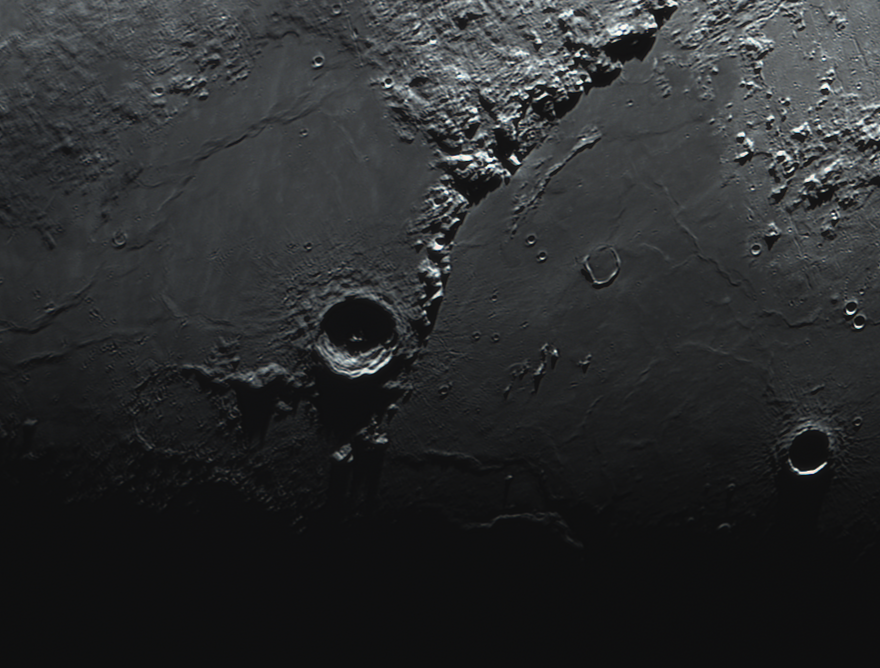
Here’s an example of such an image taken by an amateur’s telescope with a mirror 20 cm in diameter; the lunar crater (just left of center) known as Eratosthenes. It’s not one of the largest at around 59 kilometers across and 3.6 kilometers deep, nor is it one of the smallest. By comparison, one of the smallest which can be seen with such a telescope is Messier, which is 9.65 km in diameter. If the name Messier is familiar, he was the French astronomer famous for his late-18th century list of over 100 astronomical objects he made while hunting for comets.
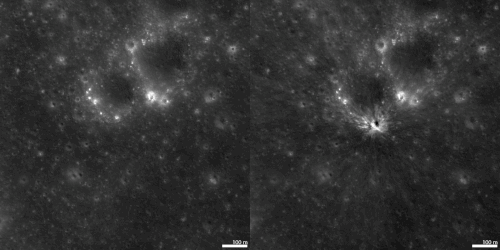
There have been instances where amateurs have accidentally captured the creation of a new crater while taking their photos of our closest neighbor in space as shown in this GIF animation. It switches back and forth between both before and after views of one of these rare events. The crater which was created is about 34 meters in diameter, and was captured by an Earth based telescope on 11 September 2013.
Unfortunately, based on the current predicted time of day when 2024 YR4 might hit our satellite, it will be in the middle of the afternoon here in Sweden, though this doesn’t make it any less exciting. No doubt there will be some astronomical organizations who, able to observe the Moon, will be live-streaming a feed so that we’ll all have a chance to participate if and when it happens. There is also the chance that better predictions will come out, better pinpointing the time. We’ll just have to wait and see what the next seven years bring us!
For more general information and several interesting animations about 2024 YR4, follow this link.
By: Tom Callen