Titan scores a ringer
Saturn’s largest moon may have led to the planet’s rings
If you were to walk down the street and randomly ask a hundred people what solar system planet they would either think of first, or was the one they considered to be the most beautiful, I’m pretty sure that “Saturn” would be the majority of answers. It’s so iconic that the sixth planet from the Sun is often seen in all variety of media representative of the concept of “space.” And what makes it so are the extensive rings encircling it. Lest we forget, we also know today, that Uranus (1977), Jupiter (1979), and Neptune (1984) have ring systems too, though Saturn’s are the most extensive.
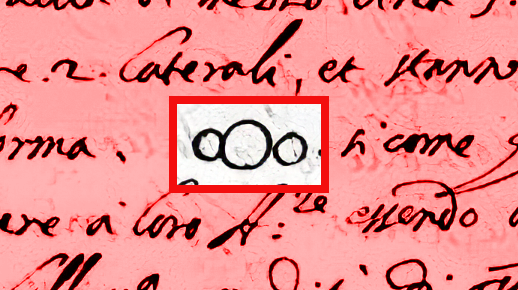
No one had any idea there could be anything like rings around a planet, the first clue coming in 1610 when Galileo Galilei (1564 – 1642) first turned his low-power, homemade telescope on the night sky. The picture above could be considered similar to a modern-day “discovery image,” appearing in a letter to the then Duke of Tuscany. According to the Italian scientist, “The planet Saturn is not alone, but is composed of three, which almost touch one another and never move nor change with respect to one another.” He thought they resembled “ears.”
When Galileo looked again at a much later date, the planet had tipped so the rings were more horizontal and edge-on, making them invisible to his simple telescope. Completely confused, he thought that perhaps Saturn had “eaten his children,” like the ancient Titan god, Cronus, of Greek mythology. In reality, when he observed the rings the first time and thought they were two bodies accompanying the planet, it was because both they and Saturn were tipped up a higher angle toward Earth, making them look moon-like on either side of the planet’s disk.
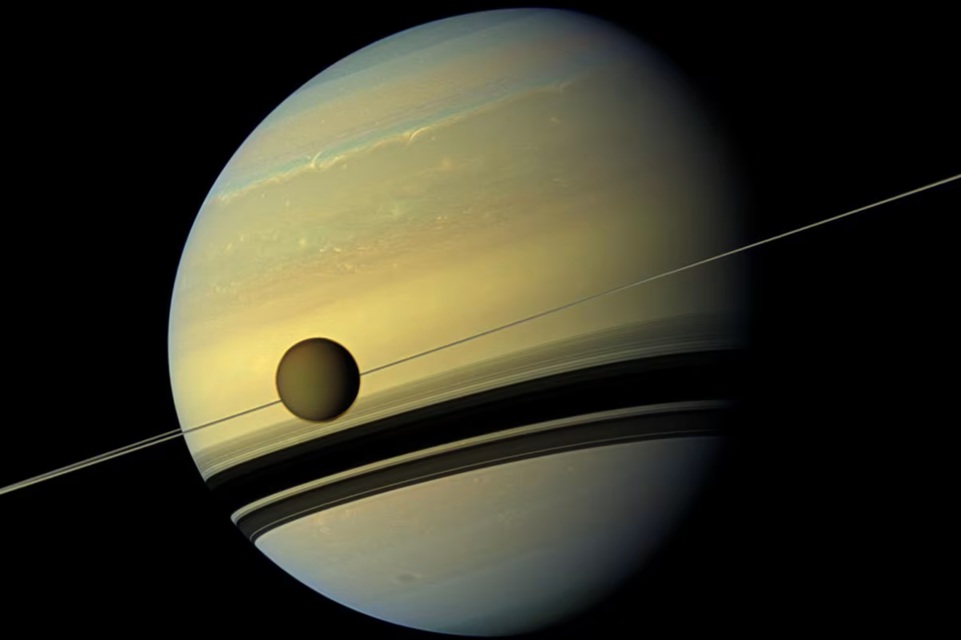
In this Cassini spacecraft photo, we can see the planet, the edge-on ring system (the thin line from lower left to upper right), their dark shadows cast onto the top of Saturn’s atmosphere as well as Titan, the planet’s largest natural satellite out of its 274 moons known to date. One thing you can immediately note is that this moon appears to be featureless, looking like a dark-orange ping pong ball. It’s because Titan is surrounded by a dense atmosphere made up of methane, the only moon in the solar system known to have one at all. Not only is it dense, but it’s four-times denser than Earth’s own envelope of gases.
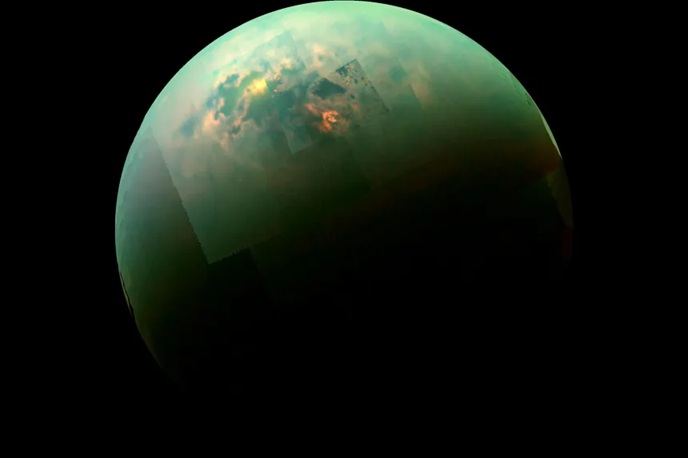
If we were able to see through Titan’s atmosphere, which Cassini could do, we would still see a body, larger than the planet Mercury and roughly half the size of our own world, with some unusual features. These include things like a surface containing lakes and seas of liquid hydrocarbon gases, such as methane, and there is evidence for other chemicals too.
NASA, like other national space agencies, often goes back and takes a second look at data collected from earlier missions in the solar system as new, more powerful analyzing techniques become available. A reexamination of data from the Cassini spacecraft, which orbited the ringed gas giant from 2004 until 2017 when it was then purposely crashed into the planet’s atmosphere, has revealed new information about both the possible origins of Titan, but also Saturn’s famous rings.
According to these new results, Titan may have been modified from its original size when it was crashed into by another moon about half a billion years ago. Rather than completely destroying this second satellite, part of it was absorbed by Titan, helping to make it larger, while the rest of it became other, much smaller moons.
Titan, in turn, could have caused some of these smaller bodies to crash into each other, with the resulting much finer-sized material eventually forming Saturn’s beautiful rings, perhaps around a million years ago. Made up of billions of icy particles ranging in size from dust to small houses or even mountains, the rings have an outer diameter of 282,000 kilometers, and are only about 100 meters thick according to robot spacecraft measurements.
The results of the initial collision of the interloper moon hitting Titan may also help explain why Saturn itself is leaning over 26.7° relative to the plane of its orbit around the Sun. Sound familiar? This same tilt of the planet making it appear to be higher and lower is why Galileo first saw the rings, thinking they were smaller bodies accompanying the planet, and then couldn’t see them when observing again much later. I myself have even seen this visible/invisible effect using amateur-sized telescopes over the course of Saturn orbiting the Sun.
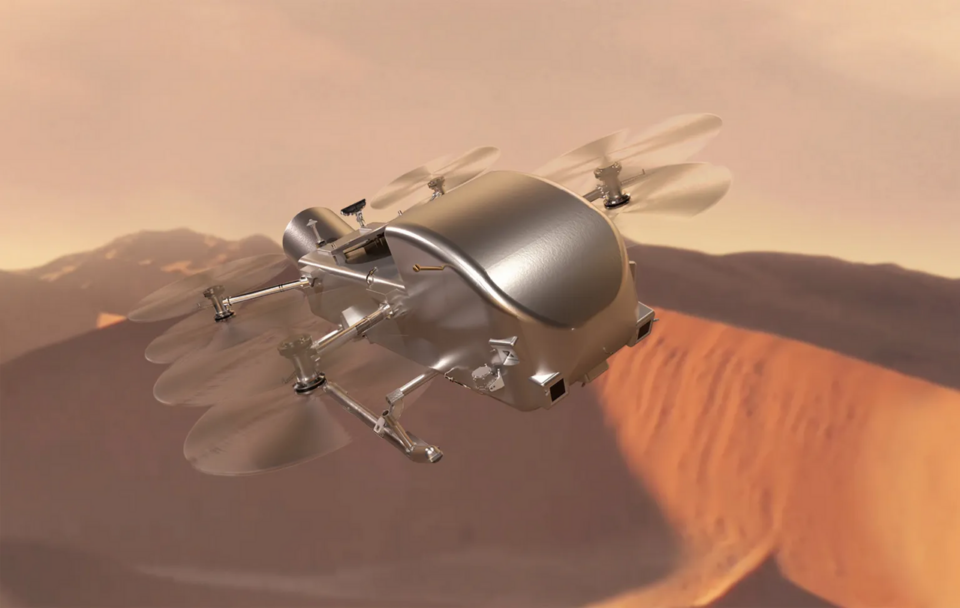
Stay tuned as there will be more to look forward to. Currently planned is “Dragonfly,” a car-sized rotorcraft (think something like a drone) powered by nuclear energy, scheduled to explore Titan’s surface. Launched in 2028, if all goes well it will begin its work below the giant moon’s orange-colored clouds in late 2034.
By: Tom Callen