We spy with Webb’s eye
Spotting the most distant supernova ever observed
It’s the start of a new year, an event we often associate with fireworks. So, what could be more appropriate than to begin 2026’s series of articles by taking a look at the most distant exploding star ever seen. Not only that, but its host galaxy was also able to be identified. These discoveries, made in the third year of James Webb Space Telescope (JWST) operations, can be added to its already long list of achievements.
When looking at distant objects in the universe no matter what kind of telescope used, we’re looking back into time. One of the reasons to have such large, specialized telescopes, like JWST, is to look even farther and in more detail.
Back in the middle of March this year, there was a very strong burst of gamma ray energy detected, caused by a very massive star (designated GRB 250314A) exploding. There was a lot of this going on in the early history of the universe, a period of rapid evolution, after it formed in the Big Bang nearly 14 billion years ago. This particular massive star event happened “only” 730 million years after the universe’s creation, placing it about 13,020,000,000 lightyears away.
While other large telescopes around the world could observe this exploded star, it was the James Webb Space Telescope which was able to actually able to prove conclusively it was a supernova. Not only that, but the galaxy in which it took place was found to be no different than the others surrounding it at the same point in time.
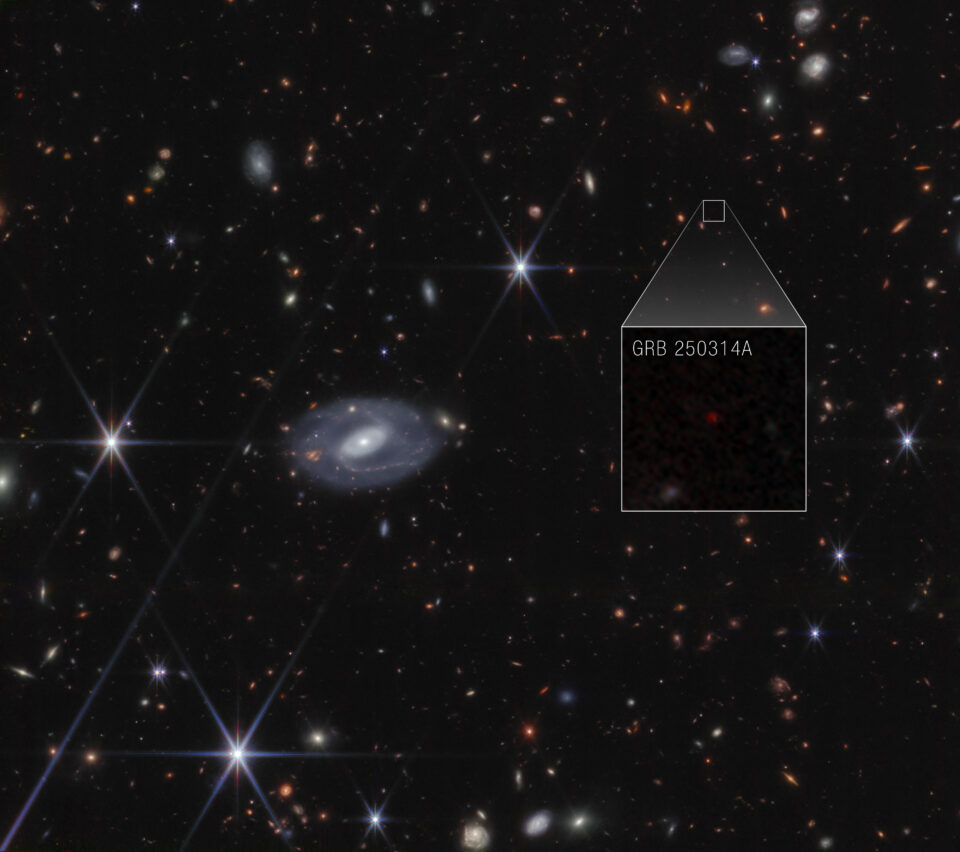
In this deep-space image taken by JWST, we can see a field of galaxies, with those largest being closest to us. The square inset on the right shows an enlarged part in which we can see a small, fuzzy red spot: the galaxy hosting the supernova.
Even more surprising was that the behavior of this distant supernova is the same as those much closer to us, including examples in our own Milky Way Galaxy. An exciting result, prior to Webb there had been little chance to understand stellar evolution at such a great distance. Putting this another way, it means there is the possibility to examine individual stars when our universe was only 5% of its current age.
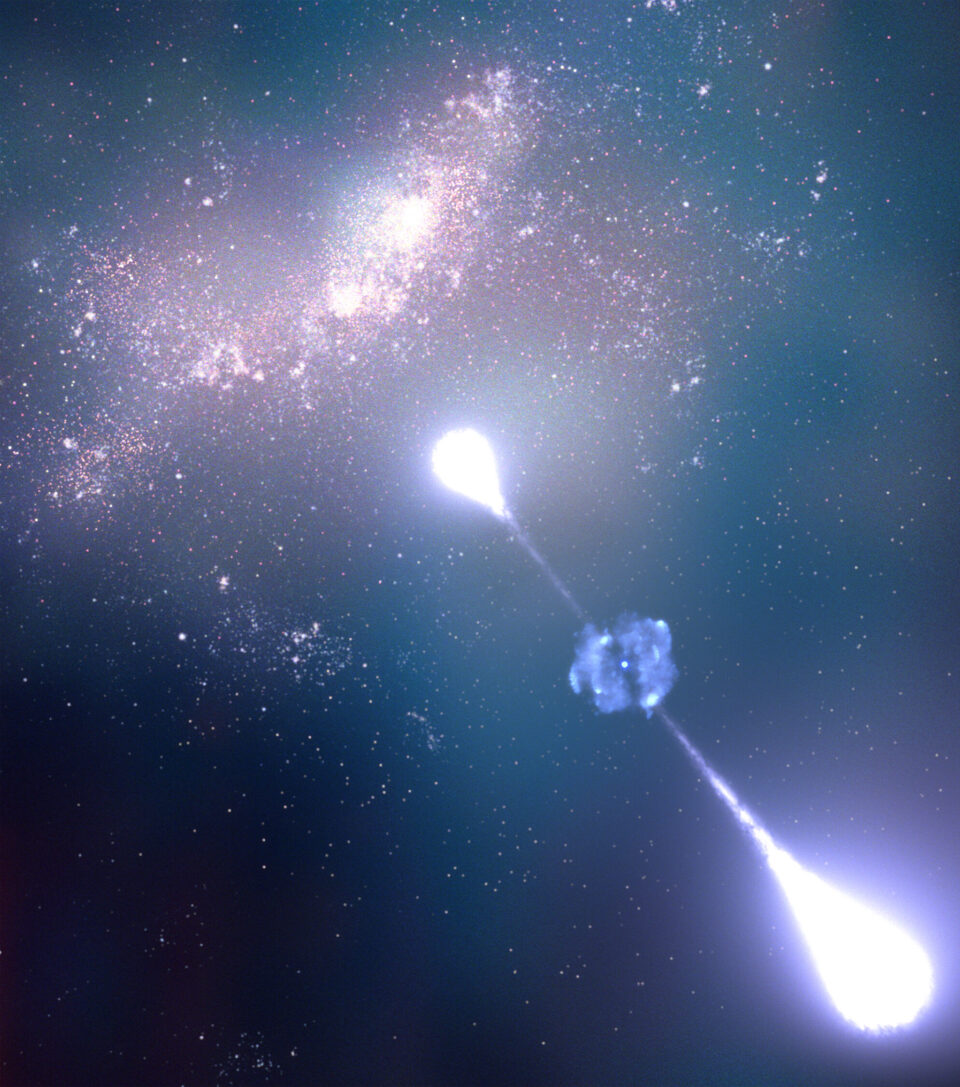
These violent, gamma ray-producing events come from the collision between two neutron stars, or the interaction of a single neutron star and a black hole. In this artist’s view, we can see the start of the explosive event, whose light and the gamma ray burst reached us back in mid-March 2025. There are two jets of material being shot out of the center of the system, which is part of the initial gamma ray burst which caught astronomer’s attention. The rest of the host galaxy can be seen to the upper left of the picture.
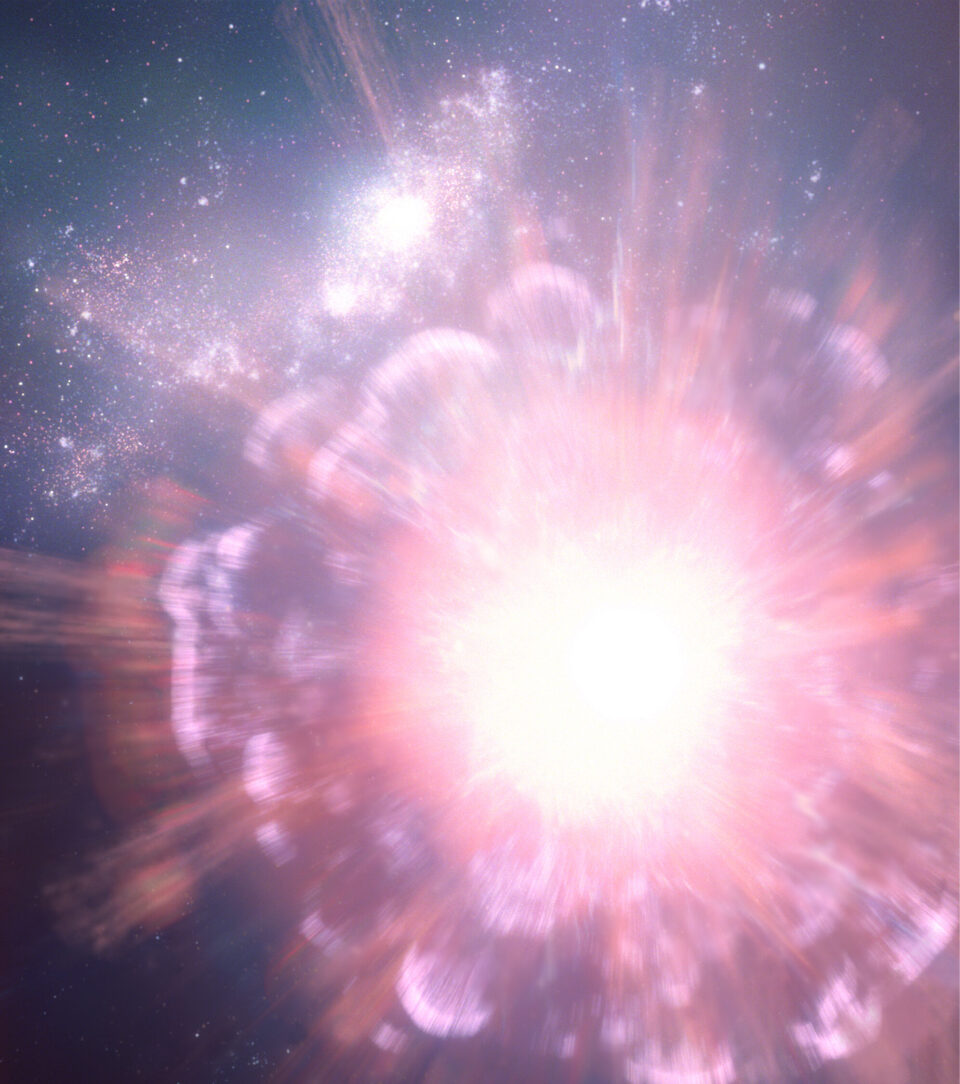
Another artist’s view, it’s now three-and-a-half-months later; when Webb made its own observations of the supernova. This was done on purpose so that this space telescope could get a better look after things had a chance to develop in the time since the explosion. The destroyed star itself is still bright, now surrounded by a shell of expanding material of pink-colored ionized gas and dust.
Additionally interesting about these record-breaking observations was that Webb broke its own record for seeing the most distant supernova; one it imaged 1.8 billion years after the creation of the universe. Which means the more recent one observed, starting mid-March, is another 1.07 billion years older.
For more general information, follow this link, and for additional details, see here.
By: Tom Callen