Long-Distance Voyagers
Still on the job after nearly 50 years
For some older readers the words “Long Distance Voyager” might conjure up the 1981 Moody Blues tenth studio album (you may have to ask your grandparents about them) by the same name, which actually predates even compact disks being introduced the following year. For others of perhaps the same age, it can also mean the two Voyager space probes sent to study the outer planets of the solar system. Planetary scientists noted that there was an opportunity to send a spacecraft into the outer solar system on a “Grand Tour,” which would allow them to reach the outer gas giants Jupiter, Saturn, Uranus, and Neptune. This was because the planets in their respective orbits would be aligned in such a way to allow robot probes to use gravitational assists to “slingshot” them from one to the next. To do so, they would have to fly relatively close enough to each successive planet in turn that they would be able to steal an infinitesimally tiny amount of their rotational energy in order to whip them on to their next gas giant target farther out.
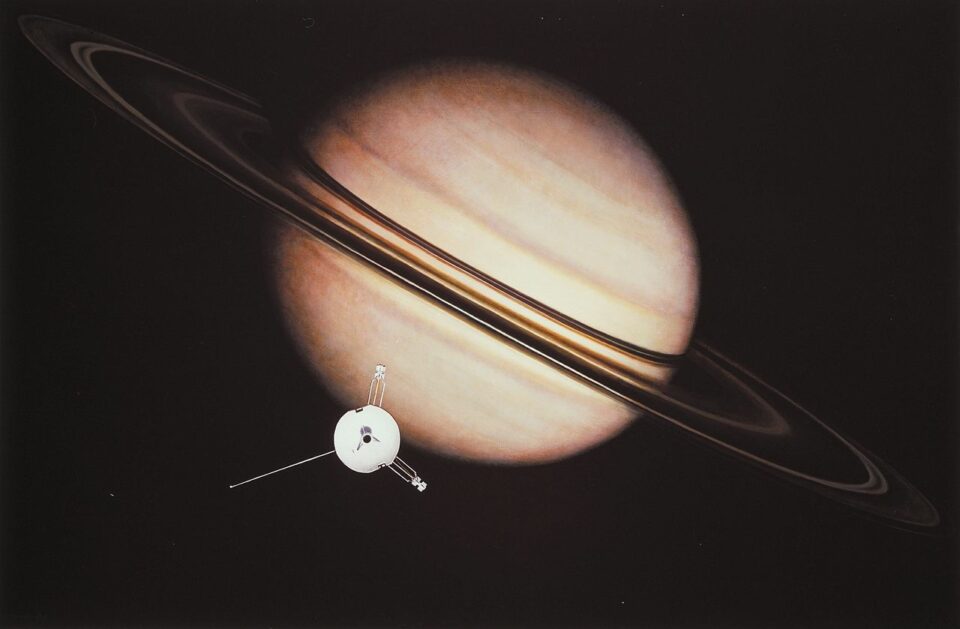
Jupiter and Saturn had recently been visited by the Pioneer 10 (Jupiter, 1973) and Pioneer 11 (Jupiter 1974, and Saturn 1979) probes, revealing interesting worlds and our first close-up, though low-resolution, looks at some of their satellites. This artist’s view gives an impression of Pioneer 11’s encounter with Saturn. The two outermost, Uranus and Neptune, remained unvisited, still appearing as nothing more than colored map pins—pale seafoam-green for Uranus, and sky-blue for Neptune—in even the largest earthbound telescopes.
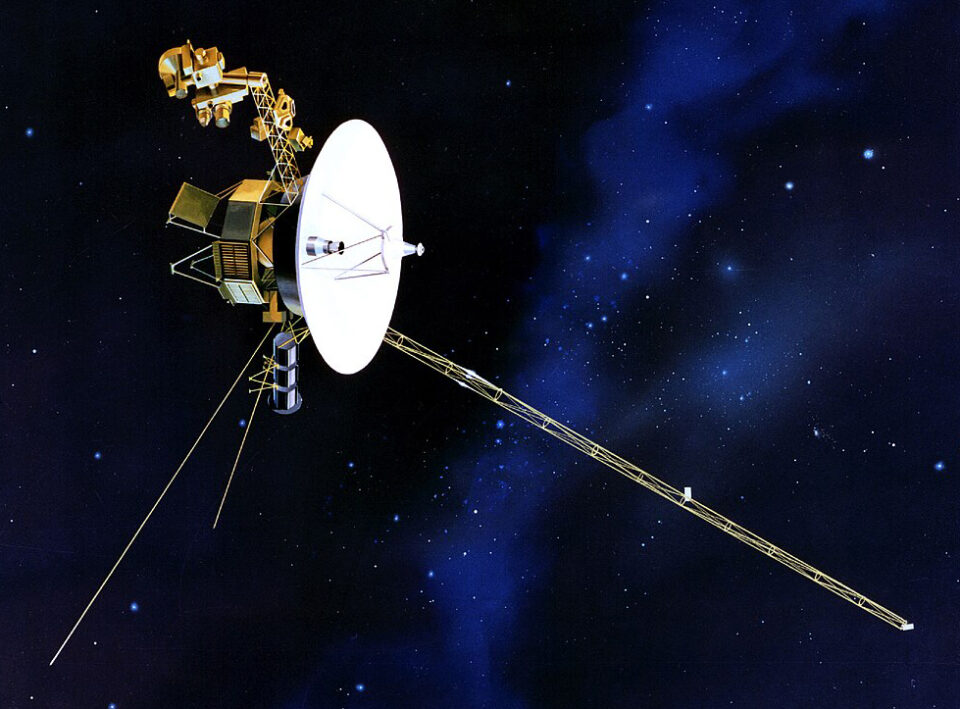
Larger than the two Pioneers, Voyagers 1 and 2 (the large white high-gain radio communications antenna seen in this artist’s picture, is 3.7 m in diameter) would be given different missions, though they would start out similarly.
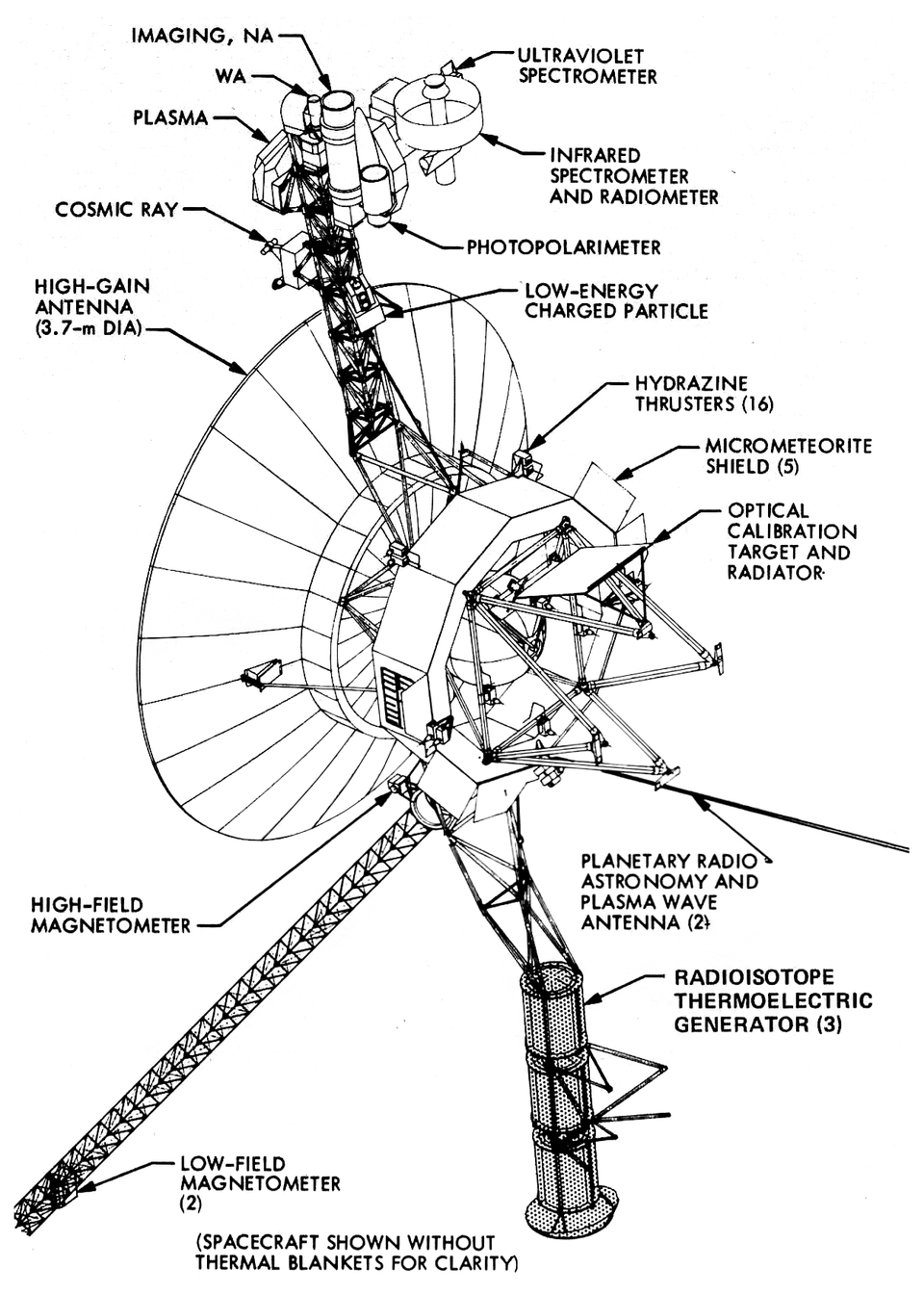
Both carried ten instruments, including a very sophisticated camera platform for capturing images. Since they knew in advance the flight path when going past a distant planet, like Neptune, where there was less light, the platform was able to do a little simple panning in order to compensate for the probe’s motion to get a longer picture exposure time as long as the planet wasn’t too close.
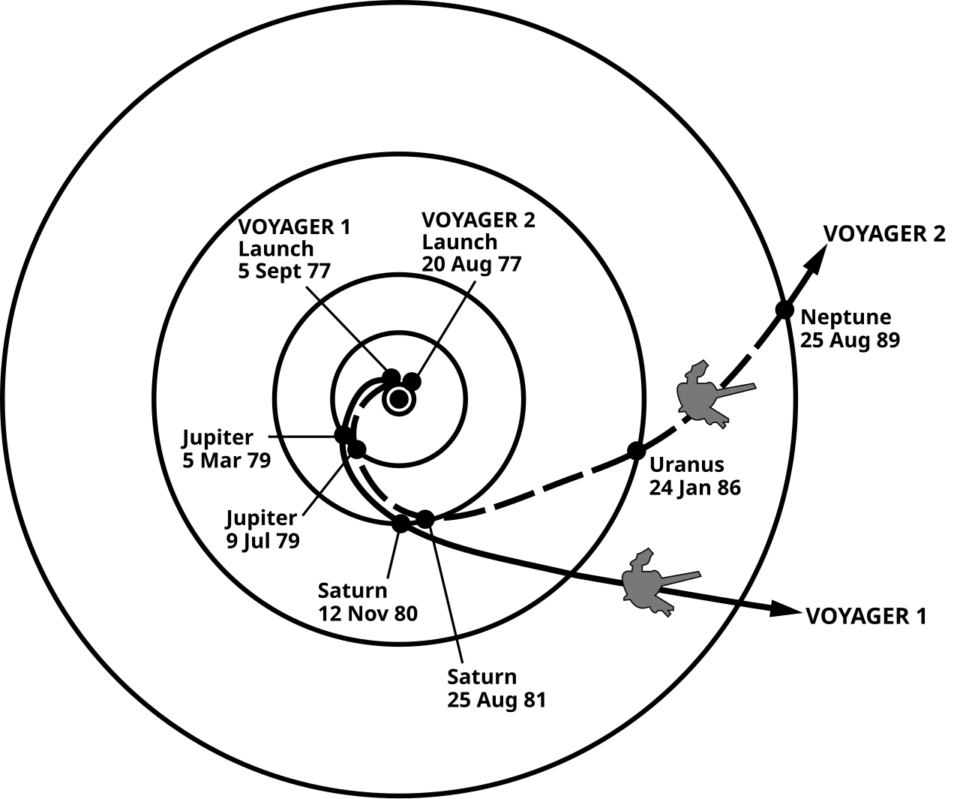
Both would visit Jupiter and Saturn, but then Voyager 2 would be directed onward to encounter Uranus and then Neptune before continuing on its way out of the solar system. Voyager 1 was already on its way, and the two would take different paths to probe the outermost reaches of the Sun’s influence.
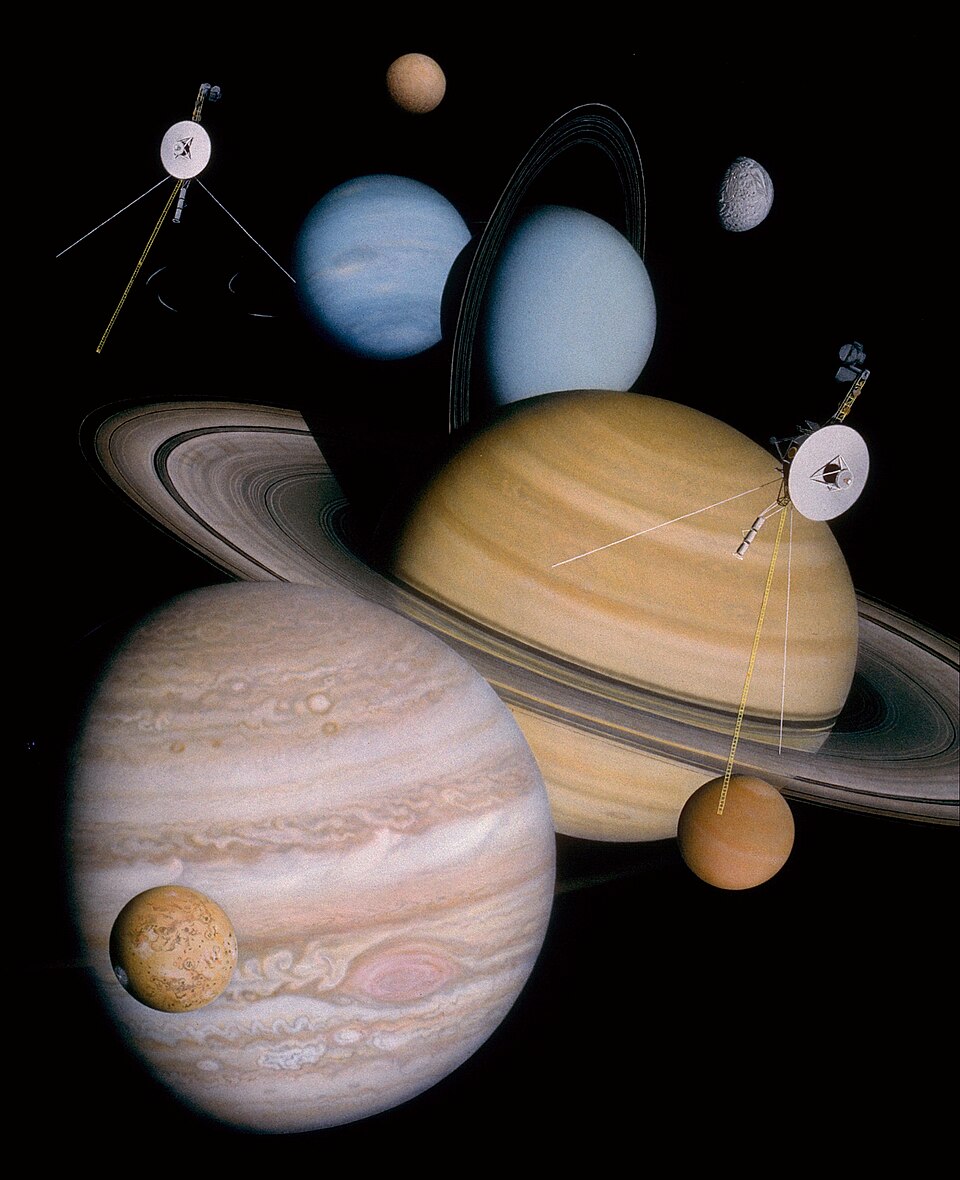
Though it looks like a photograph, this overview painting by space artist Don Davis summarizes the gas giants visited by the two Voyagers as well as a representative moon for each of them; for example, Jupiter’s volcanic Io, and Saturn’s atmosphere-covered Titan.
Since the farther one goes out in our planetary system the weaker the amount of sunlight, this removed the possibility of using solar panels to supply the electricity needed to operate them. Instead, they get their power from what are called Radioisotope Thermoelectric Generators (or RTG – the thing that looks like three coffee cans hanging under the probe in the drawing of Voyager above), which uses the decay of plutonium-238 to make the 470W of power the Voyagers initially had at launch. Since this radioactive element has a half-life of just under 90 years, this gradually decreases over time, which brings us to this latest news concerning Voyager 1.
Both Voyager 1 and 2 are beyond the Sun’s heliosphere, the magnetic bubble of our star’s magnetic field and outflowing stream of particles, now literally flying in interstellar space. Voyager 1 is the farthest functioning spacecraft from Earth right now at about 25.40 billion kilometers, and its identical twin, Voyager 2, is at about 21.35 billion kilometers.
Originally planned to last five years, both probes have over-performed their life expectancies by about 45 years, and with that there have to be some tradeoffs. Each year they lose around 4W of power due to their declining RTGs, and to be able to keep things running while still being able to supply heat to warm them, some scientific instruments have had to be turned off, beginning with those no longer able to supply useful data.
On 17 April, NASA sent a signal to Voyager 1 to shut off one of its last three remaining scientific experiments in an effort to try and conserve electricity. This Low-energy Charged Particles detector, which was used to study the amount of energy of electrons and ions around the probe, was shut off on Voyager 2 in March 2025, though Voyager 1’s could be turned back on again if need be.
There is more ahead for both spacecraft, with plans being made to perform what’s being nicknamed a “Big Bang.” This May or June, NASA is going to try and make a switch between what instruments onboard Voyager 2 are turned off and which ones are on. Being used as a test subject, this probe will have instruments drawing more electrical power turned off, while those using less power are turned back on again. Why Voyager 2? Because it has more electrical power remaining, and as can be seen from comparing how far from Earth they are above, it’s also a little closer to home. If this test works, the same will be done for Voyager 1 in July. In other words, everyone should keep their fingers crossed in the near future for both spacecraft’s sake. August (Voyager 2) and September (Voyager 1) 2027 will mark 50 years since they were launched to begin their long-distance journey through the solar system, and literally beyond it into interstellar space.
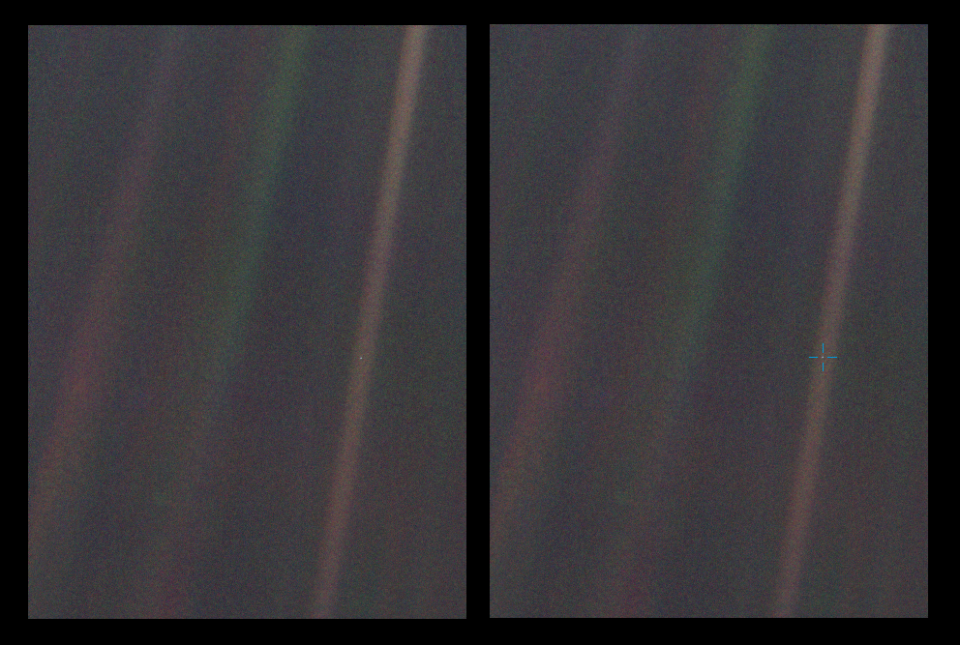
If you think Apollo 8’s “Earthrise”, or Artemis II’s “Earthset” photos were thought provoking, consider this one. When 6 billion km from Earth, Voyager 1 looked back to its home planet and took a picture that has become known as the “Pale Blue Dot,” which is very fitting. In the left half we can see Earth, the tiny blue speck halfway-down the ray of light at the right side of the picture. In the second half on the right, I’ve added a blue crosshair on it to emphasize it.
From Voyager 1’s great distance, our world was a mere point of light, less than the size of a picture element (i.e., pixel) in the probe’s narrow-angle camera; about 0.12 pixel across. The scattered rays of light seen running up and down through the picture result from taking the image so close to the Sun’s position in the sky.
I think planetary scientist, author, and science popularizer, Carl Sagan (1934 – 1996), said it best when it comes to this very simple, yet powerful, picture:

“Consider again that dot. That’s here. That’s home. That’s us…. The Earth is a very small stage in a vast cosmic arena…. To my mind, there is perhaps no better demonstration of the folly of human conceits than this distant image of our tiny world. To me, it underscores our responsibility to deal more kindly and compassionately with one another and to preserve and cherish that pale blue dot, the only home we’ve ever known.”
– Carl Sagan
By: Tom Callen