Cracking a “chicken or egg” problem
Can a giant black hole form before its galaxy does?
Most people, regardless of their age, have heard the old riddle about “which came first, the chicken or the egg?” Sometimes such problems crop up in the world of science when considering two things as in the example above.
In the case of astronomy, this could apply to which came first: the star and its planets, a planet and its moons, or in this case, the galaxy and its associated black hole? We know, for example, there is a massive black hole at the center of our own Milky Way Galaxy, and many of the others observed by astronomers also contain them. Most contemporary thinking has been that after a galaxy first forms, its earliest stars are very massive. Quickly consuming all of their nuclear fuel, they then collapse to become black holes. These, in turn, gobble each other up, growing larger and larger until forming a single object having the mass of millions to billions times that of our own Sun. Thousands of these are known in the early universe, but is this scenario how they got to be so large and so fast?
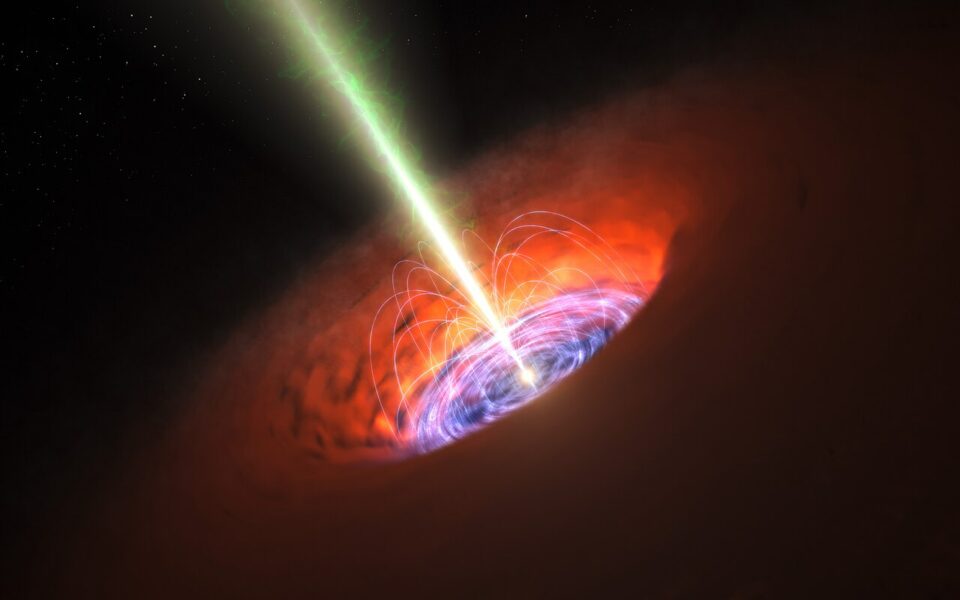
Here we can see an artist’s impression of what one of these supermassive black holes in a galaxy’s center might look like when viewed from up close. The unseen black hole lies at the center, surrounded by a disk of super-heated material that’s slowly spiraling down into its gravitational grip. Jets of particles streaming away at nearly the speed of light appear like searchlights from both its top and bottom.
As you may already know, when we look at objects in the universe, we are seeing them as they once were due to their distance. And this applies to even the nearest, most familiar things. When we see the Sun, it’s not as it is right now, but how it appeared eight minutes ago because its average distance of about 150 million kilometers from Earth makes it 8 light-minutes away. This is how long it takes for its light to reach Earth. So, when using a telescope, we’re looking backwards in time, and the larger the telescope, the further back we can look.
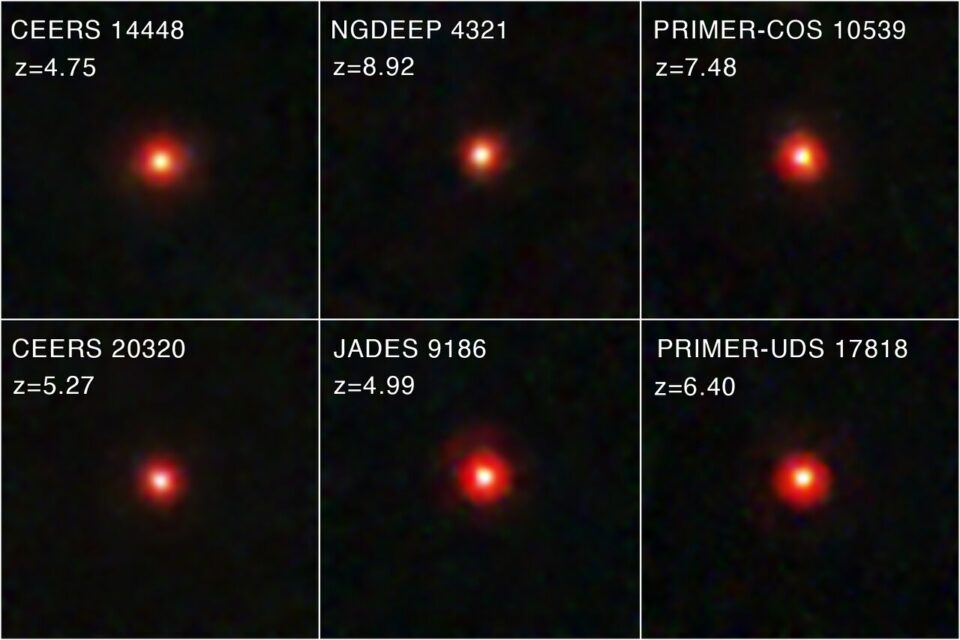
Which brings us to these new results from the James Webb Space Telescope (JWST). Early after this most sophisticated observational tool ever made went into operation, astronomers began to notice something unusual. Due to its extremely high resolution power, they started spotting red dots, very small in the sky, and far, far away in the distant, young universe. Named “Little Red Dots” (LRD), they start to show up in large numbers in the data around 600 million years after the Big Bang, about13.8 billion-years-ago. And they rapidly decrease in number about 1.5 billion years after this universe-creating event, or some 900 million years later. While not yet well understood, one new theory is describing potentially related processes that may have occurred in the early universe. Looking at this JWST image of six different LRDs, they really do live up to their name.
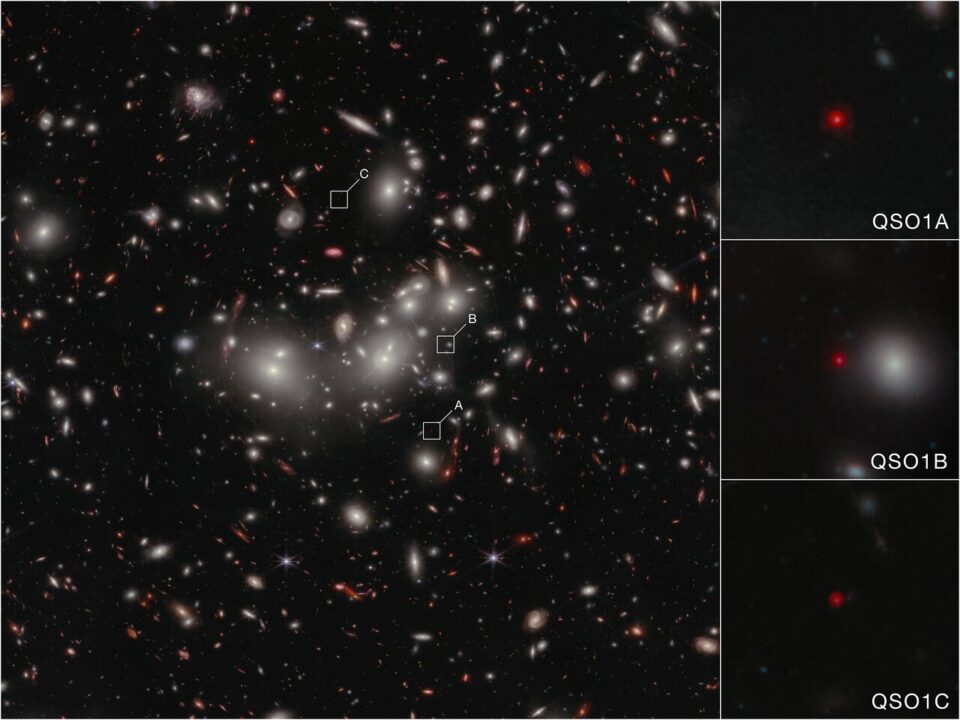
JWST was observing a compact cluster of galaxies, Abell 2477, found in a modern catalogue of nearly 4,100 of these dense groups created by American astronomer, George O. Abell (1927 – 1983). They noticed a typical example of one of these LRDs that was in existence 700 million years after the Big Bang, or when it was only about 5% of the universe’s current age. What made this one especially useful and interesting to study was it didn’t exist in one example, but three, and all were of the same object. How can this be?
Due to the extreme gravity of this cluster of galaxies, the light from this LRD, dubbed QSO1, is literally being bent around from behind this group, or “lensed” as it’s called, so it became both visible and magnified. Each of the three images of QSO1 (seen vertically to the right), known as QSO1A, QSO1B, and QSO1C, can be seen scattered in an arc around Abell 2477 in the left half of this JWST image. They all don’t appear quite the same because of the conditions of their lensed image’s surroundings. QSO1B, for example, looks fainter due to its proximity to the white elliptical galaxy to its right. Just for reference, all of the other objects in the larger photo are also distant galaxies. If you look closely, you can even make out details in some of them, such as spiral arms.
In spite of it looking like a point of red light, we know that QSO1 is about 1,300 light-years across, or about 650 times wider than the Oort Cloud, the most extreme outer region of our solar system. The brightest of the three, QSO1A, has a supermassive black hole 50 million times the mass of the Sun. Surrounding it is a cloud of hydrogen and helium gas, which is roughly about half the mass of the black hole. This is the opposite of what normally would be expected; the galaxy should be outweighing its black hole, not vice versa.
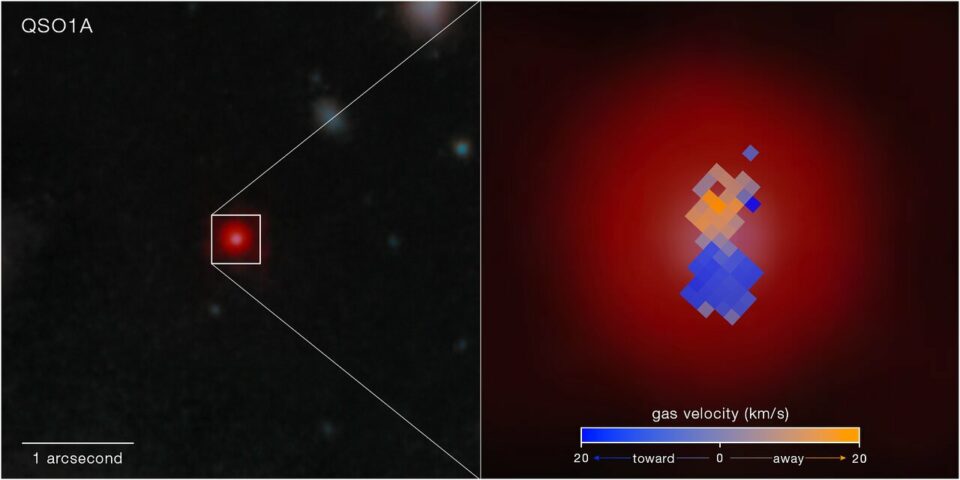
An instrument onboard Webb, a combination of camera and spectrograph that can be used to take the “chemical fingerprint” spectra of an object, has made the image on the right of QSO1A, whose red dot is seen here on the left. The linear color scale on the right is the key to showing how fast the gas is orbiting around the supermassive black hole; either towards the telescope (blue) or away from it (orange). In the magnified view of QSO1A, the blue area shows its orbiting speed as it’s headed toward JWST at about 20 km/sec at its darkest color. The orange region, on the other hand, is moving away from the telescope at 20 km/sec. It is this motion of material, calculated just like a planet going around the Sun, that enabled astronomers to estimate the 50-million-solar-masses for the black hole at the object’s center.
The outstanding question remaining is how could this supermassive black hole form in such a short amount of time without going through the cycle of many massive, exploding stars turning into smaller black holes while the object making QSO1 was developing. The conclusion suggested to answer this is that 50-million-solar-mass black hole must have existed before its host galaxy. In fact, it possibly formed within the first second of the Big Bang’s creation of the universe, which also means it must have been immense even from its very beginning. No doubt future observations of some other such Little Red Dots will yield similar results, adding weight to this second, alternative way for these huge objects to form in the centers of their galaxies.
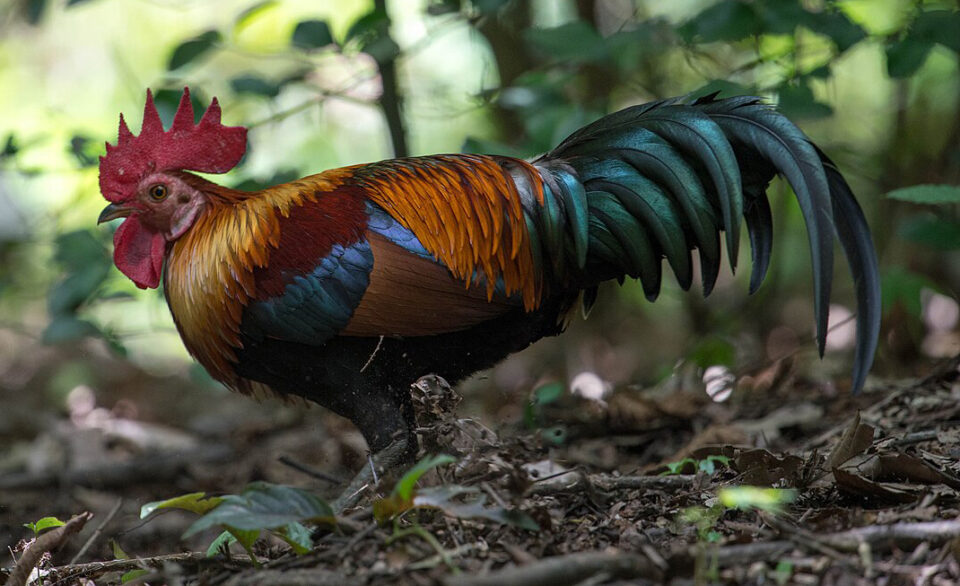
Oh, and just in case you’re wondering about the answer to the “chicken and the egg” riddle from a scientific point of view, it was the egg. If you think about it for a second, it actually makes sense. At one point in the past, about 58,000 years ago, there was an ancestor of the chicken, the Red Junglefowl (Gallus gallus, shown here) which laid a literal egg. Nothing unusual about that except this egg contained, for whatever reason, a genetic mutation.
The bird that hatched from this mutated egg became the very first true example of what we know today as a chicken. So, the egg had to have come first! But as far as what we consider to be the modern domesticated chicken, that didn’t come about until some 7,000 to 10,000 years in the past, with direct archaeological evidence of their regularly being around we humans coming from around 3,500 years ago. Now there’s something to think about the next time you make use of one of these little, white ovoid-shaped wonders of nature!
For the ESA press release, follow this link.
By: Tom Callen