A pair of protoplanets
Newly forming protoplanets have been found circling a distant star
In last week’s article I talked about how both the James Webb and Hubble Space Telescopes had studied star formation in star clusters in four different galaxies. This would lead to a better understanding when planets might form around them as our own Earth and its neighbors did 4½ billion years ago. Ground-based telescopes have revealed an example of a pair of protoplanets forming in the disk circling a Milky Way Galaxy star, designated WISPIT 2, seen in the constellation of Aquila, the Eagle.
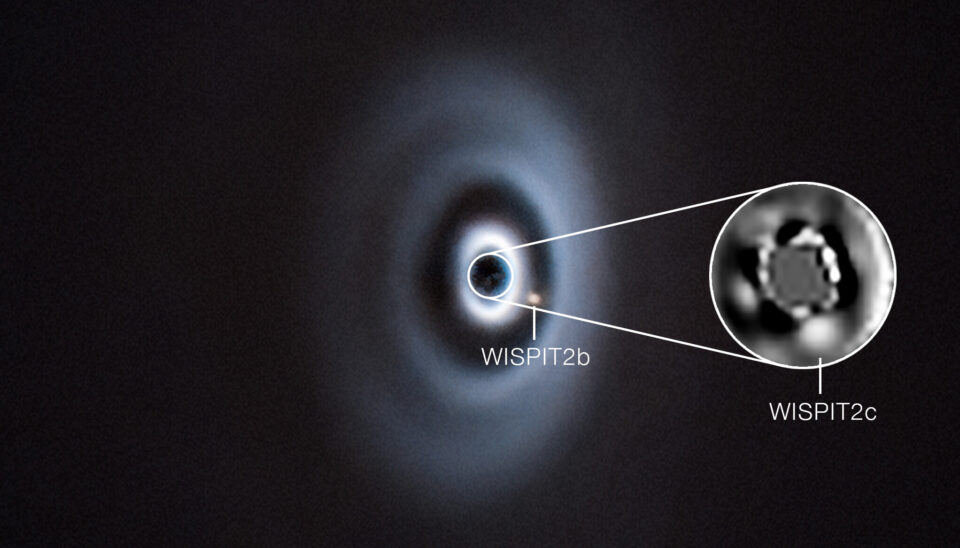
WISPIT 2 was known to have one planet around it before, but these recent results with ESO telescopes have shown that there is a second that is also in formation. The first of the pair, WISPIT 2b and discovered last year, is around five times the mass of our own solar system’s Jupiter and at a distance about 60 times that between the Sun and Earth. Putting this another way, this first discovered protoplanet seen in this picture’s dark gap in the disk is twice as far from its star as the planet Neptune is from ours.

In this diagram, the distances between the planets are to scale, but their sizes are not. The second, newly discovered protoplanet, WISPIT 2c, is only four times the Sun-Earth distance (or between Mars and Jupiter, but closer to the latter), and is twice as massive as WISPIT 2b, or ten times Jupiter’s. With these kinds of masses, both of these have to be gas giants, like Jupiter, Saturn, Uranus, and Neptune in the outer reaches of our solar system.
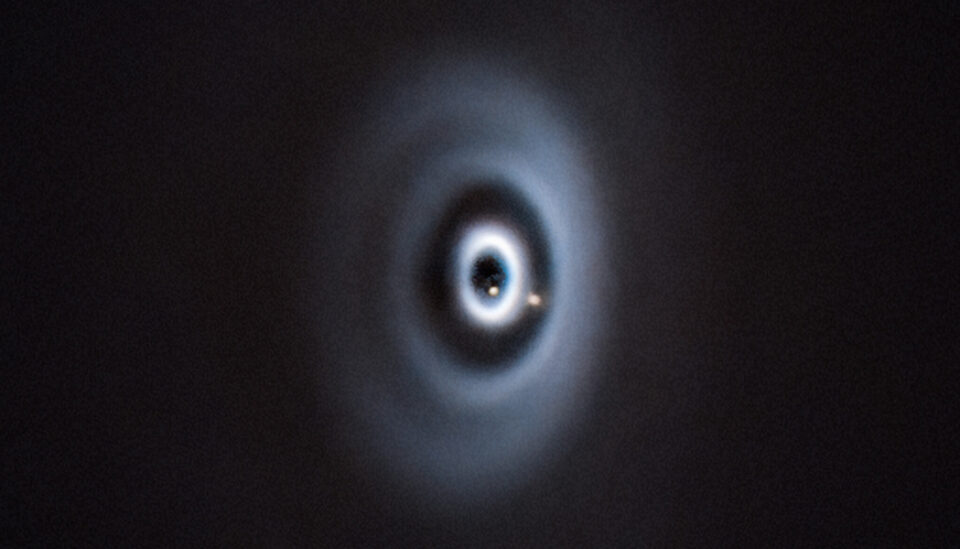
The gaps where these two planets are in formation are a direct result of their accumulating the disk material around them, sweeping it up as they grow. This shows up much more clearly in this “cleaned-up” version of the image. It also brings up another interesting point. As seen here, it looks like the disk of material around the star WISPIT 2 is tipped a little bit away from us on the right side. If it had been turned so that we were seeing the plane of the disk edge-on, it might have made it potentially more difficult to pick out the two planets.
This isn’t the first time exoplanets have been observed circling other stars. What’s special about WISPIT 2 is that this is only the second time when astronomers have actually observed two exoplanets in formation, which could be likened to the origins of Earth and the seven other planets of the Sun’s family. It’s like a snapshot of our distant past. Will there be other forming protoplanets found there? Only time will tell.
For the press release with pictures, follow this link, and for a zoom-in video (be sure your sound is ON), see here.
By: Tom Callen