Building blocks on Mars
Curiosity discovers organic molecules needed for life on the Red Planet
After Earth, Mars has the best chance for life, or at least may have been the home of former life, albeit it microbial, in the solar system. NASA’s long-term plan has been to “follow the water” when it came to the Red Planet after it was discovered there were water-created features on the planet’s surface as far back as Mariner 9 in 1972. Why was this important? Because our understanding of how life originated, or as we understand it, needs to have water, which is an important part of the process. While there was no evidence of liquid water now, there certainly was enough evidence of it in the past in the form of river beds, past river deltas, large canyon systems, and what were once large lakes. As part of the “follow the water” ethos, NASA has put a series of robotic rovers down on Mars to explore areas where large amounts of water were once known to exist.
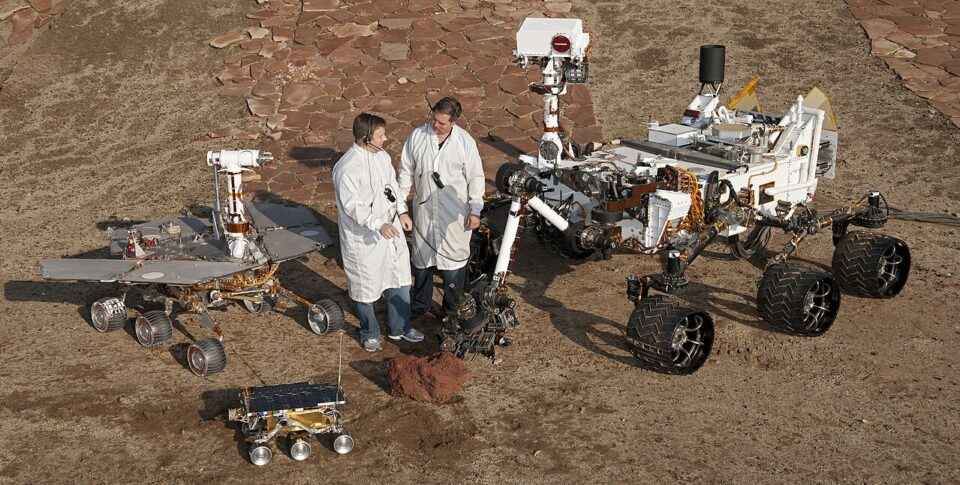
The Curiosity rover landed on Mars in August 2012 in Gale Crater near the foot of what’s known as Mount Sharp. One of its goals was to examine the sedimentary rocks found there (i.e., the kind deposited in layers by water) to look for signs of conditions that could have supported life in the Red Planet’s past. Here we can see two Jet Propulsion Laboratory engineers standing next to three generations of NASA’s rovers it’s sent to Mars to get a sense of just how large Curiosity is. In the foreground we can see little Sojourner (1996), the first rover to ever drive on the Martian surface. To the left of the engineers is a representative of the twin rovers Spirit and Opportunity (2004) delivered to two different locations. To the right is the small car-sized Curiosity, the subject of this article.
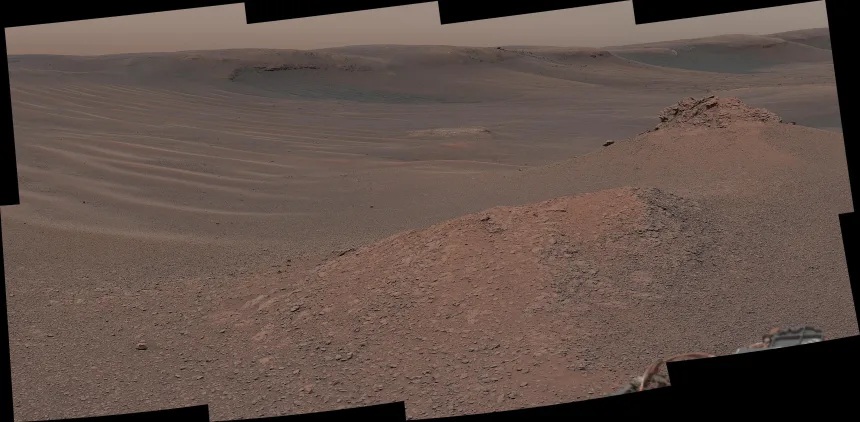
Curiosity’s MastCam (the camera-looking box with the lens seen on the tall stalk over the rover in the group picture above) took this panorama in the Mount Sharp area in 2019. If you look carefully, you can see both fragments of sedimentary rock layers (left center foreground) as well as more complete formations (like the large structure to the upper right). Such rocks in the area included both mudstones from ancient lakes as well as sandstones formed by moving water flowing into it. Much of it is rich in clays, a byproduct of a watery formation, which can be very good at preserving materials.
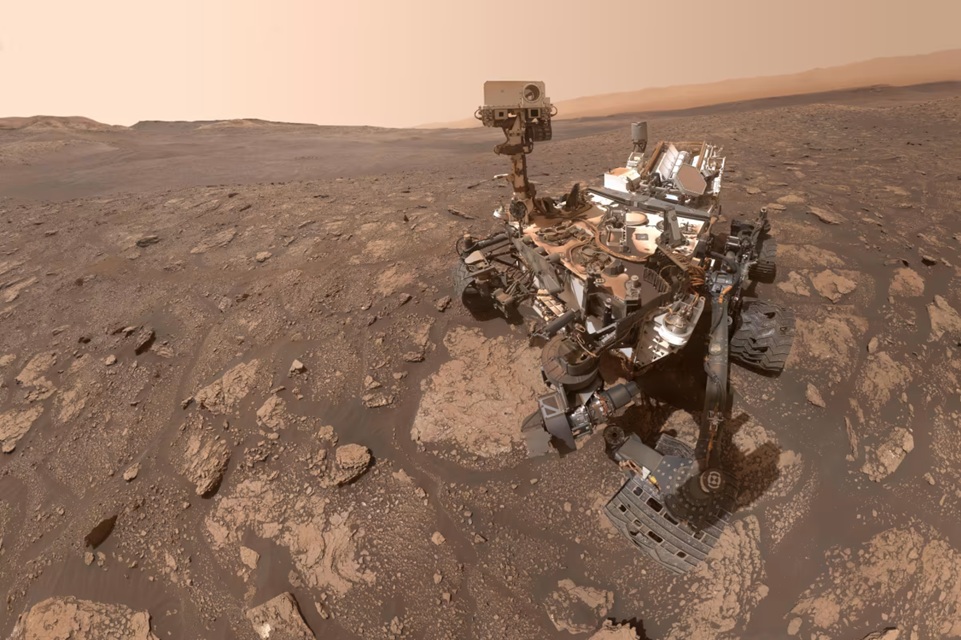
Believe it or not, but it’s possible for Curiosity to take a “selfie” picture just as anyone here back on Earth. This one was made back in 2020 after the rover had drilled some samples from a rock (the large square-shaped one directly in front of it next to the front right wheel) in an area of Mars nicknamed “Mary Anning.”
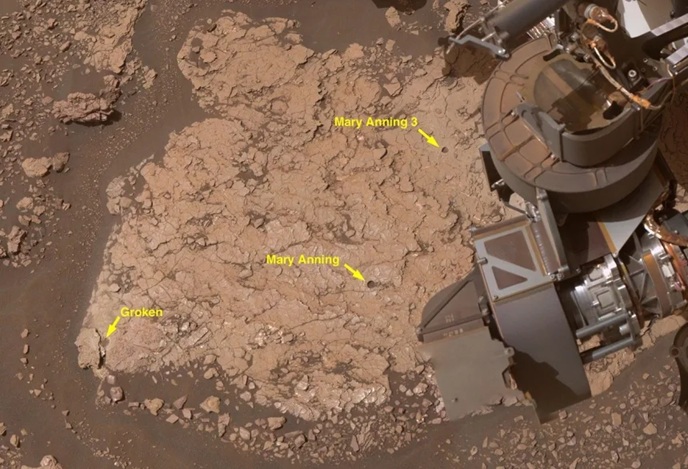
Here we can see a photo of the sampled rock in question, we can see three small circular drill holes labeled in yellow. After the material from the drill holes was collected, it was pulverized and dropped into Sample Analysis at Mars (SAM), an automated laboratory inside of Curiosity’s body. One of the experiments SAM can conduct is to heat such samples inside a small oven, causing them to release gases from their minerals. Another analysis is to drop samples into a small cup of a corrosive solution called TMAH, short for tetramethylammonium hydroxide [N(CH3)4+OH− in case you were wondering]. This breaks down large molecules into smaller ones, making them easier to identify, or to reveal their presence at all as they would have otherwise been hidden.
The results were that the science team was able to identify 21 carbon-containing molecules, including nitrogen heterocycle, a ring of carbon atoms including nitrogen. More importantly, it’s a structure that serves as a forerunner to both RNA and DNA; nucleic acids coded with genetic information found in terrestrial life, including we humans. There was also evidence of a carbon and sulfur-bearing molecule found in meteorites that have fallen to Earth’s surface, possibly bringing some of the building blocks for starting primitive life on our own planet.
Part of the research was to perform a check on Curiosity’s results by using a sample from the Murchison meteorite, an organic-rich rocky specimen that fell from the sky as a large fireball and was collected in Australia in September 1969. When a small sample from this was exposed to the same corrosive TMAH as the Martian rover’s “Mary Anning” sample, its large molecules broke down into similar results found by SAM on the Red Planet.

As already noted, the site where these drill samples were made is named “Mary Anning,” which appears next to two of the holes drilled in the large flat rock in the close-up picture from Curiosity. At first glance, this name sounds like an unusual choice for someplace on Mars. Anning (1799 – 1847) was a successful English fossil collector, dealer, and paleontologist who began to collect her first specimens as a grade schooler as part of her family’s efforts to financially support themselves. The sedimentary rock cliffs along England’s southwestern coast in Dorset County were quite full of a variety of fossilized aquatic species. Quite successful along with her older brother in their digging, she discovered the first, correctly identified porpoise-like ichthyosaurus skeleton at the age of 12.
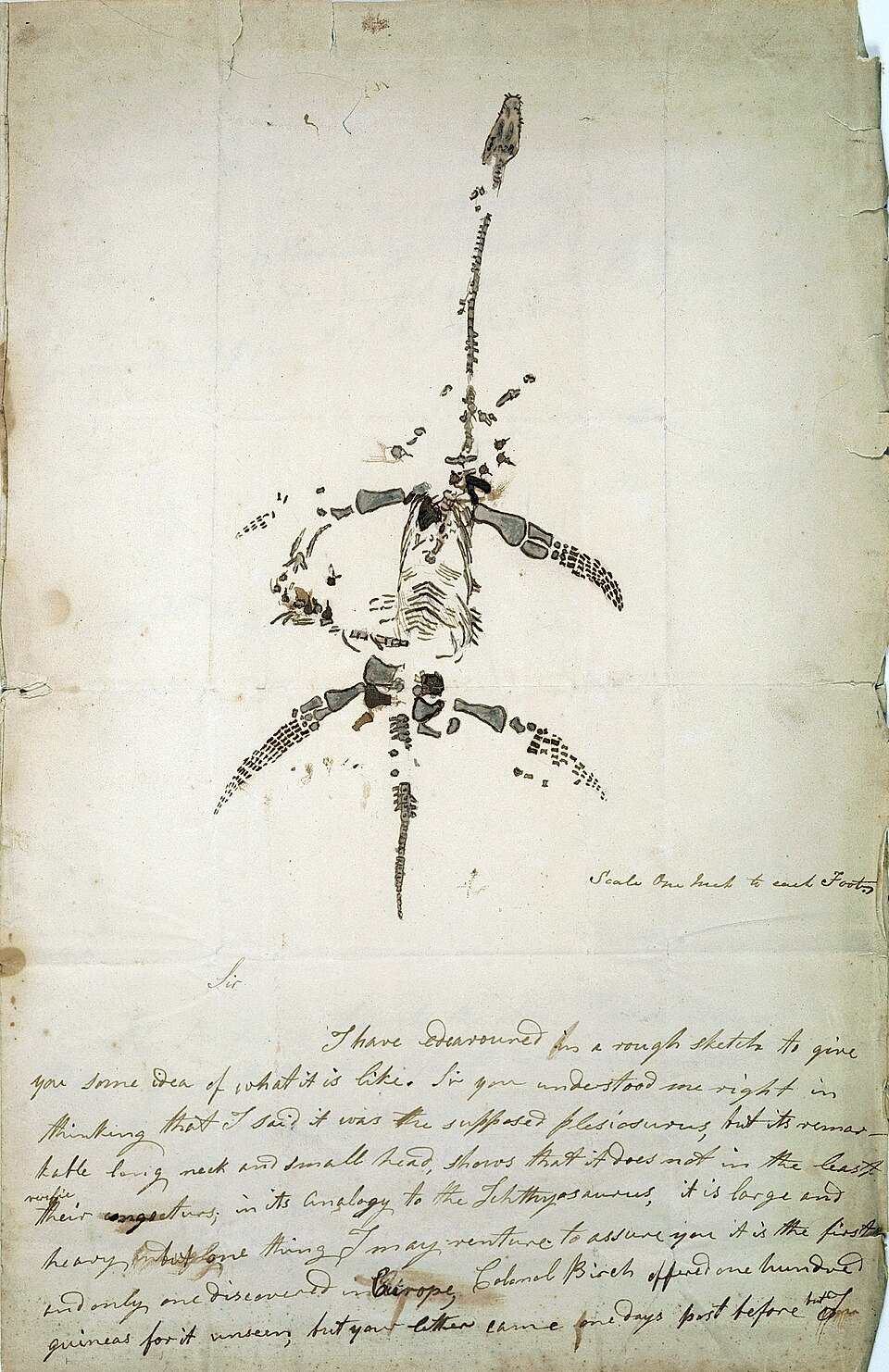
Anning also found the first two complete plesiosaurus skeletons ever discovered, large marine reptiles, that once ruled the seas. This example, Plesiosaurus dolichodeirus, is shown in a drawing she did as part of a hand-written letter she penned.
It’s anyone’s guess what Mary Anning would have thought about being associated with the distant fourth planet from the Sun, but one thing is for sure, we will no doubt be hearing more from its surface in the years to come.
By: Tom Callen