Marking the summer solstice
Two ways we have marked the longest day of the year in the past
The longest day of the year—well, actually every year—is soon approaching on 21 June, though it can also be between 19 and 22 June because of Gregorian calendar leap years. Not only do we know this annual date, but we can also pinpoint the time down to the second, 10:24:00 CEST, when it occurs in 2026. The only thing we can’t predict at the moment with complete certainty is how the weather will be on this day. Regardless of that, Earth won’t wait in its orbit around the Sun, and summer begins astronomically at this time for those of us who live in the northern hemisphere.
We know this due to any number of astronomical software applications on both personal computers and other hand-held devices that can reveal this. If you go back a little farther in history, astronomical calculations involving mathematical formulas told us the date and the time. Even without them there is a simple way to figure this out for yourself with the help of a tall stick driven vertically into the ground, or a handy flagpole at ground level. Each day it gets closer to the summer solstice, the shorter the shadow cast by the stick (or flagpole) when the Sun is due south. Finally, on the actual solstice and for a few days after, the shadow will remain at its shortest, and will then gradually get longer over the weeks ahead as the Sun’s path in the sky sinks a little lower each day as we head toward the autumnal equinox, the first day of autumn, in late September. And as you might imagine, the shadow would be at its longest on the winter solstice, the shortest day of the year, when the Sun makes its lowest pass across the daytime sky.
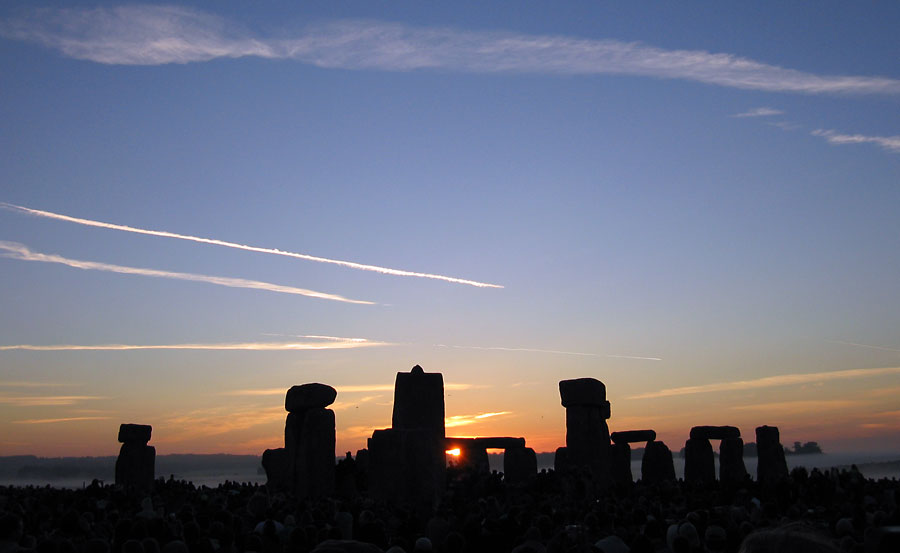
Such exercises with shadows or even better, through direct observation, have been around for a very long time when it comes to humans. Perhaps the most famous example associated with the summer solstice is Stonehenge on the Salisbury Plain in Wiltshire, England. On this date the Sun is seen to rise over the famous Heel Stone (outside of the main ring of standing stones) as framed tall structures, known as trilithons, when seen from inside the circle.
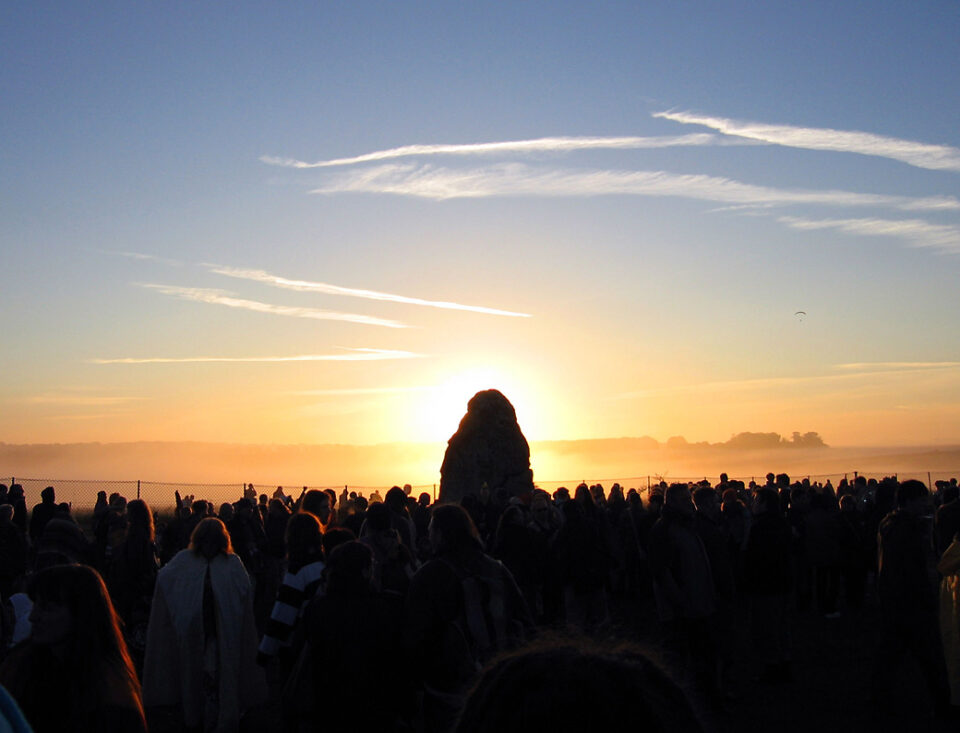
Normally closed off to the public due to the amount of erosion caused to the grounds surrounding this megalithic monument, each summer solstice thousands of people gather there to watch the sunrise. For this special event, authorities allow them to walk among the stones as the excitement builds in the gathering dawn. In this view, we can see the Heel Stone silhouetted by the Sun shortly after dawn as well as a very small fraction of the thousands of people attending. Looking closely, part of the barrier protecting Stonehenge itelf can be seen just above their heads at the left side.
I myself have been there on another date in the summer of 1998. We visiting members of the International Planetarium Society were allowed to go inside the roped-off area to admire and be amazed by the large stones we had been talking about in our public and school presentations for decades. A friend who worked at the London Planetarium grew up in the area. Prior to Stonehenge being closed off from direct access in 1977, he and his friends used to go there at night, lay on top of the fallen stones, and watch the night sky slowly pass by overhead. Talk about making memories!
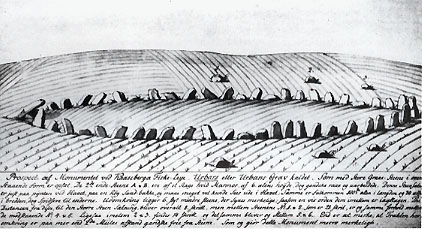
There are other such solar-related monuments made with stones of varying sizes across Europe. We can “book end” the rising point of the summer solstice Sun with that of the lesser known (at least outside of Sweden) Ale’s Stones (Ales stenar) in Skåne, the southern part of the country. This drawing comes from a book of features in this part of Sweden published in Copenhagen by Carl Gustaf Gottfried Hilfeling (1740 – 1823) in 1777. Located near Kåseberga, around ten kilometers southeast of Ystad, its actual use has not been 100% resolved. This orderly group, 59 large boulders and 67 meters long, is the site of a human grave, which was excavated in 1989. It could also have been a gathering place for some sort of a religious cult, or even a Sun calendar. There are a variety of different boat-shaped grave monuments made with stones, which are not the same thing as actual buried ships containing a body. Such stone ship settings number in the thousands in Scandinavia, with the majority being in Sweden. The Baltic Sea’s island of Gotland has over 350 of them, while there is another concentration of over 150 of these at Lindholm Høje in Denmark.
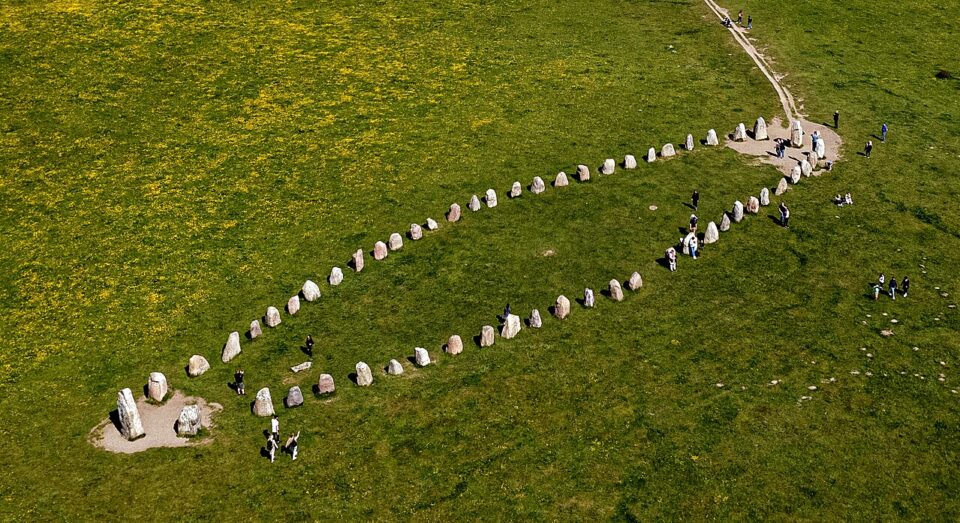
Based on carbon-14 dating of those human bones, found buried in a decorated clay pot, the suggested estimation for when they were raised, according to the Swedish National Heritage Board, is around 550 CE. In this aerial view you can see both its boat-like arrangement of stones as well as get a sense of scale from the people walking among them. While Stonehenge is most famous for the sunrise on the summer solstice, Ale’s Stones are known for pointing toward sunset on the same important date.
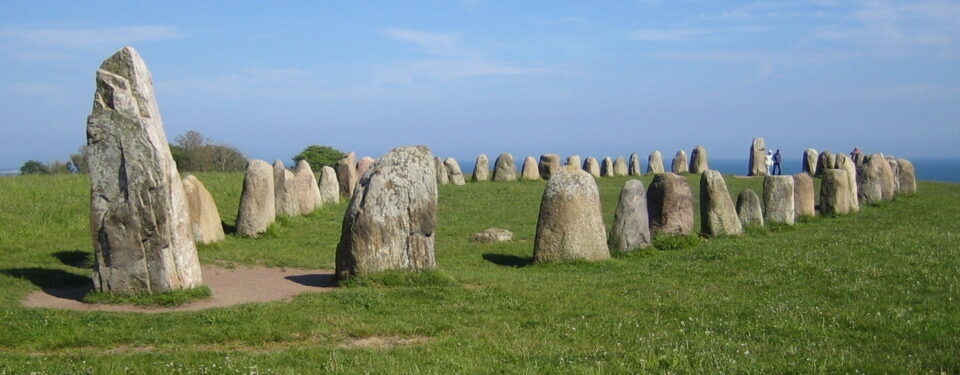
In this wide-angle view, we can see Ale’s Stones from just outside the group of stones, again with some people for scale. Perhaps this might be a destination of interest during your summer vacation?
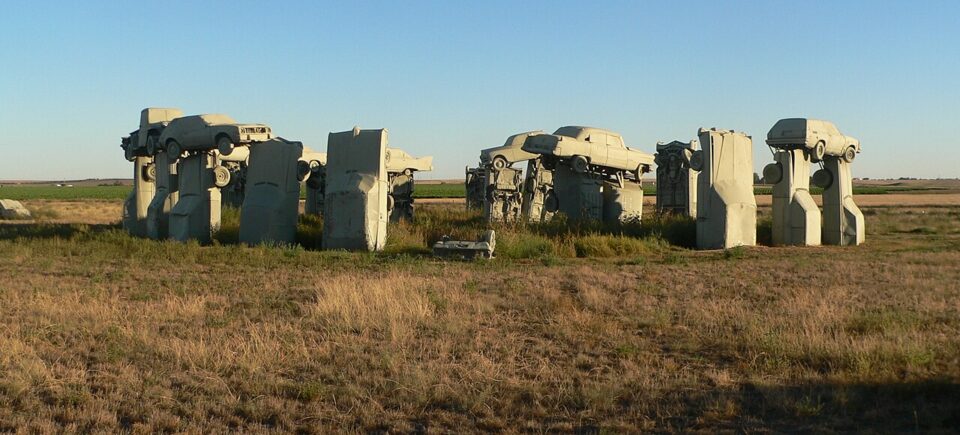
For those of you looking to add another unique destination to your bucket list, I recommend Carhenge, located near Alliance, Nebraska, in the U.S. It’s a replica of the famous megalithic structure in England, and was built using old American cars that were painted gray to resemble the stones at the real Stonehenge. Made by Jim Reinders, it was dedicated at the June 1987 summer solstice.
This will be our last space- and astronomy-related news article for the spring semester of 2026. Until we start again—just in time for the Perseid meteor shower in mid-August—all of us here at ESERO Sweden hope you have a pleasant and peaceful summer break.
By: Tom Callen