Here comes the sun!
The best view to date of our daystar
Welcome back to the start of the new 2026-27school year! While you’ve all been off on summer vacation, the universe has not been still. Old objects get better explanations and new ones are being discovered. And this includes our Sun, which was provided all those hot, sunny days to enjoy whatever activities you were doing while out of school.
I hope that many of you had a chance to safely observe the partial solar eclipse in the late-afternoon through early-evening of 12 August, followed that night by the annual Perseids meteor shower. Fortunately, summer’s bright “white nights” are always over by the time this celestial show happens, because otherwise it would be invisible to us.
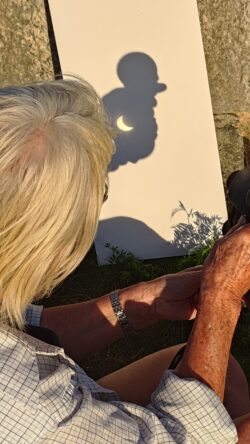
One way you can safely observe a solar eclipse—in case you didn’t happen to have a pair of solar eclipse viewing glasses you might have bought at a museum or science center store, or online—is by using a pair of binoculars to project the Sun’s image onto a large piece of white paper or cardboard. Here we can see ESERO Sweden’s own Mariana Back doing so, with the dark disk of the Moon clearly seen crossing the white one of the Sun. The trick to having the binoculars be facing perpendicular to the Sun behind you is to turn them so that their shadow on the paper is as small as possible. That way what their pointed at shines onto its surface, like this view of the partial eclipse. Never (never!) look directly at the Sun through binoculars or any other optical instrument, like a telescope.
Speaking of the Sun, on 5 August, just five days earlier than the partial solar eclipse, researchers using the Daniel K. Inouye Solar Telescope (DKIST), the world’s largest, had made the highest-quality images of the Sun’s surface. Located at the Haleakala Observatory on the Hawaiian island of Maui and named after US Senator Daniel K. Inouye (1924 – 2012), its 4.24 meter mirror allows for images of features on our star with a resolution as high as 20 kilometers.
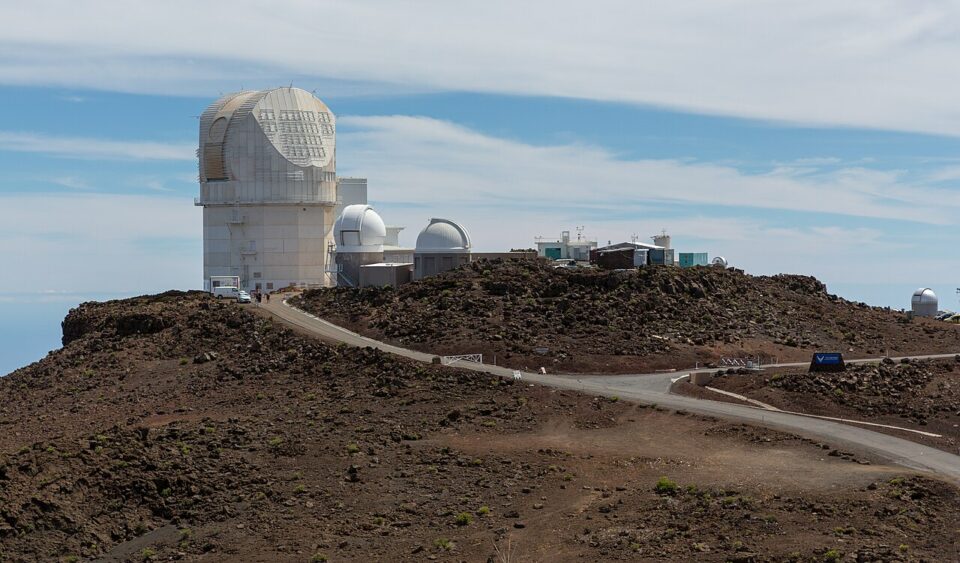
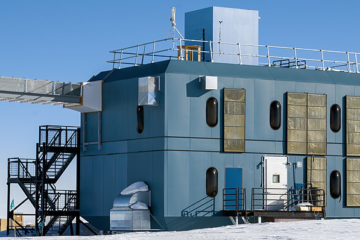
In this photo of the observatory complex close to the summit of the mountain, the DKIST is the large building on the left. Modern optical observatories are placed at such high points in order to get them above as much of Earth’ atmosphere as possible, which leads to more stable viewing conditions. It’s also helpful that they’re located as far away from city lights as possible. Telescopes such as this one also use special optics that can help remove the motion of light caused by the atmosphere’s turbulence, which is especially important for telescopes working at night. You might think this wouldn’t be important when looking at something as bright as the Sun, but every little bit you can do to improve observing conditions helps.
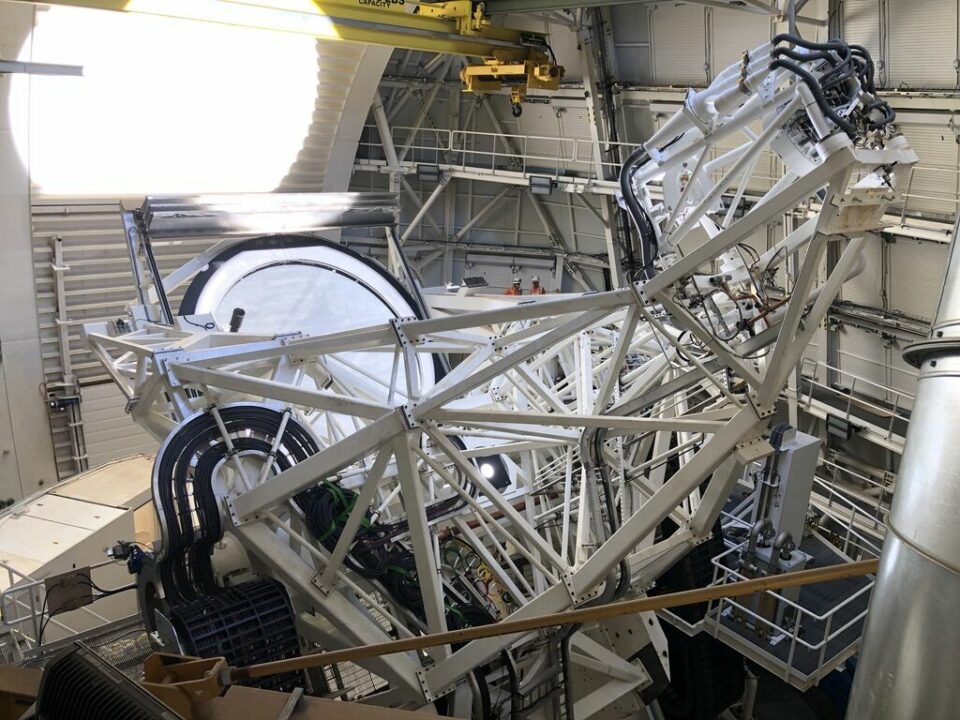
The solar telescope inside looks like this, with the giant circular mirror to the left. Its altazimuth telescope mounting allows it to simultaneously track both in the horizontal axis of azimuth as well as the vertical one of altitude. Combining both these motions together, basically removing the effects of Earth’s rotation on its axis, keeps the object being observed in view all the time.
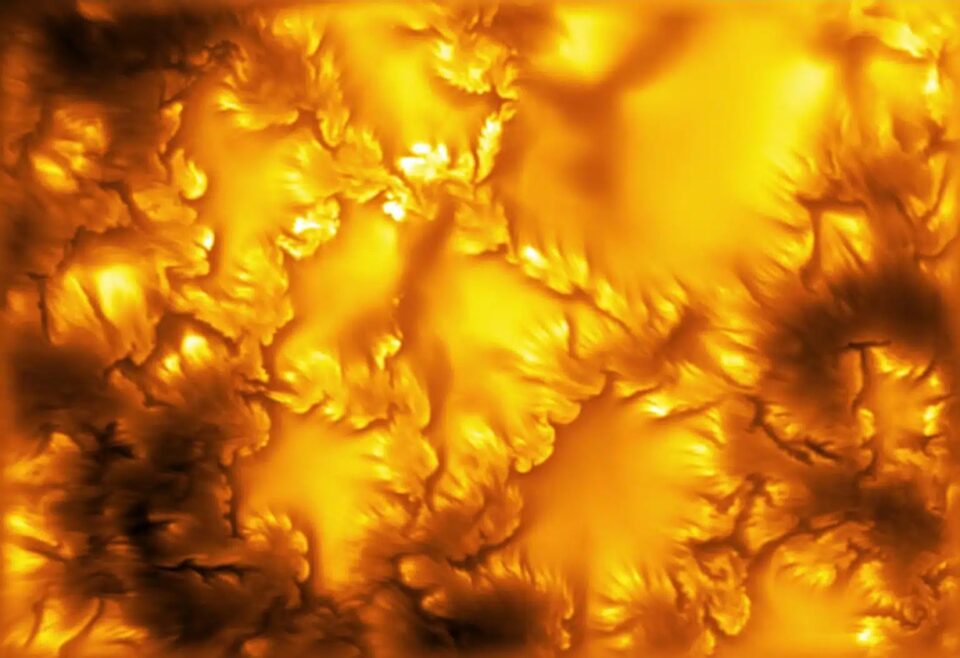
Here’s one of the super-high-resolution views of the Sun taken by the DKIST. It almost looks like a bubbling pot of oatmeal, which is not too far from the truth, at least as far as the motion of the surface goes.
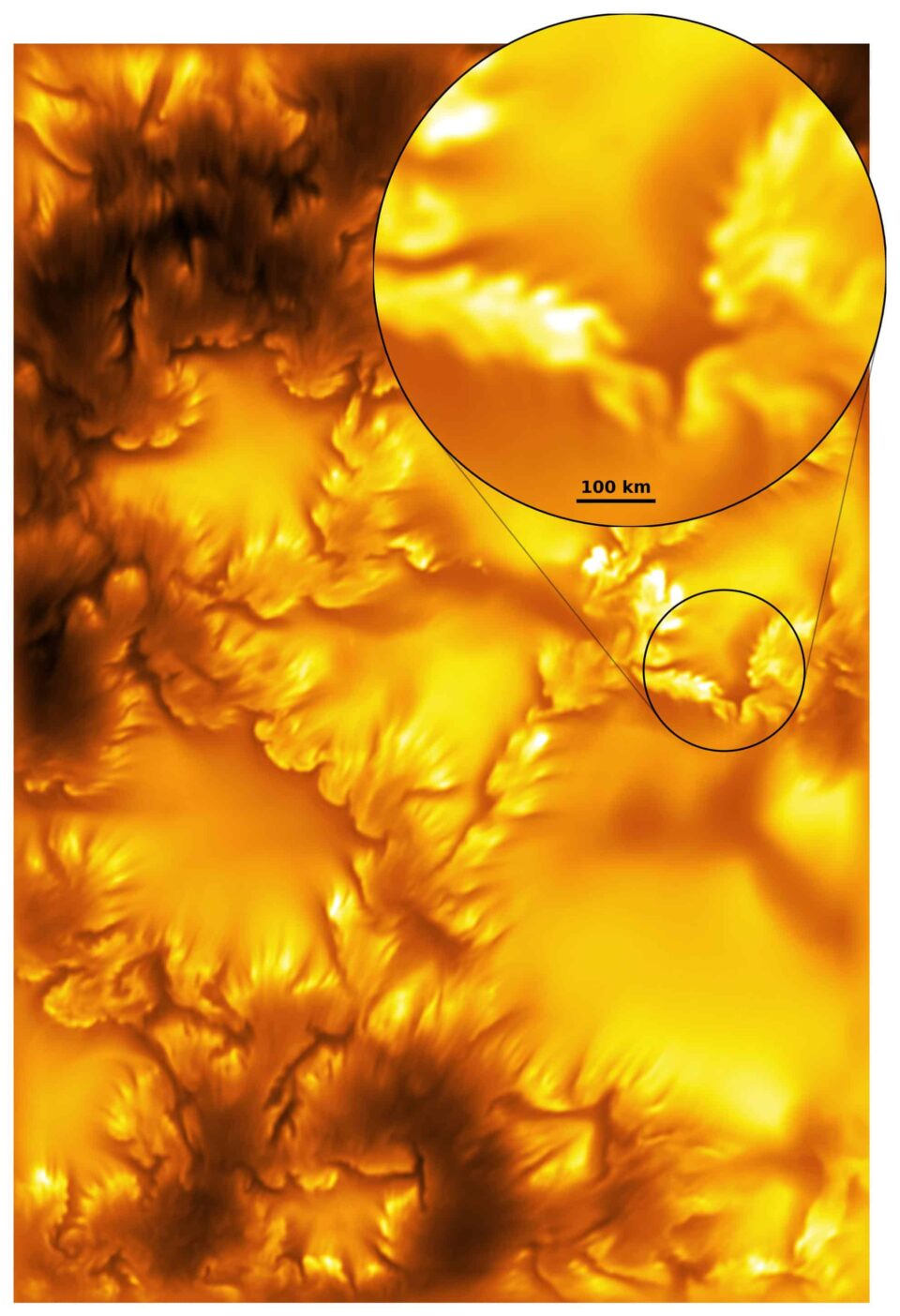
Here we can get a sense of the scale of what we’re looking at. The circled area with the magnified view above it shows a part of the Sun’s photosphere, or surface, 100 km across; approximately the distance between Norrköping and Örebro (94 km) when traveling in a straight line. What’s so important about these images and what they tell us about the star we are constantly orbiting? If you look carefully at these close-ups, you can see tiny swirling patterns on the photosphere, which look like small whirlpools we normally might associate with water. This is a sign of something called a Kelvin-Helmholtz instability (KHI). A what?
Think of it in this way. Such an instability happens when two layers of fluid or air move past each other at different speeds. The faster layer drags on the slower one, causing a small ripple at their boundary to grow into curled, wave-like billows. This is much like waves forming where fast wind blows over slower water. If you look at these two close-ups of the Sun, they do sort of resemble wave-like billows.
Two major mysteries about the Sun are why its pale, ghostly outer atmosphere, the corona, gets so incredibly hot, and why does our daystar build-up so much magnetic energy. The latter causes eruptions on the Sun’s surface, which can send bursts of energy toward us here on Earth in the form of particles. One effect seen results in the beautiful aurora borealis. The strongest of these, however, can affect important satellites, like those for GPS navigation, overload electrical power networks on the ground, and harm other technology. It can even be dangerous for astronauts in the International Space Station or, eventually, on the surface of the Moon.
This new research suggests that KHI may be responsible for both of these important features of the Sun. Not only does this allow astronomers to better understand our star and the local space weather it causes, but it also offers an insight into understanding other stars in our own Milky Way and beyond in other galaxies.
To see the Sun for yourself in this new way, you can zoom into this most-detailed view of the Sun via video (no audio). It goes from the disk we see in the daytime sky all the way down to features of a hundred kilometers.
By: Tom Callen