Crash go the moons, part I
Something new in solar system collisions
It’s an accepted fact that bodies in the solar system have been known to crash into each other both in the past—like the craters on the surface of the Moon—and more recently, such as when multi-piece Comet Shoemaker-Levi plunged into Jupiter’s atmosphere back in the summer of 1994.
Then there is what you could call a “hybrid collision,” where something manmade was directed to hit the Moon, such as the used Saturn V third stage booster rockets from the launches of Apollos 13, 14, 15, 16, and 17. Each of these impacts, hitting at about 9 200 km/h, caused the Moon to ”ring like a bell” for almost an hour because of the dry, rigid nature of interior of Earth’s natural satellite. How do we know this? Because of seismometers left on the surface from earlier Apollo manned landings. Four of the Lunar Module descent/ascent spacecraft used to bring the astronauts down to the Moon’s surface and then back up again to the waiting Command Service Modules for the trip back to Earth were also purposefully crashed to the cratered regolith-covered landscape below.
This week we’re going to take a look at one of these kinds of events; one accidentally manmade with the Moon. Next week we’ll look at another involving Mars’ smaller satellite of its two: Deimos.
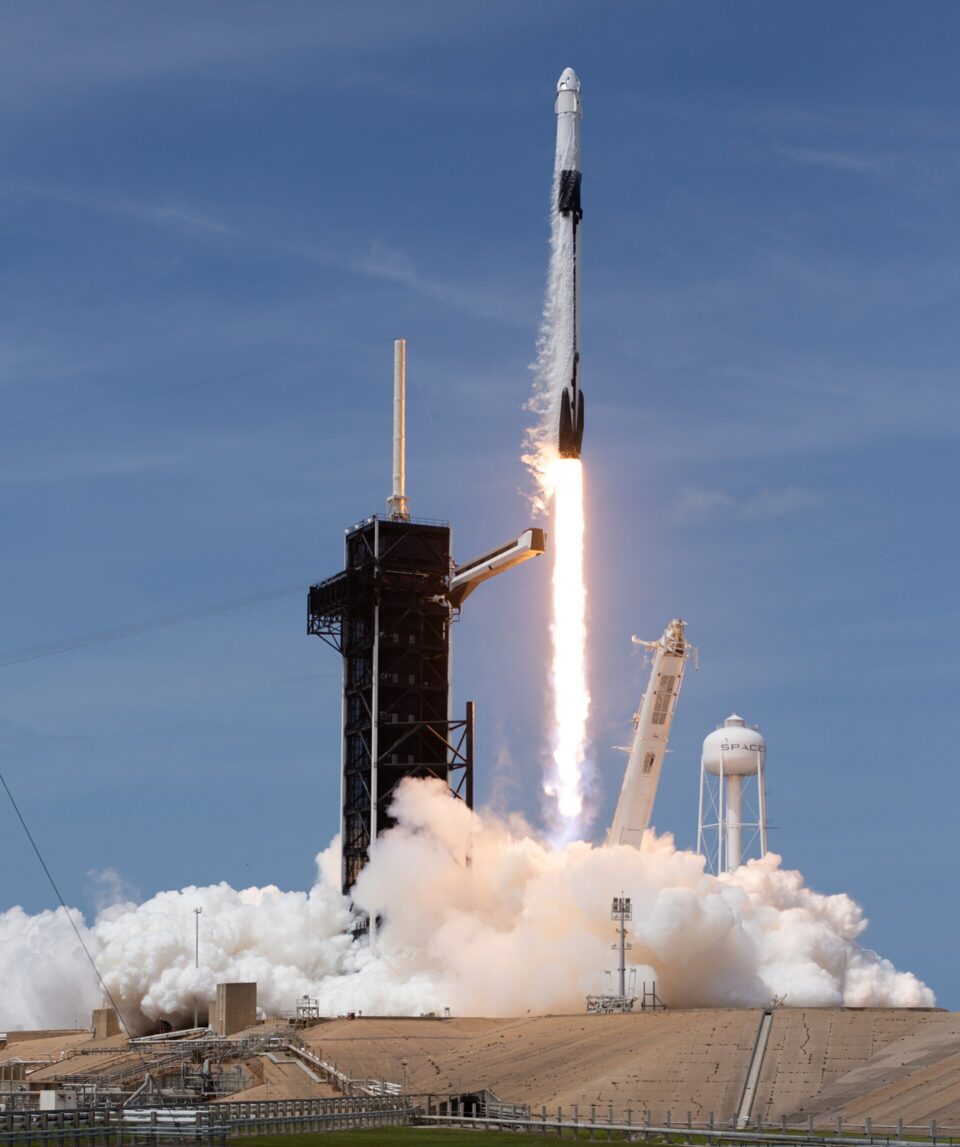
Back in January 2025 a SpaceX Falcon 9 rocket sent two commercial landers—the US’ “Blue Ghost” and Japan’s “Resilience”—on their way to the Moon. As with these kinds of two-stage boosters, the first stage returned to Earth and landed itself on a platform floating on the ocean, while the second, its fuel used up after pushing its payload of the two spacecraft on their way, was left adrift in space. But the upper stage’s story doesn’t end there.
This 4-ton, upper-stage was left floating around without any fuel and therefore no way to steer it. Unpredictable forces from the Sun and our own Earth-Moon system’s gravity gradually nudged the empty metal cylinder into a decaying path over the next 18 months. This is what led it to , intersect and collide on 5 August with the surface of our natural satellite—at a speed of about 8,700 km/h—in the vicinity of the crater Einstein. Located on the western limb of the Moon, this 181.47 km-in-diameter feature named for the famous German-born theoretical physicist, Albert Einstein (1879 – 1955), is hard to see easily from Earth.
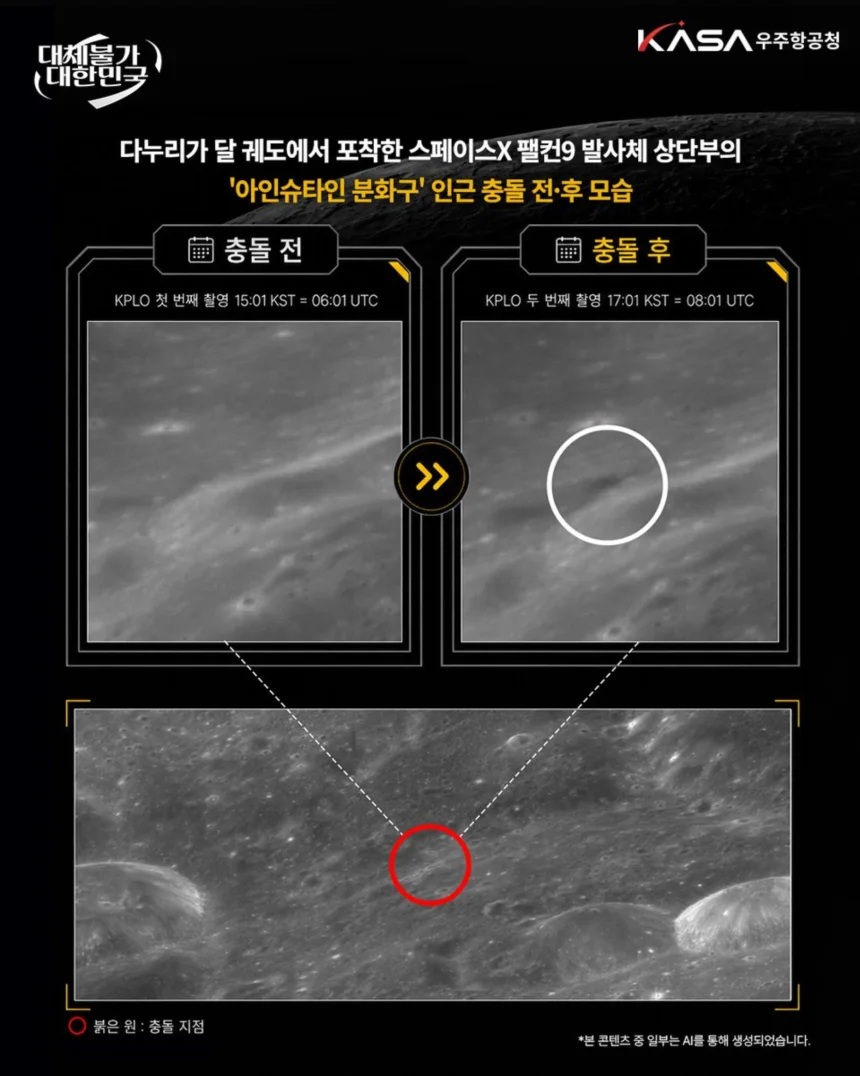
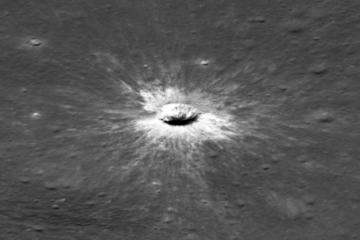
The Korean AeroSpace Administration’s (KASA) “Danuri” orbiter was able to obliquely image the area both before (upper left picture) and after the impact (circled, upper right), which allowed NASA’s Lunar Reconnaissance Orbiter (LRO) to provide a more direct, top-down image to compare with one it had taken before of the same location.
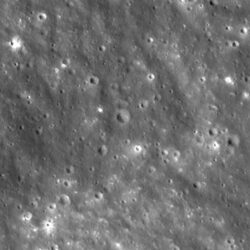
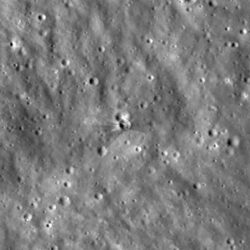
Here’s LRO’s view taken before the Falcon 9 upper stage hit (left) and then after during its 11-12 August fly-over (right) the area. The delay between the actual 5 August event and the picture-taking was because of how this NASA satellite orbits the Moon. It circles once every two hours while the lunar surface below it slowly turns, so the area below LRO has to “catch-up” so it can be photographed. The newly-created crater, 18.288 meters-wide, is right in the center, overlaying an older, almost identically-sized crater.
Telescopes back on Earth were able to pick up a plume containing sodium and lithium gas kicked up by the high-speed impact of the Falcon 9 upper stage. Unfortunately, this accidental collision with the Moon also brought up the long-standing debate about the amount of manmade “litter” on the lunar surface. Personally, I find it very hard to consider the hardware left by actual, legitimate manned and unmanned space missions to the Moon as such, but then opinions are like noses; everyone has one.
Postscript: In October, the two winning Swedish teams of the national part of the International Mathematical Science Creativity Competition (IMSCC), which was operated by ESERO Sweden earlier this year, will be traveling to compete in the main IMSCC event to be held in South Korea. This competition stimulates innovative and creative thinking in STEAM through work with educational construction materials. Students are tasked with solving problems and turning ideas into action using 4DFrame, a material developed in South Korea and available in Sweden. With support from the Swedish National Agency for Education, Sweden has been represented by students and teachers in a national and international science competition every year since 2014. This year, Sweden is represented by four students from Lund. While there, they will also be taking in cultural sites as well as paying a visit to an aerospace-related site. We look forward to a brief report from the students once they’ve returned home.
By: Tom Callen