A 2026 Nobel for neutrinos
The biggest prize in science for a subatomic particle

On 6 October the Royal Swedish Academy of Sciences in Stockholm announced that an 82-year-old Belgian-American physicist, Francis Halzen (University of Wisconsin-Madison), had won the 2026 Nobel Prize in Physics for his leading work with IceCube, the large neutrino detector buried under the ice in Antarctica.
If you don’t think that neutrinos don’t cross your path on a daily basis, you’re in for a surprise as roughly 100 trillion (100,000,000,000,000) of these subatomic particles stream through your body each second. And since there are 86,400 seconds in a day, I’ll let you work out how many that is every 24-hours.
Almost all of these tiny, ghost-like particles originate from nuclear fusion, which is what makes our star’s energy providing us with both light and warmth, inside the center of the Sun. With so many of these particles hitting each and every one of us around the clock, do they have any effect? Since neutrinos have no positive or negative electric charge and almost zero mass, this allows them to pass straight through solid matter, even human bodies, completely unnoticed. They cause neither harm nor damage in the process. In fact, the chance of a single neutrino interacting with any of the 7 octillion (7 X 1027) atoms in your body during an average lifetime is only about 1 in 4, or 25%.
By now you might be saying, “Big deal,” but neutrinos are, in fact, just that. That they exist tells us something about the various energetic processes out in the universe based on the different kinds of objects they are streaming from. The Sun just happens to be the closest source to us. And while those coming from it make up the bulk of what’s detected, neutrinos from other cosmic sources are fewer and harder to capture. And this is after traveling through stars, moons, planets, and entire distant galaxies without changing! Which is where Halzen and his team’s building the large IceCube neutrino detector comes in. It may have taken hundreds of committed people to do so, but the original idea had to come from one person.
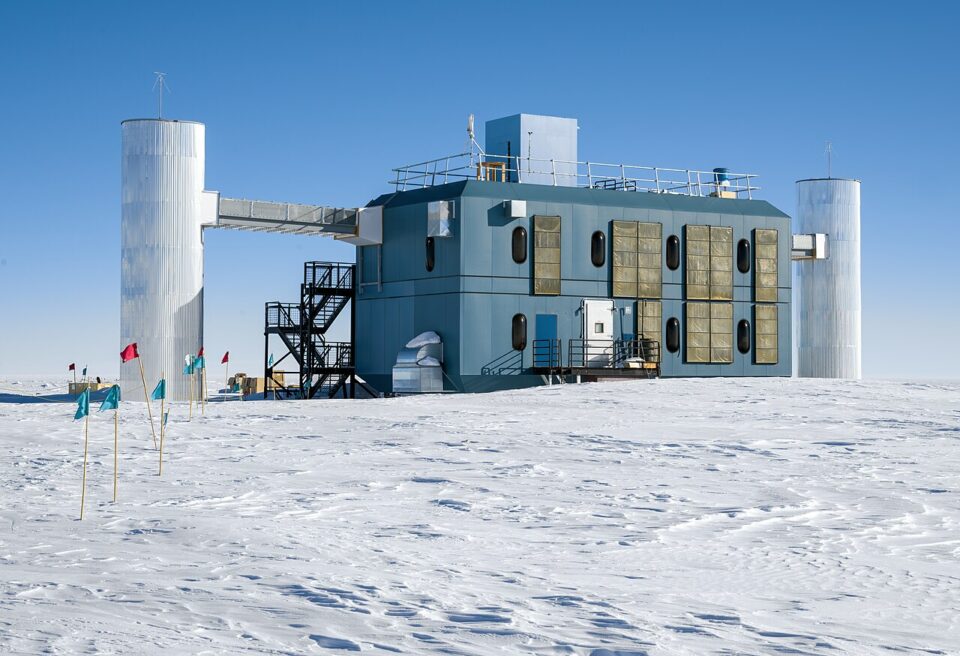
Here we can see the IceCube Neutrino Observatory at the Amundsen-Scott South Pole Station in Antarctica; please make a mental note of its apparent size and shape for later. Prior to the setting up IceCube, there was its predecessor, AMANDA (Antarctic Muon and Neutrino Detector Array), which used spherical optical sensors, digital optical modules (DOM), on long cables going down into the ice. Unfortunately, this array was unable to detect what Halzen’s team was looking for, and plans were made to expand it.
This is what led to IceCube; an array covering a cubic kilometer of ice with more DOM light sensors than AMANDA. When first completed in 2011, the new neutrino observatory had 5,160 light sensors divided between 86 cables, 60 per cable, reaching down to individual depths between 1,450 and 2,450 meters. How does one drill such deep vertical holes into ice? By using what’s known as a hot water drill.
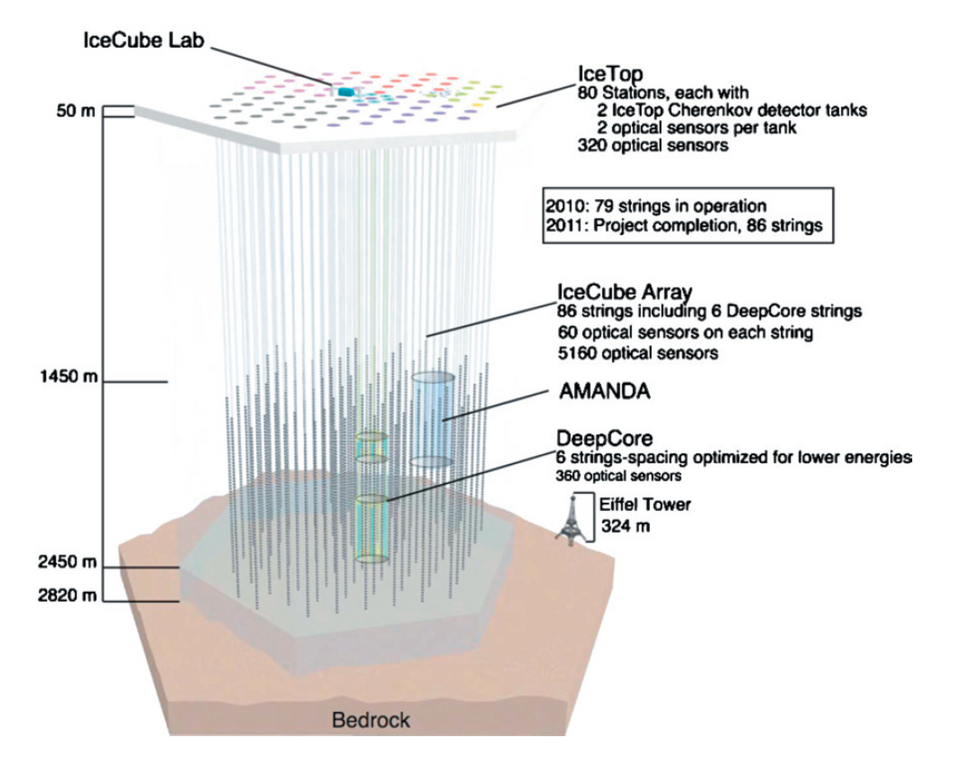
The three-dimensional diagram shows IceCube; note that the original AMANDA array (the blue-colored cylinder on the right) can be seen. Recall that I asked you to make a mental note of the apparent size and shape of the IceCube building? That small blue rectangle shown on the surface of the ice at the very top is it!
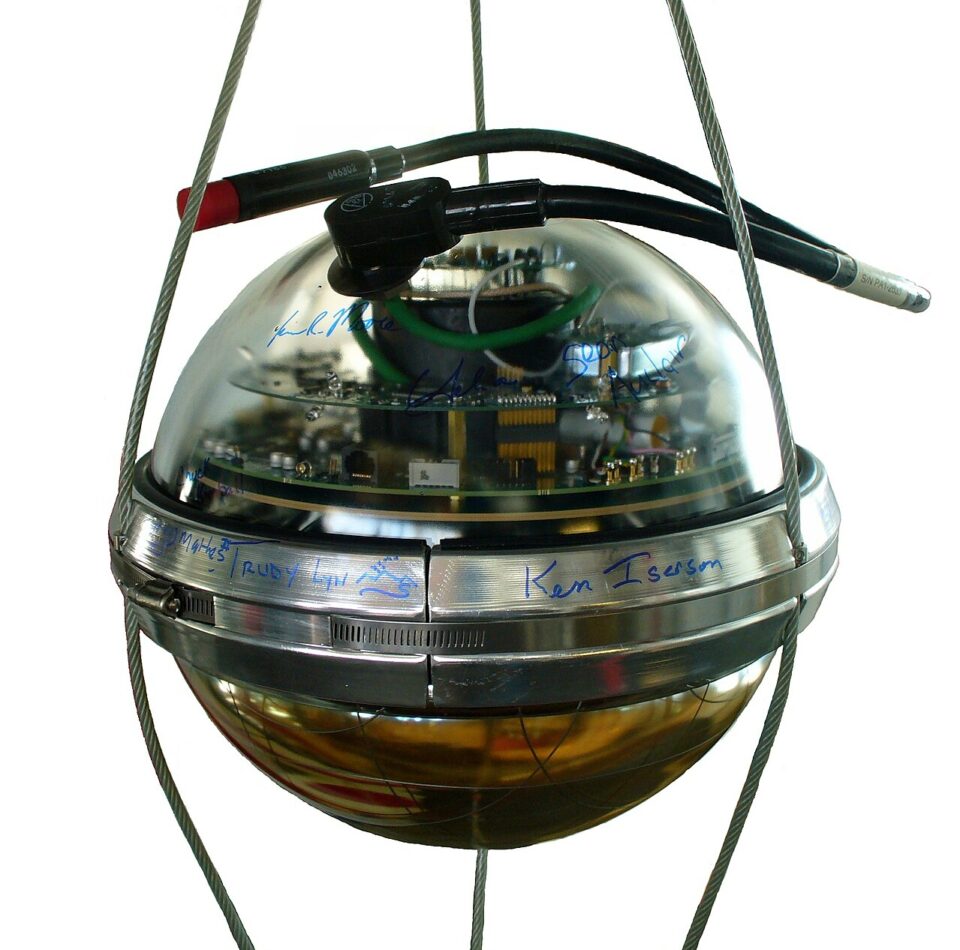
Since they were mentioned, what do IceCube’s DOM light sensors look like? My first impression was that they look like one of the Imperial Viper Probe Droids from STAR WARS that Darth Vader had sent out searching the ice planet Hoth for Luke Skywalker, but the only thing the two black objects have in common is “ice.” These DOMs, again 60 spaced out along each cable of IceCube, contain a photomultiplier tube to detect flashes of light caused by neutrinos, and a single-board acquisition computer, which sends digital data back up the long cable. Once the information reaches the rectangular blue observatory building on the surface, their results are counted.
Following the completion of the original array in 2011, an upgrade for the observatory was approved in 2019, which was successfully completed as announced in February 2026. This winning of the 2026 Nobel Prize in Physics could be called “the icing on the cake,” the result of long hard work and usable results about neutrinos from high-energy objects in the universe.
Francis Halzen’s work is significant, because, according to the editor-in-chief of “Physics Today,” it’s been a while since there has been a solitary person who has won the Nobel Prize in Physics. By comparison, the 2026 prize in Chemistry went jointly to two researchers, while a different trio won for Physiology or Medicine.
In case you’re curious, the Nobel Prize, besides winning the world-famous gold medal with the portrait of Alfred Nobel on it, carries with it a cash award of 12 million Swedish kronor ($1.2 million at today’ exchange rate). And perhaps most of all, widespread international recognition for their work and research. We extend our heartfelt congratulations to this year’s Nobel Prize laureate in Physics!
By: Tom Callen