A new dwarf in the family?
The Vera C. Reubin Observatory may have discovered a new dwarf planet
Not only were the Sun and planets formed during the birth of the solar system from a large cloud of gas and dust 4½ billion years ago, but so were innumerable smaller objects, like comets and asteroids. Most of these lie in the outer solar system beyond the orbit of Mars, with some even as far as the sphere of comet nuclei, the Oort Cloud, at the outer edge of the Sun’s family.
Five naked eye planets, Mercury, Venus, Mars, Jupiter and Saturn, plus Earth, were known to the ancients. So, it was quite a sensation when a new planet, Uranus, was found telescopically in 1781. Its distance of twice that of Saturn from the Sun literally doubled the diameter of the solar system overnight.
As more observations of Uranus were made, it was found to not exactly be following its predicted orbit, so speculations were made that perhaps there was yet another body pulling on it, making the planet named for the god of the sky “misbehave.” Sure enough, there was; Neptune, also found telescopically, in 1846. But things didn’t end there.
As you might have already guessed (or read an astronomy textbook), things were still not quite right with how Uranus was orbiting in spite of the discovery of Neptune. This indicated to some that there must be yet another planet “out there.” This attracted the attention of well-known Mars observer, Percival Lowell, and he made some estimations where one might look to find it. And at his private observatory in Flagstaff, Arizona, someone was given the task to try and find it. And that they did, photographically, in 1930 via a relatively large photographic telescope. But there’s a little twist to the story here.
Pluto’s true mass was only determined after the 1978 discovery of its largest moon, Charon. Smaller than Earth’s Moon, Pluto’s mass was thereby unable to produce measurable gravitational effects on either Uranus or Neptune. As it turned out, the supposed orbital anomalies were not real, but came largely from errors in the assumed mass of Neptune, and the limitations of contemporary historical observations and calculations. After Neptune’s mass was revised, there were no remaining oddities needing another large planet to explain them. But this hasn’t stopped people from speculating about the existence of a yet undiscovered, distant “Planet X.” There’ve been some false alarms, though nothing has been found for real.
After Uranus was located, but before Neptune came to light, there were some other previously unknown bodies discovered to be orbiting the Sun; the asteroids. Named so because they resembled “little stars,” the first of these was Ceres in 1801, followed by Pallas in 1802. Too small to be planets themselves—the sizes of asteroids discovered becoming smaller and smaller all the time as observational methods improved—about 1.6 million asteroids have been discovered and cataloged up to the present day. Roughly 900,000 of these are formally numbered and confirmed with verified, calculated orbits.
At the 2006 International Astronomical Union meeting, a new definition for what an orbiting body had to be in order to be considered a full-fledged planet was voted on and accepted. As a result, Pluto got demoted to being considered a dwarf planet. It is, however, the largest of these smaller planets at ~2,377 km, followed by Eris (~2,326 km), Haumea (~1,560 km), Makemake (~1,430 km), and Ceres (~940 km). Such objects can also be referred to, since they are beyond the average distance of Neptune, as being members of a group collectively called Trans-Neptunian Objects (TNOs).
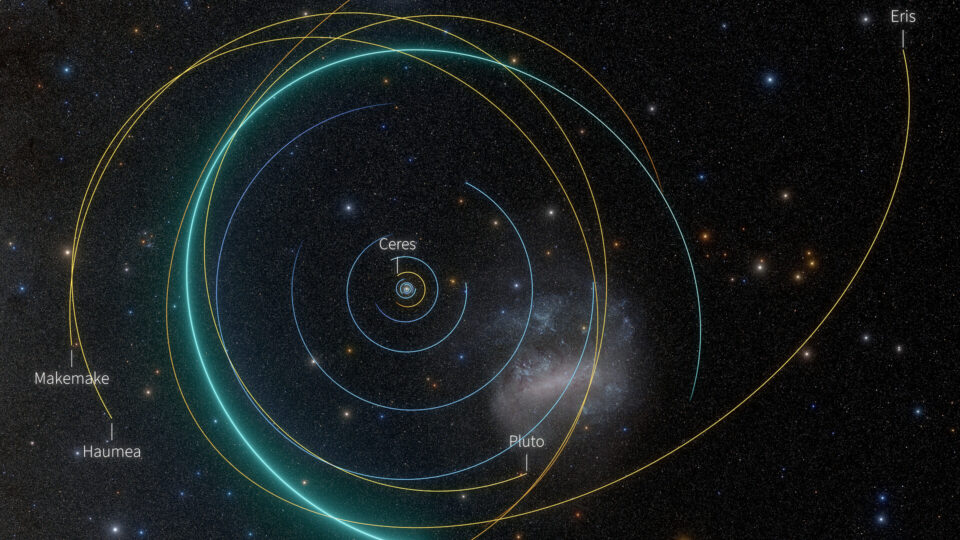
All of this brings us now to the recent announcement from the newly operational Vera C. Reubin Observatory; they may have found their first dwarf planet, a member of our solar system. While they had already discovered more than 11,000 newly confirmed asteroids, this is different as it’s a larger class of object. This picture shows its bright blue orbit compared to the darker blue orbits (unlabeled) of the regular planets and the yellow ones of the five already-known dwarf planets.
Why do astronomers want to study such distant objects? Because their size, composition and orbital paths tell us something about how our solar system formed. They also provide valuable clues as to how the giant gas giants—Jupiter, Saturn, Uranus, and Neptune—have migrated to their current orbits over time, and how smaller bodies, like comets and asteroids, were affected as a result.
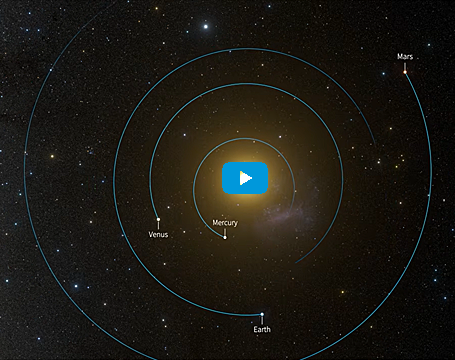
This new dwarf planet candidate, given the temporary and very unglamorous name ED138, has an orbit tilted almost 25° from the nearly horizontal plane of the solar system, a good sign it could be such an object. How did its original orbit around the Sun get to be at such a crazy angle to everything else? Through gravitational interactions with Neptune. Clicking on this picture will take you to a 3D video showing ED138’s relationship to the outer regions of the solar system.
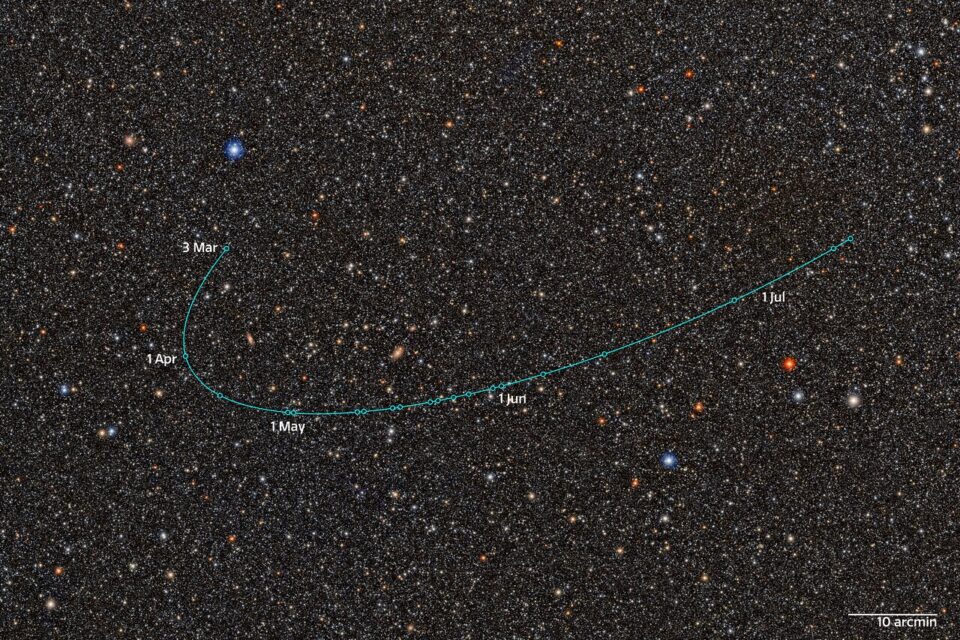
One thing that’s special about this discovery made by the Vera C. Reubin Observatory is due to its ongoing observing program of photographing the entire southern heavens each night. This example VCRO image shows both the orbit of ED138, but also gives an idea of what the background sky is like. The potential dwarf planet was found in a region very dense with distant stars in our own Milky Way Galaxy, making it much more difficult to detect with other telescopes. Because the VCRO is able to compare pictures taken night after night of the same part of the night sky, its motion stood out to the powerful computer program algorithms used to sift through billions of point-like star images as seen in the picture; enough so that an orbit could be calculated, and the rest is history.
Not all TNOs are candidates to be a dwarf planet. Shape is important, and there has to be enough mass for the object to have pulled itself into a sphere through its own gravity; one of the three new guidelines about what qualifies for a planet. Size is another one, and preliminary data suggests that ED138 is somewhere between 600 and 1,500 km in diameter, which puts it in the range of the five already recognized dwarf planets mentioned above. Further investigations will determine whether or not this icy ball, similar in composition to the other dwarves, can be truly classified as a newly discovered dwarf planet.
By: Tom Callen