Pretty hot stuff!
The planet closest to the Sun has shrunk more than expected
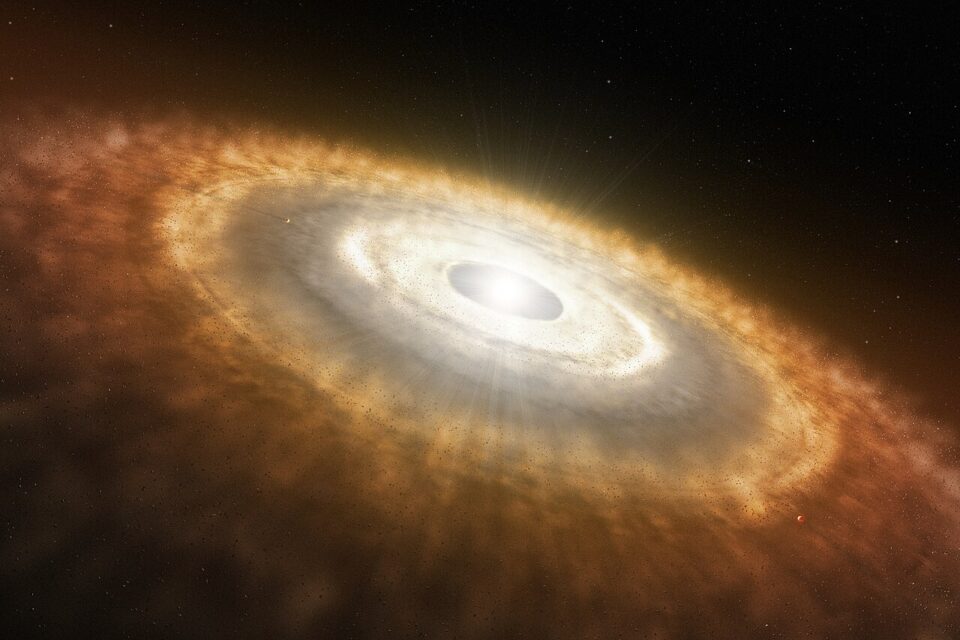
Four-and-a-half billion years ago, our Sun formed out of a nebula of gas and dust that had collapsed into a large, hot spinning disk. With the star forming at its center, this is also in the direction where the concentration of heavier elements took place, which we can see evidenced today with the differences between the inner and outer planet of the solar system. Those four closest to the Sun are rocky and metallic, while the outer ones are giant balls of slushy, frozen gases.
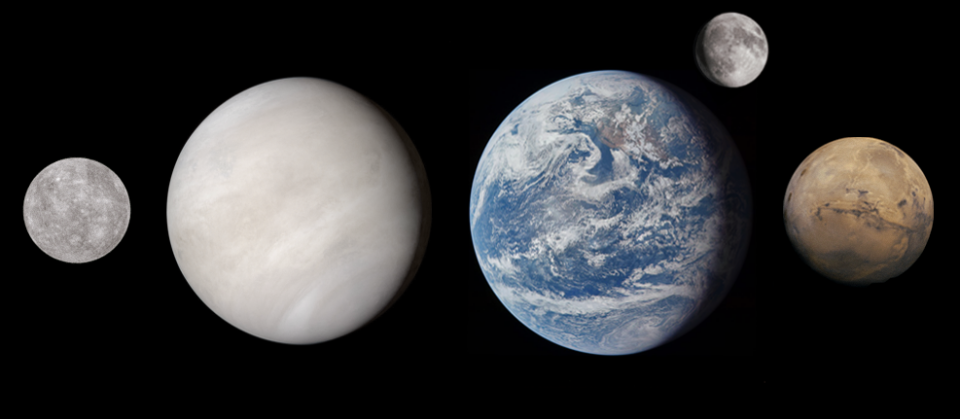
We can see a comparison (left to right) of Mercury (4,880 km in diameter), Venus (12,103.6 km), Earth (12,756 km) and its Moon (3,474 km), and Mars (6,779 km), all shown to scale with one another. Note that the Moon is almost as large as Mercury, and that Venus and Earth are so close in size as to sometimes be referred to as being “twins.”
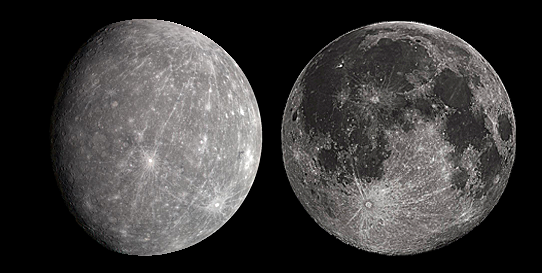
I’ve made this side-by-side view of Mercury and the Moon so that they are both roughly the same size. At first glance the smallest planet in the solar system looks very much like Earth’s satellite, and it’s not too surprising that people not familiar with their differences confuse the two all the time.
The biggest clue it’s the planet and not our Moon is if you look at Mercury’s craters. You can see that they don’t have very large amounts of material, known as an ejecta blanket, surrounding them, caused by impacting bodies, like asteroids. This can be explained by its very dense metallic core, whose strong gravitational field doesn’t allow for extensive ejecta blankets to form around Mercurian craters. The material blasted out of the craters can’t get very far before its pulled back down to the surface again. One popular euphemism for the smallest planet in the solar system is that it’s like a big ball bearing surrounded by a thin shell of rocky material. The second densest planet in the solar system after Earth, it’s because of this metallic core.
Being the closest planet to the Sun, Mercury’s surface is a broiling hot 420 °C, which is hot enough to melt pure zinc, lead and tin. Its night side, on the other hand on the opposite half away from our star plunges down to -170 °C. Even though this tiny world has a year only 88 days long, its day (sunrise to sunrise) is 176 Earth days long, or about twice the length of its year.
Due to this high heat from being so close to the Sun it has always been presumed that Mercury was larger and one time, and has been shrinking over the billion of years since it formed. As its interior got relatively cooler, the surface would contract as a result. New findings, however, speculate that it has shrunk more than was previously thought.
As with other terrestrial objects in the solar system, Earth, Moon, and Mars, Mercury has also been bombarded over that same period of time by both asteroids and comets, leaving craters of all sizes behind. Not only have these smaller objects made their own marks on these surfaces, but in the case of the smallest planet, they may have also covered up some of the evidence of how much its surface has actually shrunk.
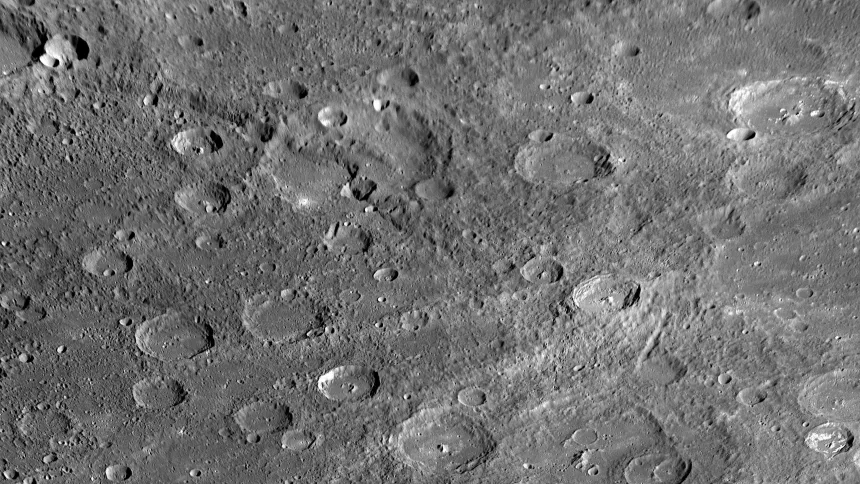
In this view taken by NASA’s MESSENGER orbiter, which surveyed the planet between 2011 and 2015, there is a large cliff running diagonally across the surface (upper left corner toward the center). Some of these can be up to a kilometer high and run for hundreds of kilometers in length. The upper part marking the cliff’s edge is the original surface level, while the part that is below and laying at the bottom is where it dropped down due to shrinkage as Mercury cools. Similar structures can be seen on other terrestrial planets too.
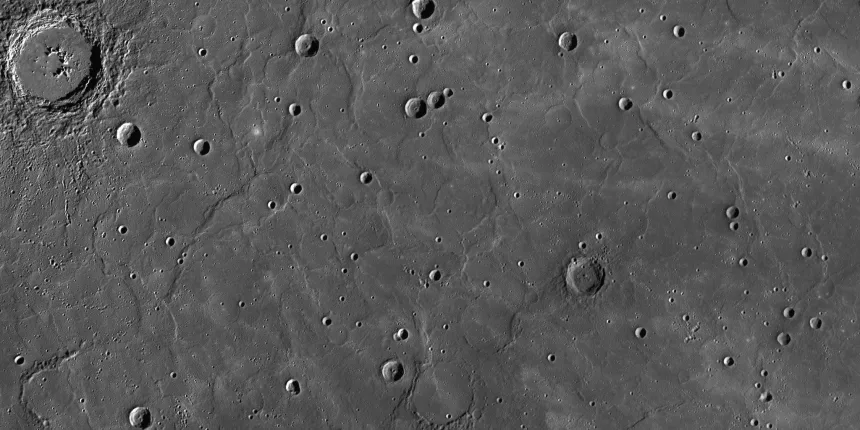
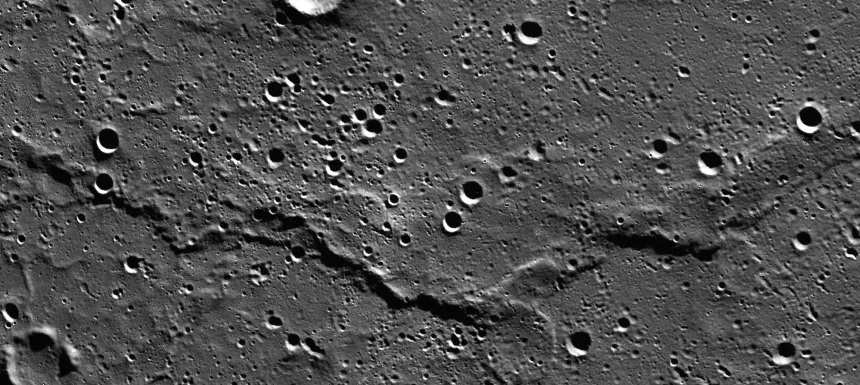
In these two MESSENGER pictures there are contracting wrinkles seen on the surface in the left one, while wrinkle ridges appear in the right one. Both come from the same thing as the cliffs; shrinkage due to cooling.
Reviewing results from MESSENGER, researchers began to compare Mercury’s rough surface versus smooth areas. What stood out was that there seemed to be fewer wrinkles in the rough areas, leading them to conclude that perhaps they had been covered over by debris from impacts. This could then lead to an underestimation of how much the planet’s surface had shrunk from cooling, and therefore a difference in its size.
The next step was to make an educated estimation as to how many more wrinkles might have been present in the rougher areas prior to the impact events that would have covered them up. This led the team to believe that Mercury had shrunk some 10% to 30% more than had been thought before, which means a decrease in its radius of almost 12 km. Prior to this, the amount of had been estimated to have been between 1 to 2 km, maybe even as much as 7 km.
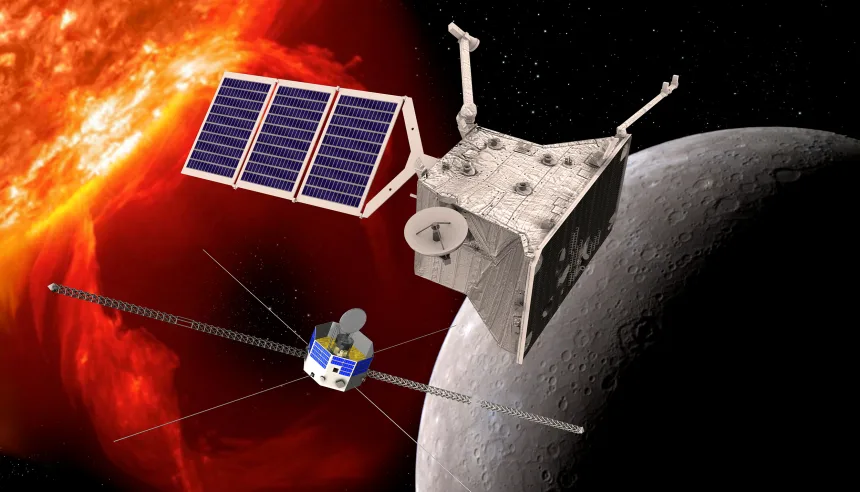
Mercury has been visited by two unmanned probes in the past; NASA’s Mariner 10 (1974 – 1975), and MESENGER (2011 – 2015). The next one to do so will be the European Space Agency’s BepiColombo. Launched from Earth on an Ariane 5 rocket on 20 October 2018, it was originally scheduled to begin orbiting the closest planet to the Sun in December 2025. Due to a problem related to the thrust of its solar electric propulsion system, its arrival was delayed until 21 November 2026; about a month from now. Part of the mission, which is expected to last a year upon arrival, will be the deployment of two orbiters that will separate from the main spacecraft to perform their own objectives.
Stay tuned as I’m sure we’ll be hearing more about BepiColombo in the future. One of the things they’ll definitely be looking at will be the continued resolution of just how much Mercury has shrunk since its formation.
By: Tom Callen