A new giant eye in the sky
The Nancy Grace Roman Space Telescope has been launched
There have been a number of major telescopes sent into space over the last decades, but have you ever given it a thought as to who they were named after? In case you have lost track, here are nine of them, who they were named after, and what those individuals did that they were honored in this way:
| Space Telescope | Named for and why |
|---|---|
| Hubble Space Telescope | Edwin P. Hubble (1889 – 1953), an American astronomer who proved that the universe is expanding. |
| Kepler Space Telescope | Johannes Kepler (1571 – 1630), a 17th-century German astronomer and mathematician known for working out the laws of planetary motion still in use today. |
| Spitzer Space Telescope | Lyman Spitzer, Jr. (1914 – 1997), an American theoretical physicist who first proposed placing a large telescope in space with the advantage that it could escape the effects on observations caused by Earth’s constantly-moving atmosphere. |
| Chandra X-ray Observatory | Subrahmanyan Chandrasekhar (1910 – 1995), an Indian-American Nobel laureate and astrophysicist who studied star evolution and whose work showed at what different masses how stars would end their lives: white dwarves (like the Sun), neutron stars, or black holes. |
| Fermi Gamma-ray Space Telescope | Enrico Fermi (1901 – 1954), an Italian-American physicist and Nobel winner who pioneered high-energy physics. |
| Compton Gamma Ray Observatory | Arthur Compton (1892 – 1962), an American physicist who won a Nobel Prize for his work on photon (i.e., light particle) scattering. |
| Herschel Space Observatory | British-German astronomers and siblings William Herschel (1738 – 1822), the discoverer of infrared light and the planet Uranus, and his sister Caroline (1750 – 1848), a comet hunter. |
| Planck Space Observatory | Max Planck (1858 – 1947), a German theoretical physicist who founded quantum mechanics. |
| James Webb Space Telescope | James E. Webb (1906 – 1992), the NASA administrator responsible for the American manned space program that eventually put 12 astronauts on the surface of the Moon. |
Are you noticing a pattern here? With the exception of mentioning Caroline Herschel, something most people don’t even think of in association with the space observatory sharing her and her brother’s name — and in spite of her contributions to astronomy — they are all named after male figures from astronomy, physics, and space. If one didn’t know better, one could believe that there have been no contributions in these fields from the other 50% of the human population, and yet that’s not the case; from Hypatia (c. 350–370 – 415 CE) in ancient Alexandria, to the present day. Attitudes toward women in science have changed, and on a large scale.
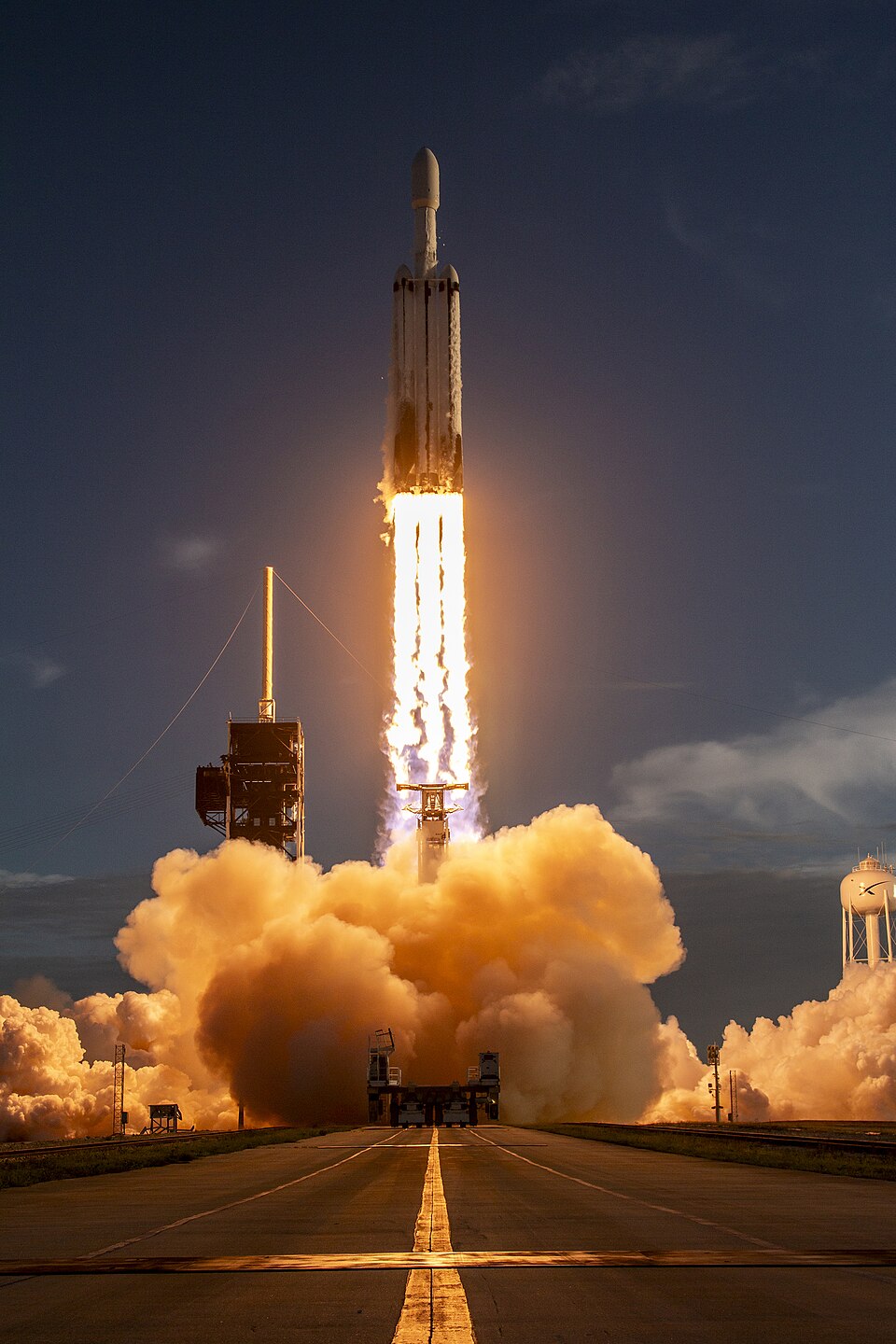
On 30 August 2026, a SpaceX Heavy Falcon rocket shot the Nancy Grace Roman Space Telescope (NGRST) on its way to an observational point in the Sun-Earth system known as L2 (i.e., Lagrangian point #2 out of five). Settling into its orbit here at a distance of about 1.5 million kilometers from Earth, the James Webb Space Telescope is also in the vicinity of L2, though the two face no risk of colliding as they will be many hundreds of thousands of kilometers apart.
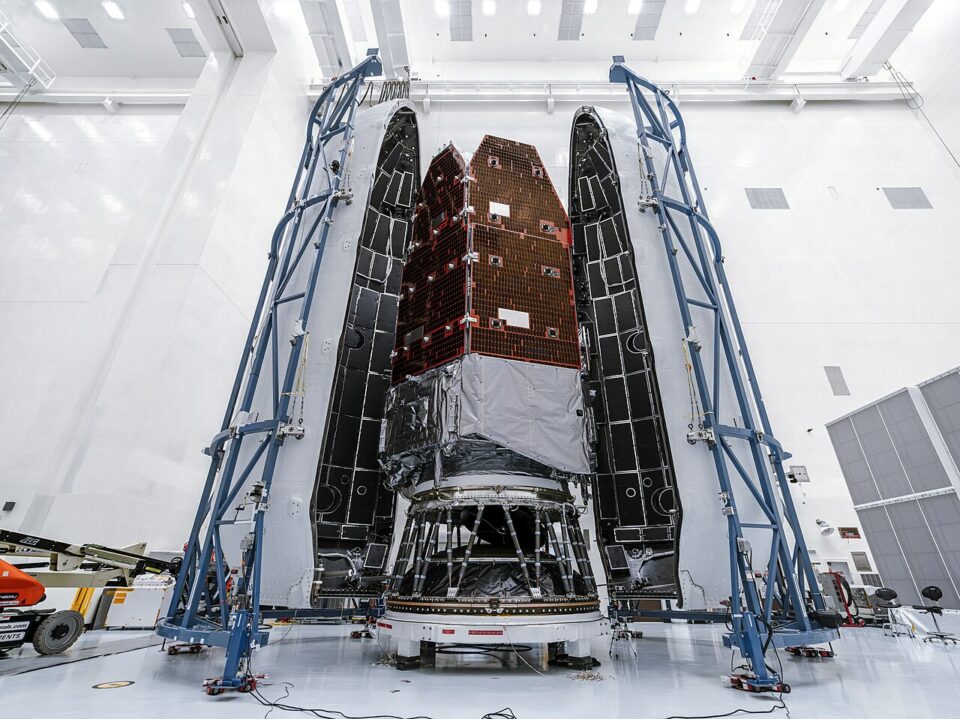
Here we can see the folded-up telescope being inserted into its payload fairing (the tall white “half-shells” on its left and right) before it was attached to a SpaceX Falcon Heavy rocket. This encapsulation helps shield the spacecraft during rollout to the launch pad, ascent when the rocket lifts it from Earth, and then in the early phases of flight through Earth’s atmosphere.
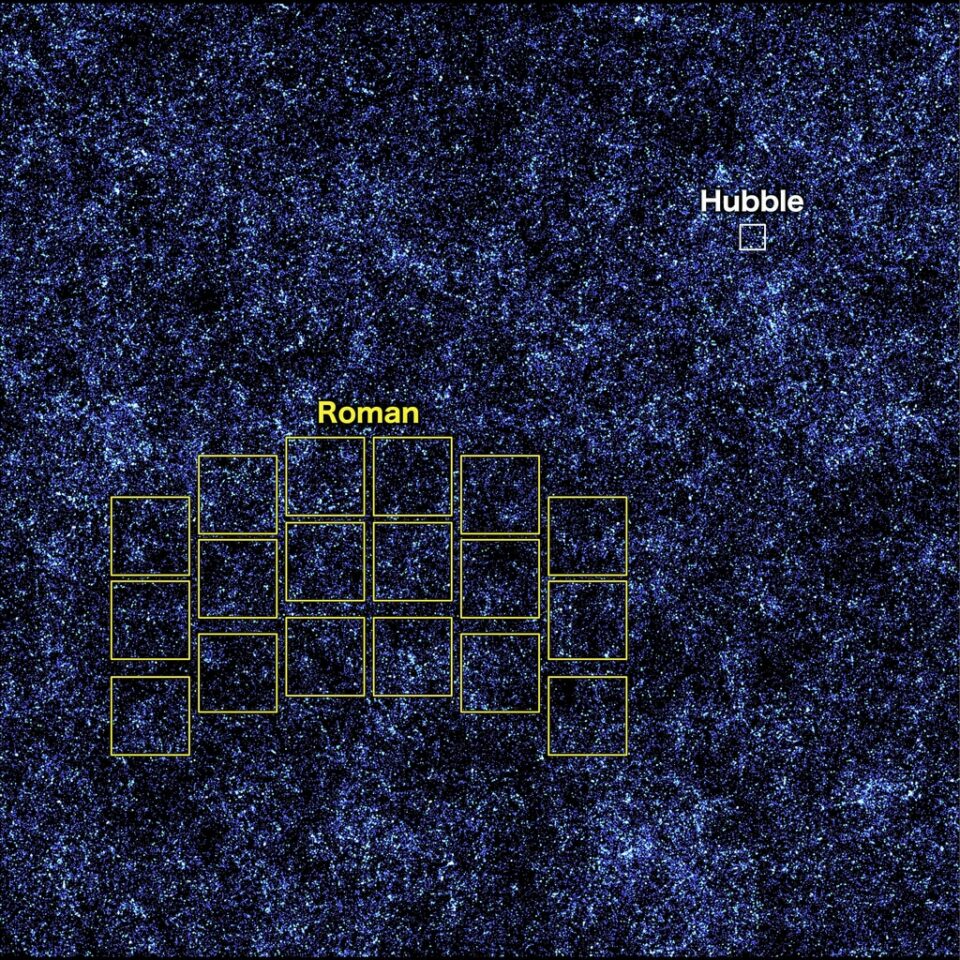
NGRST will observe the universe with a mirror 2.4-meters in diameter, with a resolution as good as the Hubble Space Telescope (HST), but since its Wide-Field Instrument—working in multi-band visible light and the near-infrared—has over 300 million pixels, it can cover an area 100-times larger than HST. This view shows a comparison between what the CCD chips on these two space telescopes can both cover.
A second NGRST instrument, a high-contrast, small-field-of-view camera, the Coronagraph Instrument, is a spectrometer covering visible and near-infrared wavelengths of light. Some of this new space telescope’s goals are to search for exoplanets circling other stars, better understand the development of the universe from its beginnings to its current “soap bubbles” structure observed today, and how this might have been affected by dark matter. It will also check how consistent general relativity is as well as the curvature of spacetime (i.e., the fusion of the three dimensions of space and the single dimension of time). NGRST’s dark matter results will be complimentary to the ESA’s own Euclid wide-angle space telescope, which was launched back in July 2023.
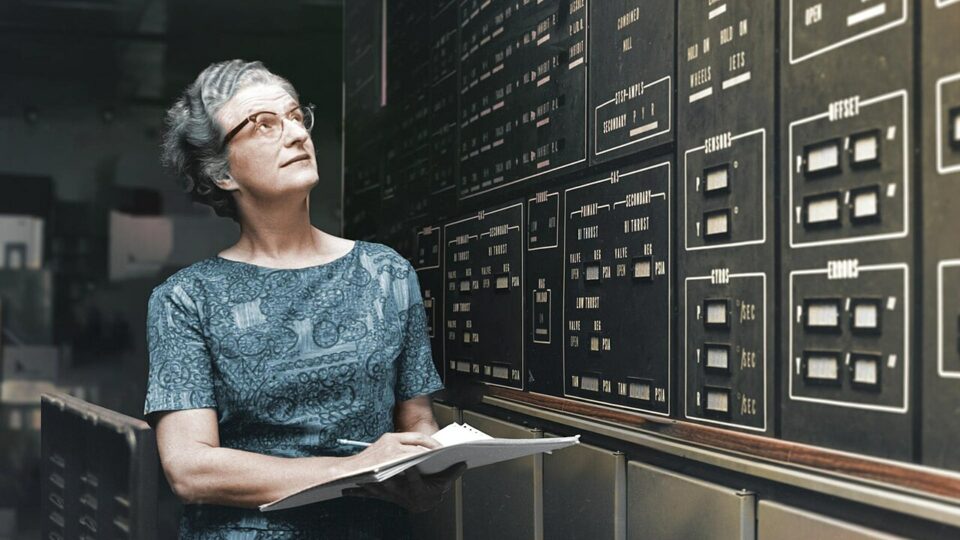
By now you may be asking yourself, “Who exactly is Nancy Grace Roman (1925 – 2018)?” A trailblazing American astronomer when there were very few women in such careers, she served as NASA’s first Chief of Astronomy, and that agency’s first female executive. While in this position, Dr. Roman earned the nickname as being the ”Mother of Hubble” for her vital role in planning and securing support for space-based observatories, such as the Hubble Space Telescope.
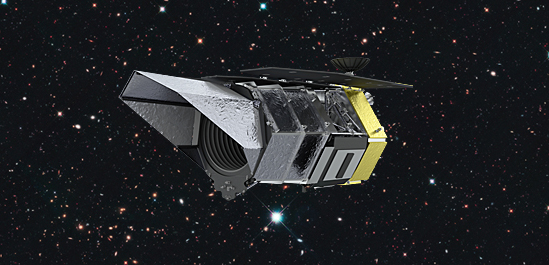
Now the Nancy Grace Roman Space Telescope will bear her name, with its first pictures expected back, following testing and making sure everything is operating, in early 2027.
By: Tom Callen