Crash go the moons, part II
Something very old in solar system collisions
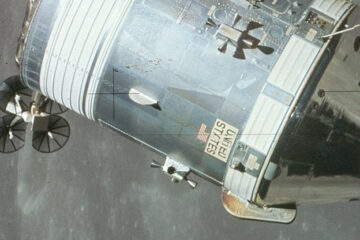
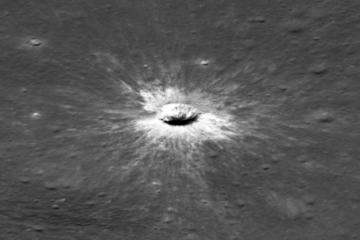
As we saw last week, it’s well accepted that manmade things have been known to reach the surfaces of other bodies of the solar system, like the Moon. The same could be said for unmanned probes arriving at the planets, such as Mars and Venus. Many have made successful landings, providing very valuable information about where they are, while others have crashed and been destroyed after making such a long journey from Earth. And then there are those which were completed unplanned; on 5 August a Falcon 9 rocket’s upper stage hitting the Moon near the crater Einstein.

This week we’re going to take a look at another satellite collision, this time in the solar system’s past, involving Mars’ smaller moon, Deimos. First discovered in August 1877along with the larger Phobos by Asaph Hall (1829 – 1907) at the United States Naval Observatory (USNO) in Washington, D.C., they were so small as to be believed to be asteroids captured by the Red Planet’s gravity. Hall, responsible for what was then the world’s largest refracting telescope with its giant, Alvin Clark-made 660 mm objective lens (i.e., the one at the front collecting light). He had been using it to try and find any natural satellites circling Mars. Prior to this, such small bodies were already known to be circling Jupiter, Saturn, Uranus and Neptune, but no one had spotted any for the Red Planet. Either there were none, or they were very small compared to the others.

Part of the problem was that the USNO campus was located very close to the Potomac River in an area that was both swampy and plagued with frequent fogs—appropriately named “Foggy Bottom”—which interfered with observing. According to astronomical history, Hall was about ready to give up the search, but was encouraged by his wife, mathematician Angeline Stickney (1830 – 1892), to keep looking. The pair are an early example of collaboration within a married couple as she helped calculate the results from his observations, and they certainly weren’t the last. There are examples of such cooperative astronomical pairs to this very day. According to these results of hers, any moons would be located very close to Mars as compared to the other then-known moons of the solar system. It was both this and their size making the task more difficult.
On 12 August 1877, Hall discovered smaller Deimos (16.08 km × 11.78 km × 10.22 km), and less than a week later, 18 August, he had found Phobos (25.90 km × 22.60 km × 18.32 km). While they’re orbiting a planet named for Mars, the Roman god of war, they’re named “Dread” (Deimos) and “Fear” (Phobos) for the followers of the ancient Greek version of the god, Ares. As the then nearly-48-year-old astronomer later wrote, “The chance of finding a satellite appeared to be very slight, so that I might have abandoned the search had it not been for the encouragement of my wife.”
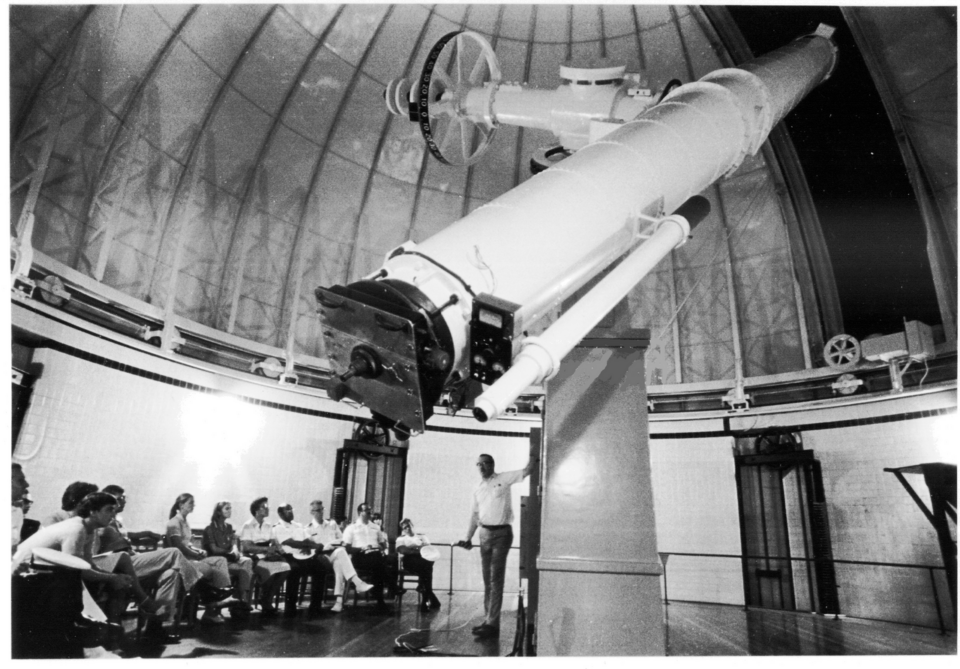
Fortunately, the USNO was later moved to its present Massachusetts Avenue site (this photo of the Clark telescope shown is from around 1980)—much farther away from the Potomac River—in 1893. Not only were the skies overhead much better for observing, but now away from the swampy Foggy Bottom area, fewer astronomers were becoming sick. They had experienced severe shaking chills, high fevers, and chronic weakness from mosquito-borne disease, that led to many lost workdays each year.
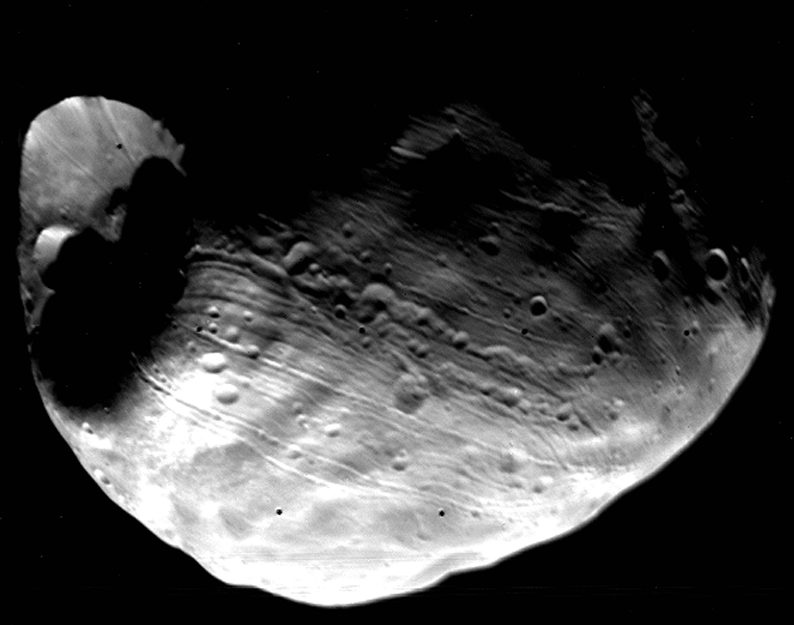
When Phobos was later photographed by the Viking 1 orbiter on 10 June 1977, a large crater (seen here at the moon’s left end) about 10 km-in-diameter was discovered. In honor of Angeline Stickney’s contributions to the discovery of the two Martian moons, it was named after her.
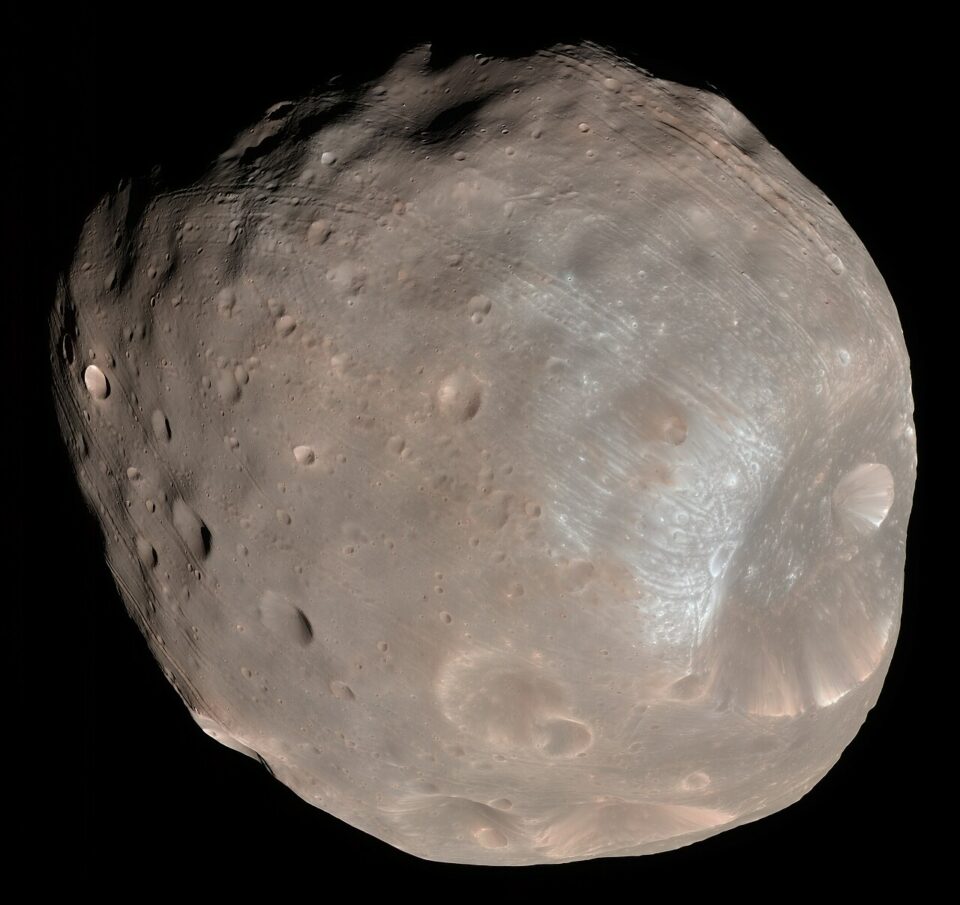
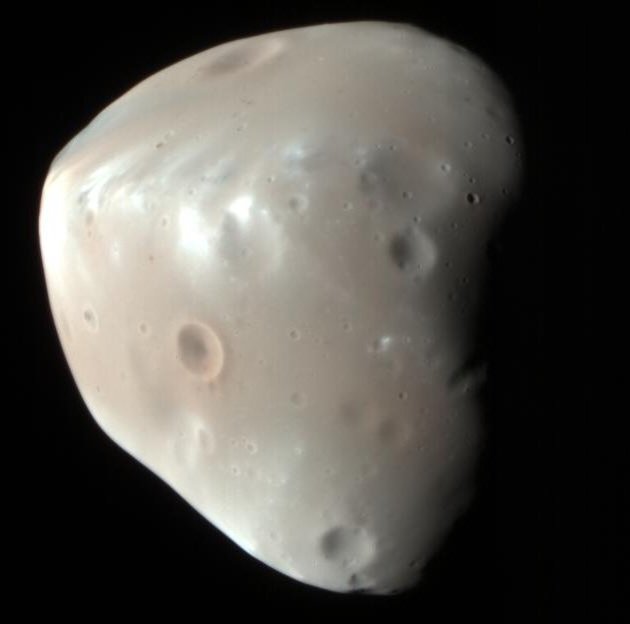
With time planetary astronomers were able to make close-up views of both of these tiny satellites with the help of other, more advanced robot spacecraft. The photo on the left shows Phobos taken by the Mars Reconnaissance Orbiter (MRO) in 2008, while Deimos, to the right, was also taken by MRO in 2009. One thing that’s apparent about this second, smaller satellite is that its surface doesn’t appear as detailed as that of its larger companion. It’s not a question of the camera taking the picture, but that Deimos is covered with a layer of fine dust and rubble, regolith, which has filled in and blurred its surface features. Researchers also noted that this small moon also had a 10-kilometer-wide impact basin at its southern pole. Were the material covering Deimos’ surface and this feature related somehow?
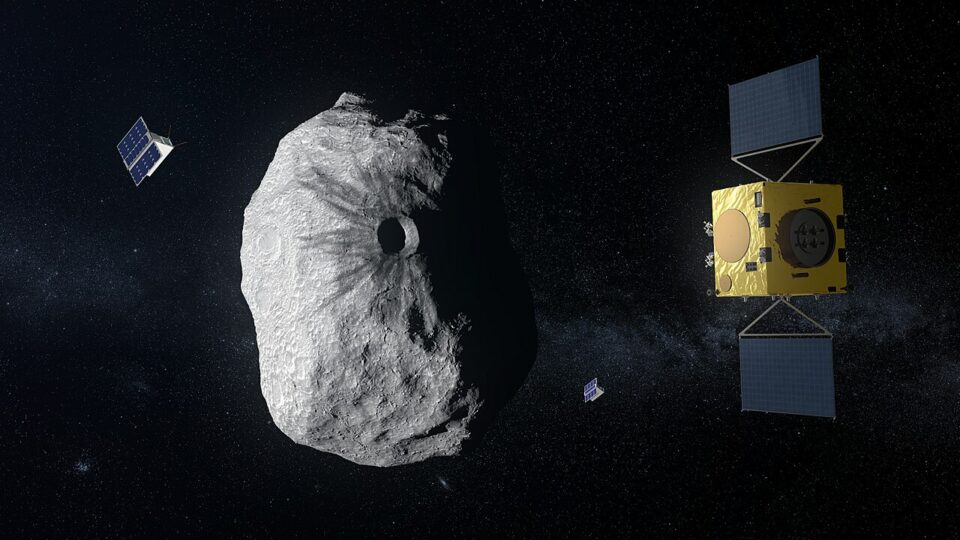
The European Space Agency’s “Hera” mission is on its way to study what changes 2022’s intentional impact of NASA’s “DART” spacecraft had after hitting the asteroid Didymos’ small satellite, Dimorphos.
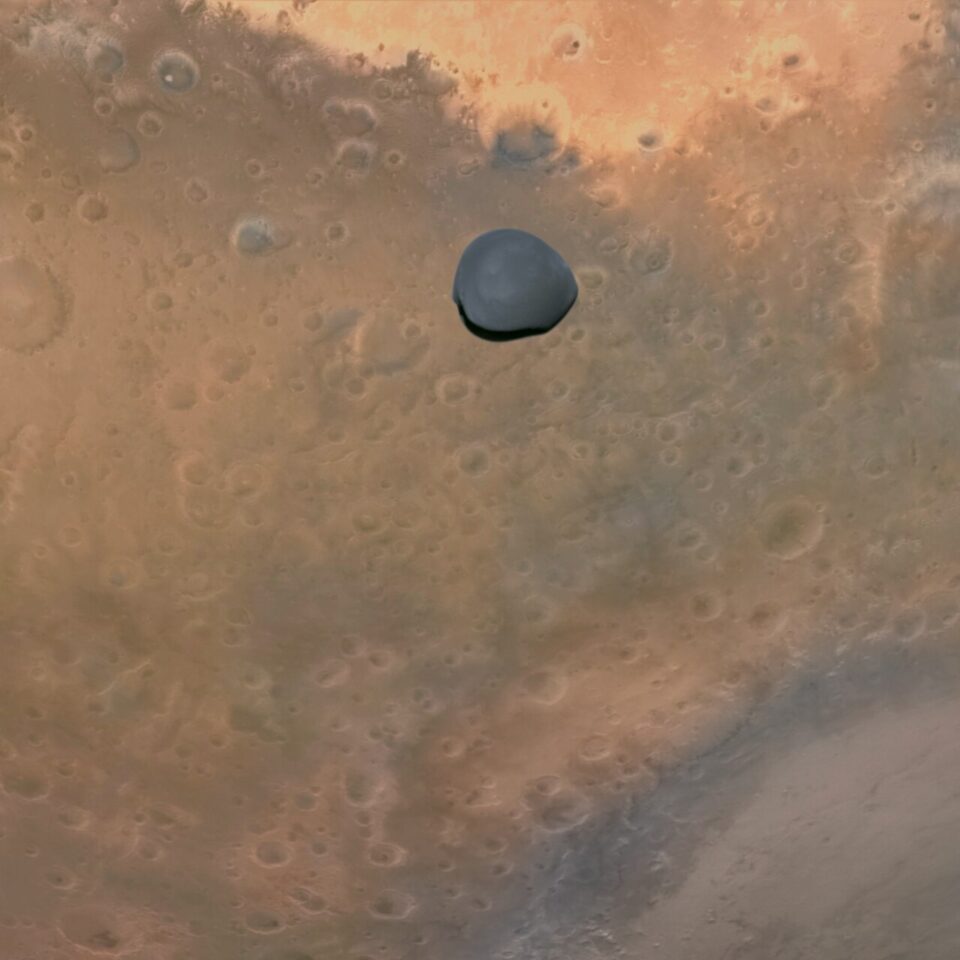
While passing by Mars to get a boost from the planet’s gravity on 12 March 2025, Hera took pictures of Deimos from as close as 300 km away. European researchers then used these to run about a hundred different computer simulations, each taking about a week, to test whether or not the smaller Martian moon had been struck by another solar system body, such as an asteroid. Parameters during these experimental runs included the density, gravity, and compositional strength of the simulated bodies as well as enabling them to analyze the millions of resulting particles flying away after their crash.
The results from the simulations seem to indicate that Deimos was hit by an asteroid around 320 meters-in-diameter at about a 45° angle, which created both the large south pole crater seen as well as the covering layer of dust. Some of this material may be up to 200 m deep, which is why Deimos’ surface appears much smoother than Phobos does. When is this believed to have happened? Best estimates place the event between a million and several hundred thousand years ago. And, the researchers believe, it only took one such impact to produce the observed results. Deimos had just the right physical properties to absorb the force of the crash without breaking apart, which also ensured that the shock waves didn’t vibrate-the surface enough and not completely erase surface features, which can still be seen peeking out from under the overlying dust.
One useful point with these results is that they will be used by the Japan Aerospace Exploration Agency’s upcoming “Martian Moons eXploration” mission (MMX) to plan what sorts of scientific instruments and sample return tools they will need. Sample return tools? Expected to head for the Red Planet by the end of 2026, MMX will attempt to make the best observations ever made of both satellites, and there are plans for it to return surface samples collected on Phobos back to Earth.
Postscript: in the modern photo of the large 660 mm refractor at the United States Naval Observatory (USNO) above, we can see one of their astronomers conducting a group visit. That astronomer is Robert S. Harrington (1942 – 1993), who, along with Tom Van Flandern (1940 – 2009), calculated the orbit of Pluto’s giant moon, Charon, which had been discovered by another USNO astronomer, James Christy (1938 – ), on 22 June 1978. The 606 km-in-diameter satellite was not photographed with this telescope in Washington, D.C., but with a 1.55 m reflector (i.e., it uses a large mirror instead of a lens to gather light) at the USNO’s Flagstaff Station in northern Arizona.
By: Tom Callen