Go big or go slow
The more massive the developing star cluster, the faster it grows and shows
If you’ve been following these articles in the past, you already know that stars form in nebulae, large cloud of gas and dust scattered along the arms of a spiral galaxy, like the Milky Way. Hot young stars condense out of these clouds, making star clusters. Over long spans of time, they all drift apart and go their separate ways, just like babies born in a hospital’s maternity ward leave as individuals and lead their lives elsewhere. Even our own Sun got its start this way 4½ billion years ago, and there are examples of some of its former stellar nursery-mates that can be seen naked eye in the night sky.
One of the things about being within our Galaxy is that it’s hard to see what it looks like. This has been compared to being on a floor within a skyscraper and trying to describe the whole building we’re inside while looking out through a dusty, dirty window. By looking at the other surrounding skyscrapers, however, we can get an idea of what’s happening within our own by seeing what’s happening in them. Fortunately, much of what we see in the universe is the same no matter where we look, just like a house cat (or dog if you prefer) in Sweden is pretty much the same as a house cat anywhere else in the world. Observations from both the James Webb and Hubble Space Telescopes (JWST and HST, respectively) have given us some new insights in the timescale of how such clusters form based on how much material their nebulae originally contained.
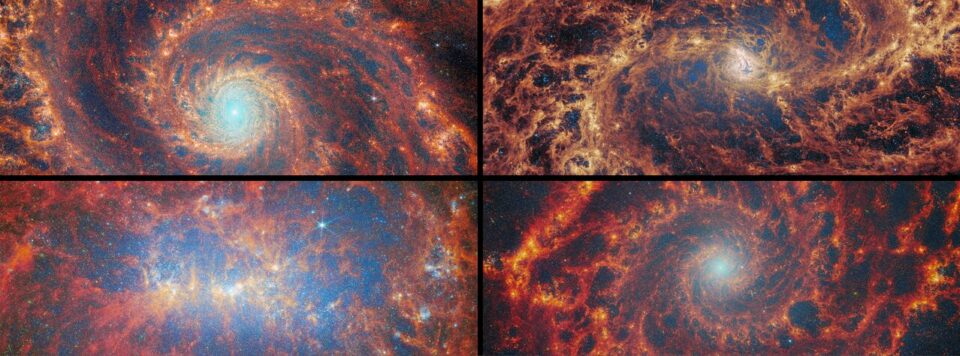
Astronomers have used both of these telescopes to study thousands of developing star clusters at different stages of their evolution. In this way they can get a better, step-by-step picture of how they form; from evolving nebula all the way to newly-born group. Again, the process is similar from place to place throughout the universe. This montage of the four galaxies from this research shows part of Messier 51 (top left), Messier 83 (top right), NGC 4449 (bottom left), and NGC 628 (bottom right). Note the bright blue colors at their centers. Seen in near-infrared light, these show the locations of bright stars. Orange- and yellow-colors show areas of ionized gas, which can be caused by the strong UV light coming from very young stars. Complex molecules and smoke-like grains of cosmic dust. indicated by reds, are seen in mid-infrared wavelengths, which are longer. In both cases, this dust, ionized gas, and complex molecules trace out the spiral arms; the places where these stars clusters are forming.
A key finding from these observations is the relationship between less massive and more massive clusters. The more massive a newly-formed star cluster (i.e., the more members), the faster they emerge from the cocoon of the remaining gas and dust they formed out of. This remaining material is blown away by strong stellar winds coming from the collective group, which makes sense. The more stars there are to sweep their birthing-nebula away, the faster they are seen as they flood their parent galaxy with ultraviolet light. A similar process took place when our own Sun first evolved, blowing the leftovers from its formation out through the rest of the solar system. Why is knowing any of this important? For one thing, it gives us a better understanding of the timeline when planets, like ours, might form as part of a star’s birth. Not only that, but it also points to both how and where planets form at least in this kind of galaxy.
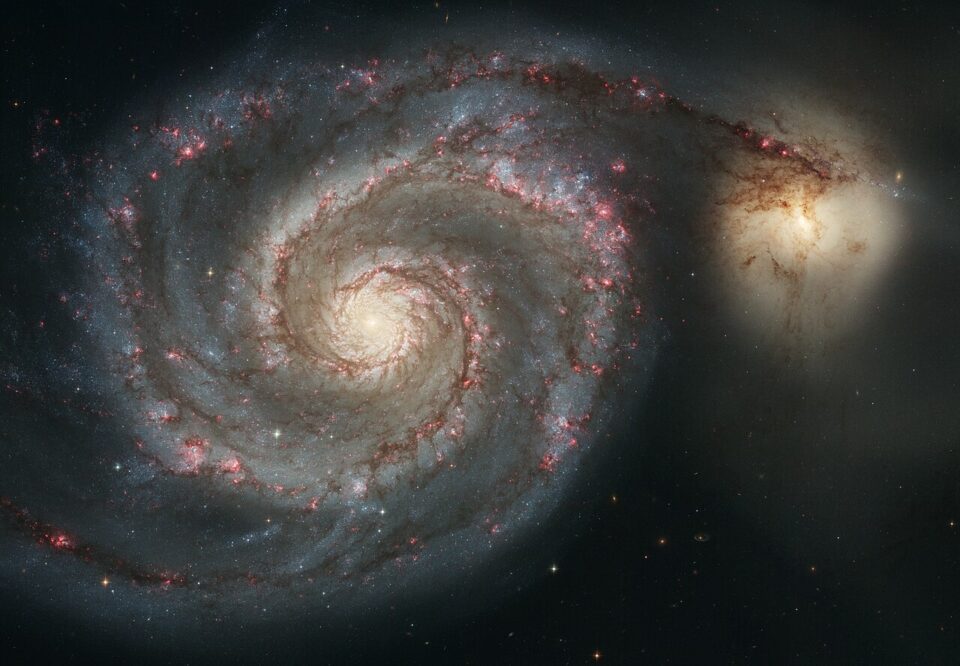
One of the four galaxies studied by the two space telescopes, M51 and another object from Charles Messier’s famous list, is a favorite target of amateur astronomers and can even be seen with binoculars under very good night sky conditions. It also plays a part in 19th century astronomical history. Also known as the “Whirlpool Galaxy,” it’s located in the northern hemisphere constellation of Canes Ventici, the Hunting Dogs. Don’t worry, you’re not alone if you’ve never heard of this small group near Ursa Major, the Big Bear, created in the 17th century.
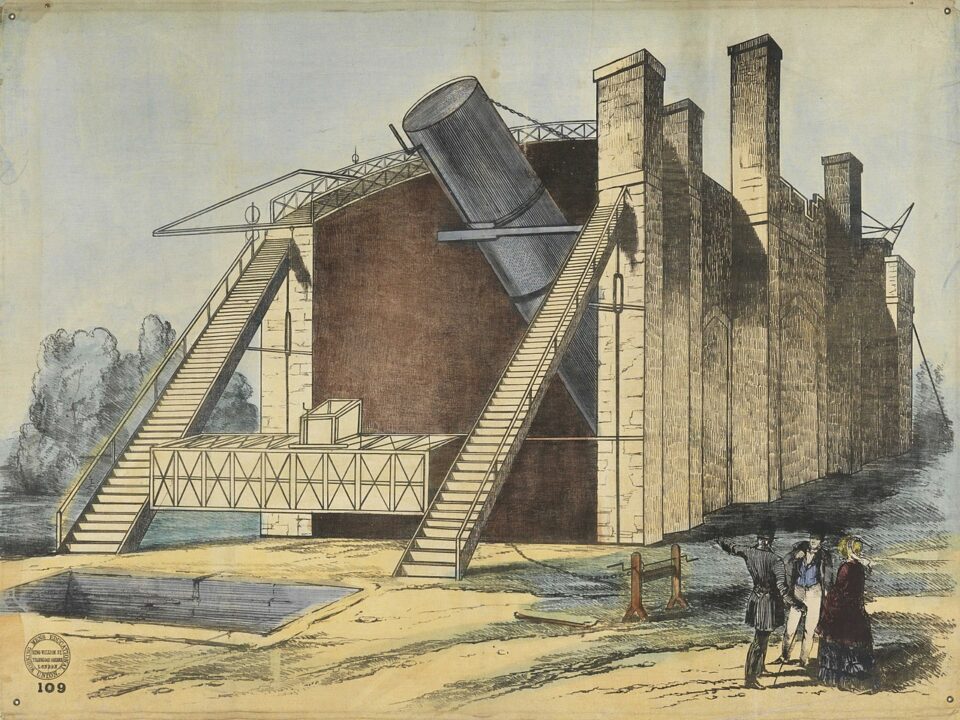
William Parsons, the 3rd Earl of Rosse (1800 – 1867), was an English engineer and astronomer. He built what is known as the “Leviathan of Parsonstown,” though you won’t find this town on a map after 1899 as it’s now known as Birr, Ireland. Built in 1845, it was even larger than any telescopes William Herschel ever built. Its cast metal mirror was 1.83 m in diameter, with a focal length of 16 m. It was the largest telescope in the world for 70 years; until the construction of the glass-mirrored 2.5 m Hooker Telescope at Mount Wilson, California and its 32 m focal length. This view shows Parson’s telescope in its supporting structure on the grounds at Birr Castle, his home. If you think it looks like it’s not very moveable, you’re right. The telescope’s tube moves up and down, or in altitude. It could also move a little in azimuth (i.e., left and right), but only so that it swept a narrow strip of the night sky about 10° to 15° wide. This picture itself is unusual as it’s been printed onto a piece of cotton fabric rather than on paper like a normal artwork. This method was probably used so as to avoid paying a fee for it to be made so. Paper required a duty, while cotton cloth did not. Such wall hangings, this one is from a series of nine having an astronomical theme, were traveled around and used in lectures for the general education of the public, much like we would use a PowerPoint presentation today.
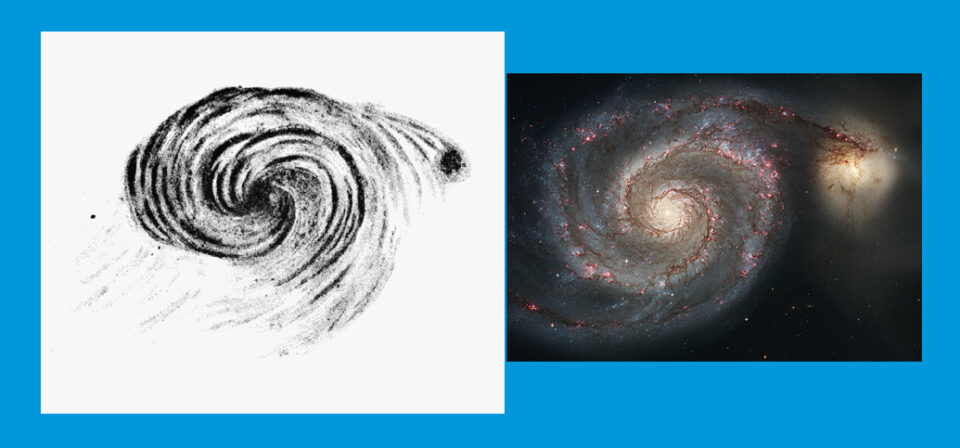
Photography was still in its infancy at the time, and the technique was certainly not sensitive enough to capture such a faint astronomical object. Besides, as Earth’s rotation slowly carried objects through the telescope’s view, their light would have smeared and the image made unusable. The drawing on the left, the only possible recourse, was originally made by Parsons with pencil on paper at the eyepiece of his giant telescope, and then redone with black ink. Note the fine nebulous structure, especially on M51’s outer parts. The modern view on the right shows the Whirlpool Galaxy in all its colorful glory, none of which Parsons could see himself due to the human eye’s insensitivity to the color of such a dim object.
The Leviathan of Parsonstown’s mirror was 1.83 m across, or just 57 cm smaller than that of the Hubble Space Telescope at 2.4 m. What a huge difference in the quality of the images between the mid-19th and late-20th/early 21st centuries. Imagine how much more we’d know about the universe today if something like the latter was available to such observers in the past.
For the ESA press release about this study of the four galaxies and pictures, follow this link. For a video with a zoom into M51, one of the four, see here (be sure to have your viewing device’s volume ON).
By: Tom Callen