Where’s the ice?
“Water, water everywhere, and not enough to drink”
As we all know, water is an essential substance on Earth, so much so that biologists know it’s important for the development of life on our planet and elsewhere in the universe. NASA’s long-running program of sending unmanned research rovers to the surface of Mars is following the mantra of “Follow the water” in their search for any signs of some form of simple life developing there in the distant past.
With renewed human interest in establishing permanent bases on the surface of the Moon, water is also an important part of those plans. Being a small satellite of a planet has its own set of conditions affecting this. Before the invention of the telescope, people thought the large dark areas seen naked eye on its surface were liquid seas and oceans. In reality, they’re actually large outflows of cool, hardened lava from the Moon’s interior.
For one thing, liquid water cannot exist on its surface. Radiation from the Sun would break up any liquid water into its component elements of two-parts hydrogen and one-part oxygen, which would be quickly lost to space as the gravity of Earth’s satellite wouldn’t be able to hold it. Nor does it have a regular atmosphere, with what it does have being best described as thin and sparse; basically it’s an ultra-high vacuum.
By the late 1960s and the days of the first lunar landings, researchers thought there could be water in the form of ice on the Moon, most likely deposited by comets crashing into its surface. Like Earth of which it was once a part, our satellite also has rocks with minerals rich in oxygen. Hydrogen, brought by the solar wind pouring out from the Sun, could combine with the oxygen, making traces of water that could be preserved as ice when located in the permanently-shadowed walls of craters at the lunar north and south poles. A sign of possible water could be in areas showing concentrations of hydrogen within the top meter of the Moon’s soil as found by 1998’s Lunar Prospector robot spacecraft near the two poles. Other unmanned missions from a variety of different countries in the 21st century have confirmed, both directly and indirectly, the existence of water ice within 20° of both lunar poles.
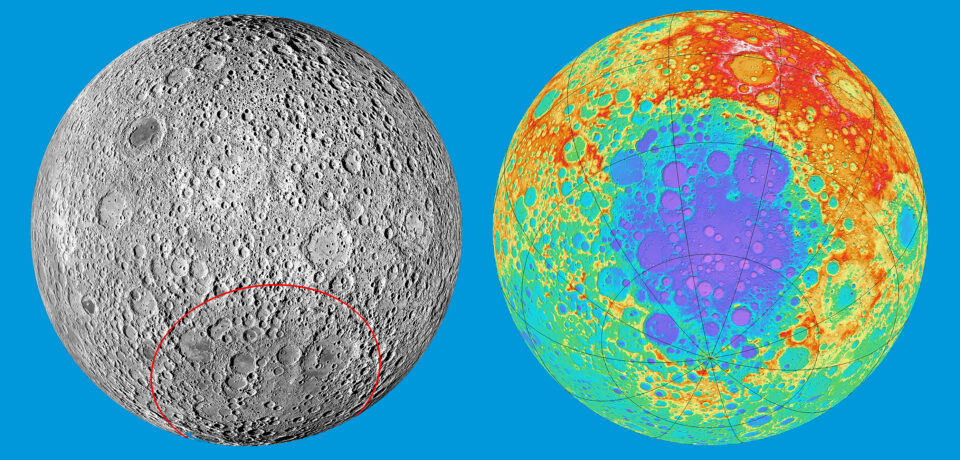
One such place where water ice has been found is in the giant South Pole-Aitken Basin area seen here. About 2,500 km wide and between 6.2 and 8.2 km deep, it is one of the largest impact craters known in the entire solar system. Estimated to be about 4.338 billion-years-old, its name comes from the Moon’s South Pole on one side of the basin and the crater Aitken on the opposite. In the left part of the picture it is circled in red. The right picture has the Moon tipped up at a little higher angle, but by comparing the pattern of craters on the left they can be matched to those purple-colored on the right. The highly colorful version shows elevations on the lunar surface, with red areas higher and purple ones lower. Such low places in this giant basin are just right for harboring shadowed crater walls that could hide lunar ice from the melting effects of the Sun.
If you think I’m belaboring this point about the water, there’s a reason. In order to have permanent stations on the Moon, there has to be a supply of water. If it can’t already be found there, that means it has to be hauled up from Earth, which is a very expensive proposition. This is what also has to be done as part of resupplying the astronauts on the International Space Station (ISS), but that’s on a very small scale when compared to what would have to be done at lunar outposts, or when considering potential lunar cities.
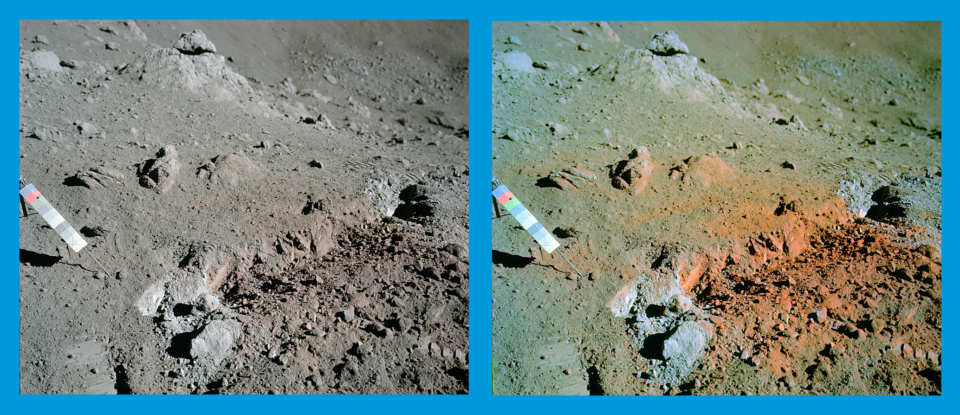
One of the surprising results from the Apollo Moon landings was the finding of miniscule amounts of water trapped inside of very tiny spheres of volcanic glass, like the orange-colored ones found during the last mission, Apollo 17, in December 1972. Harrison Schmidt, the only geologist to ever walk on the surface of the Moon, found the orange lunar soil, at first thinking it was sunlight reflecting off of the gold-plated visor of his protective lunar helmet onto the ground in front of him. But it turned out to be orange glass spherules from a volcanic eruption in the distant past. In this Apollo 17 picture, the left half shows what this looked like in true colors, while I have tweaked the colors on the right half in order for this orange volcanic glass to stand out better from the regular gray lunar regolith. To get an idea how much adjusting was done, compare the two rectangular color gnomons seen on their supporting easel in each picture. Such references were used during the Apollo missions in order to ensure that the color film the astronauts exposed with their Swedish-built Hasselblad cameras was processed to give correct colors.
Since Earth’s natural satellite has a wide variety of volcanic areas scattered about its surface, there must be lots of the spheres about. Some new research based on an estimation that there are trillions of kilograms of water trapped in these beads has made an effort to figure out just how long it might last for a lunar city and its population’s need for drinking water, disassociating it into hydrogen for rocket fuel and oxygen for breathing, growing food as well as personal hygiene.
Picking a Moon city with a population of 1 million, about the same as Stockholm and its surrounding area, the trillions of kilos of water would only last for about two-and-a-half years; certainly nothing like a planned sustained presence on the Moon. If, however, they were very careful about its usage and recycled it at the same 98% rate achieved by the crews flying on the ISS, they could stretch it to around 100 years; again, not exactly a permanent colony. The question could ultimately end up on just how much discomfort they would be willing to put up with in order to maximize water usage efficiency. By comparison, a small lunar city with 100,000 inhabitants would be able to have their water last for 1,000 years, which is starting to sound as being more sustainable. A town-sized arrangement with 10,000 inhabitants could be sustained for 10,000 years. And during that time there’s the possibility of finding another solution to the water problem. Perhaps it could be imported from some of the icier members of the asteroid belt, or pieces from one of the outer gas giant planet’s small, ice-ball moons.
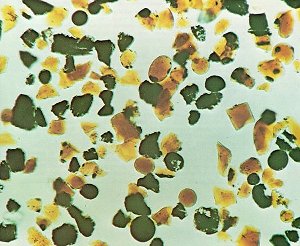
There’s just one thing remaining that no one is talking about no matter how large the proposed lunar city; how are they going to collect together and then extract all those kilograms of water trapped inside all those tiny spherules—seen here in a magnified view—of volcanic glass? Perhaps one of the students reading this article today might be the one who solves this someday in the future.
By: Tom Callen