Another giant eye begins looking skyward
The Vera C. Rubin Observatory seeks to make the biggest “cosmic movie” ever made
Last week we looked at different major space telescopes, who they were named for, and the recent launch of the new Nancy Grace Roman Space Telescope. The same sort of look at the origins of major ground-based observatories could also be made as well as to who or what they were named after.
A small sampling of the various reasons range from those who donated the money to build one (Warner, Lick, and Lowell), a person who found the big-money donor to support building one (Hale), to after locations where they were built (Mount Wilson, Kitt Peak, Mount Hopkins, Saltsjöbaden, Uppsala, and Onsala, with the last three located in Sweden). Then there’s the giants constructed in South America, whose names reflect their ever-increasing sizes (the Extremely Large Telescope/ELT, and the Very Large Telescope/VLT).
One of the latter of these that’s been completed and is now in operation is the Vera C. Rubin Observatory (VCRO), on Cerro Pachón, a high mountain peak in northern Chile. Famous for its crystal-clear night skies, it’s one of the premier locations on Earth for studying space, with an altitude of 2,715 meters above sea level.
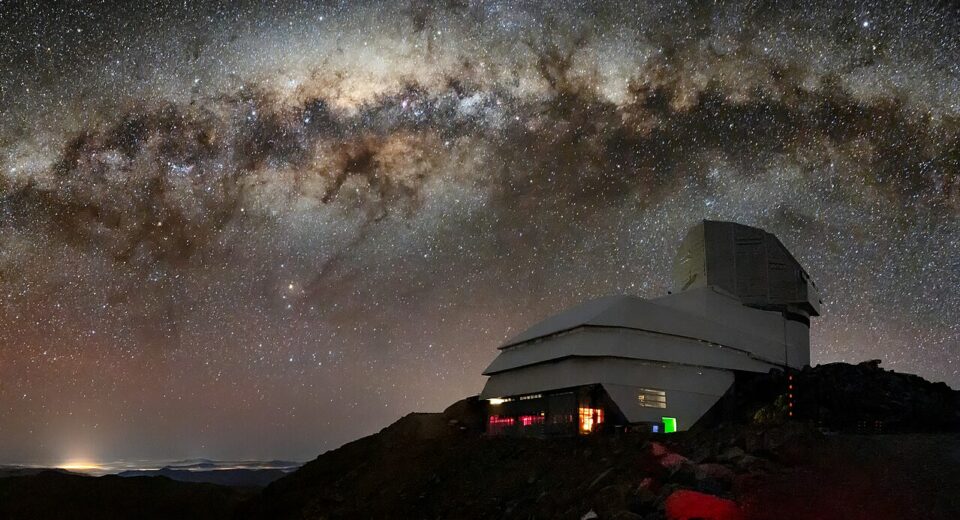
This shows not only the Vera C. Rubin Observatory at night, but it also captures one of the primary celestial targets the telescope and camera will observe: our own Milky Way Galaxy. The bulging collection of gas and stars above and to the left over the VCRO, in the constellation of Sagittarius, the Archer, is the very center of this huge system in which our Sun is but one member out of hundreds of billions.
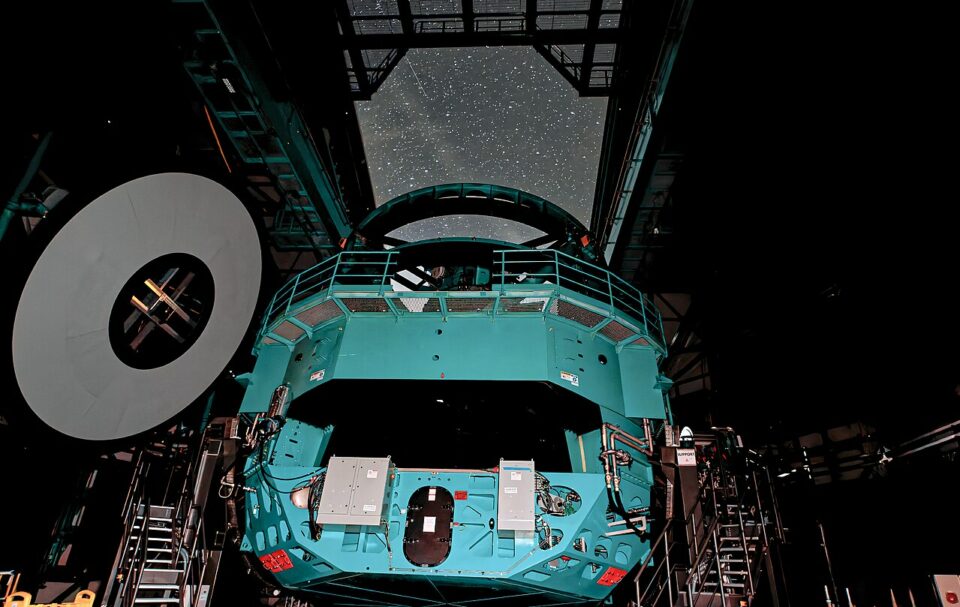
The two most striking things you notice upon seeing the VCRO’s Simonyi Survey Telescope as it’s named is both its compact physical size, which adds to its being considered “fast,” and its bright color. I’ve seen many telescopes at large optical observatories in various places around the world, but nothing quite like this. They’re usually painted white or black, and I can even think of one, the Nicholas Mayall 4.0 meter telescope at Kitt Peak in Arizona, that’s a nice medium blue, white and black. But nothing as striking as this bright teal color.
My first thought was maybe this might have been astronomer Vera Rubin’s favorite color, but it turns out this is not the case. Why teal? For a variety of reasons, but some of the most important are to establish a distinct and recognizable visual brand identity, unify the project’s aesthetics across all of its across their official logos, infographics, team apparel, and even event materials. To be honest, I can’t recall any other observatory taking this sort of active promotional approach before.
And there’s still more. We live in an age where the more public engagement and awareness there is in what’s going on in scientific research, the better the chances of it getting supported. Because this telescope’s mission involves massive public education and data sharing, the bright teal telescope mount provides a striking, modern look, one that “POPS” in photos and in promotional videos when compared to the usual bland telescope finishes.
Not only is the teal color good for both marketing and promotion, it also serves real engineering functions. One is helping with thermal management, because a warm telescope does not take good pictures, but blurry ones, because the telescope’s mirror can expand. Minimizing temperature changes is crucial, and the structure is kept inside a climate-controlled dome during the day in order to match the nighttime air temperature; a common feature of observatories no matter how large. This specialized paint will also help to protect the massive 350-metric-ton steel structure of the Simonyi Survey Telescope from wear and corrosion.
The giant telescope in the VCRO features a fast 8.4-meter primary mirror, with “fast” meaning that it doesn’t need a lot of time to make astronomical images. Think of it like the fast lens on a conventional camera. Coupled with its primary instrument, a giant, mini-bus-sized 3,200-megapixel camera, one of its initial goals is to image the entire southern sky below Earth’s equator every few nights. One of the reasons it’s able to do so is because this is a very wide angle camera, astronomically speaking. How wide? It can provide sharp images of an area of the sky 3.5°-in-diameter, which is six-and-a-half times the diameter of the Full Moon. Think about this the next time you see Earth’s closest neighbor in space in the real sky.
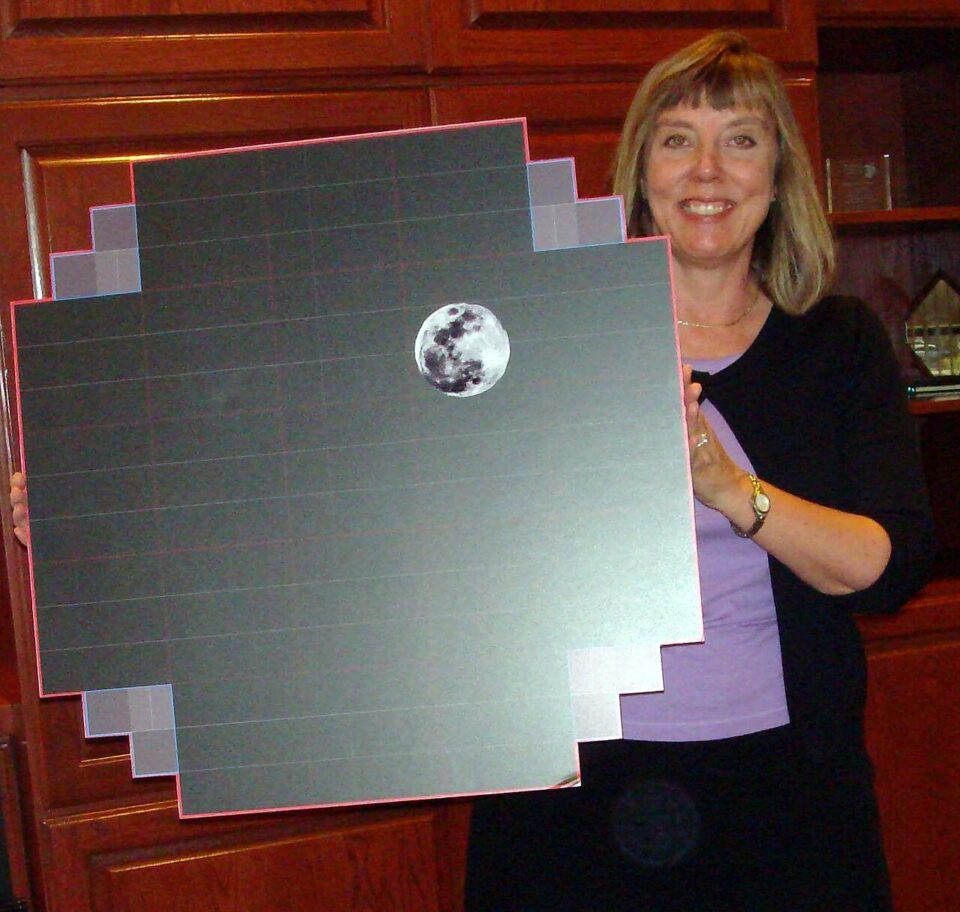
Here we can see a life-size model of the focal plane array, 64 cm in diameter, which will provide 3.2 gigapixels per individual image taken about every 40-seconds. The image of the Moon, which is 30 arcminutes, or 0.5-degrees across, has been added to show the scale of the camera’s field of view. The VCRO’s communications director, Suzanne Jacoby who’s holding the model, gives a sense of its size from a human perspective.
What exactly is the nature of this particular project that the VCRO will be involved with over the next decade? Called the Legacy Survey of Space and Time (LSST), this survey will use the giant CCD camera to photograph the entire visible southern sky every few nights. One of the benefits of having such a wide field of view is that it will be able to do so in about 1,000 images of the night sky every evening, which, over the course of a decade, will give us a new view of our evolving Universe. To be able to take so many images in a night, the Simonyi Survey Telescope needs to be able to “point and shoot” very quickly. Its compact, rigid design allows it to move and settle into its next picture-taking position amazingly fast, re-aiming to a new target area in the southern hemisphere’s sky in 5 seconds.
Curious as to how much new data this is per night of imaging? Those 1,000 images come to about 10 terabytes in total! That’s about 5 million typical printed books, or roughly the contents of a medium-sized academic library. Putting it another way, this is around 2,000 to 2,500 days—roughly 6 to 7 years—of continuous, uninterrupted music playback at standard MP3 quality. In one night…
The LSST began its mapping the Milky Way to answer questions about its structure and formation on 30 June 2026. By returning to and reimaging the whole sky from this location, one of the final results will be a “cosmic timelapse” of what’s been happening; capturing pulsating variable stars that change their brightness, locating new exploded stars (supernovas), and exploring the fossil record of galaxies. There may even be the discovery of new phenomena astronomers have never seen before, which has happened before with the introduction of larger and larger astronomical tool both on the ground and in space. While they are nothing new as far as objects go, the giant camera discovered over 11,000 new solar system asteroids alone while it was still in its systems optimization phase prior to undergoing real operations.
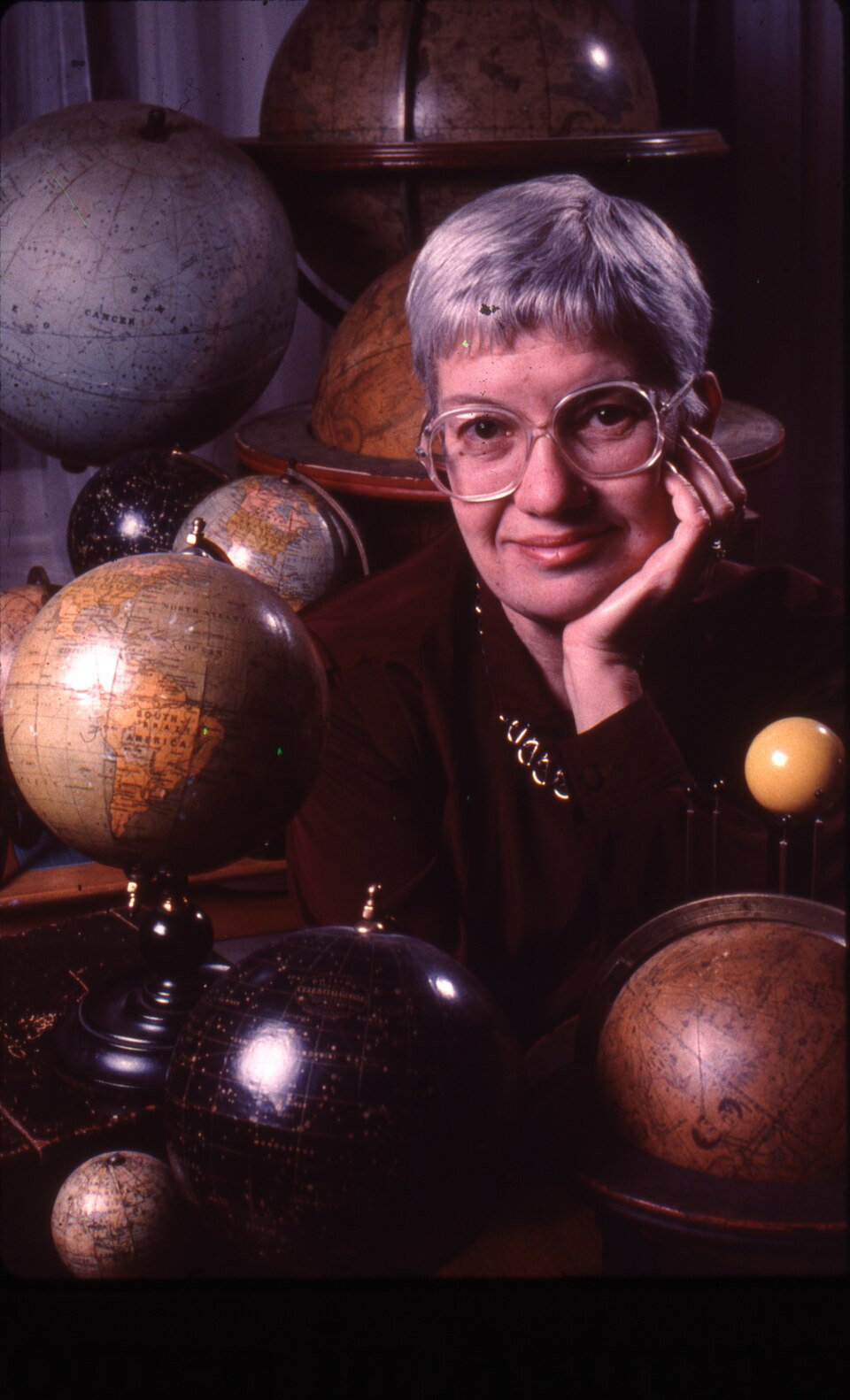
One particular area of interest is looking to solve the mysteries of dark energy and dark matter, plus the aforementioned new phenomena never seen before. Which is where Vera C. Rubin (1928 – 2016) comes in, and why this major new observatory was named in her honor. This portrait of Rubin with her collection of antique globes, taken in around 1985, is one of my favorite of her. I had the good fortune of having her come and speak about her work on discovering dark matter while I was still at the Albert Einstein Planetarium of the Smithsonian Institution’s National Air and Space Museum around this same time.
Long suspected as a possible remnant from the Big Bang that created the universe 13.75 billion-years-ago, it was Rubin who found the first evidence that dark matter was real. Spiral galaxies, with their beautiful pinwheel-like arms, rotate, but on very long timescales beyond anything humans can relate to; about 200 to 300 million years for their central regions, but, because they aren’t solid bodies, around a billion years for their outer edges. The expectation was that the rotational speed of a spiral would decrease with distance from its center, but she found that the speed remained constant. This can only be explained by the existence of matter that we cannot see.
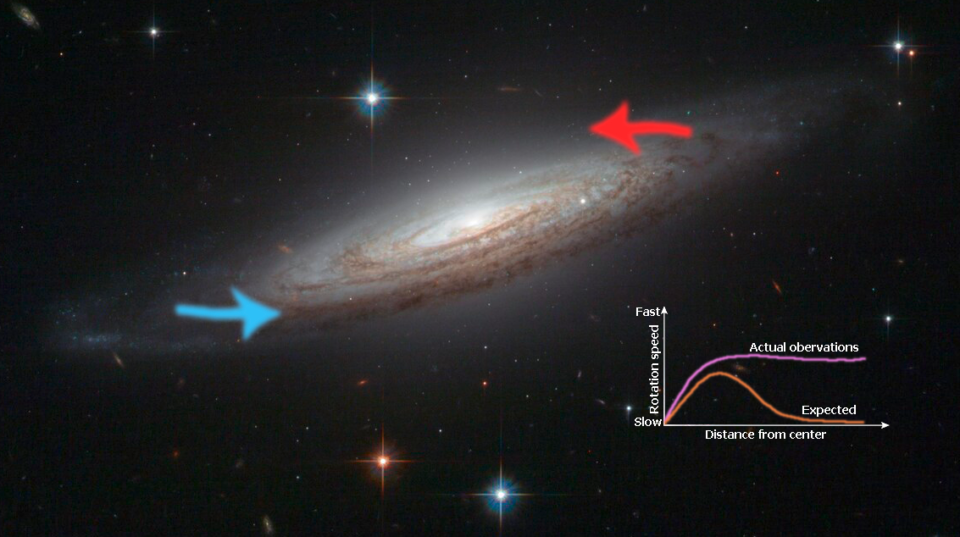
My diagram shows a spiral galaxy rotating, with the red-arrowed side to the right rotating away from us, while the blue-arrowed one is coming toward us. The orange line of the included graph shows how the rotational speed with distance from its center was expected to behave; decreasing speed the farther you measured from the center. The purple line, however, is what the actual results were; the lack of a decrease in speed shows that there was something unseen—the suspected dark matter—affecting it.

One of the questions coming to mind while I was getting ready to write this article was whether or not Nancy Roman (from last week’s article on the launching of the space telescope named for her) ever work with Vera Rubin. As it turned out, they hadn’t collaborated together, but they certainly knew each other. This photograph, taken in 1988, shows Rubin (second from the left) and Roman (at the far right) along with several other prominent women astronomers of the time.
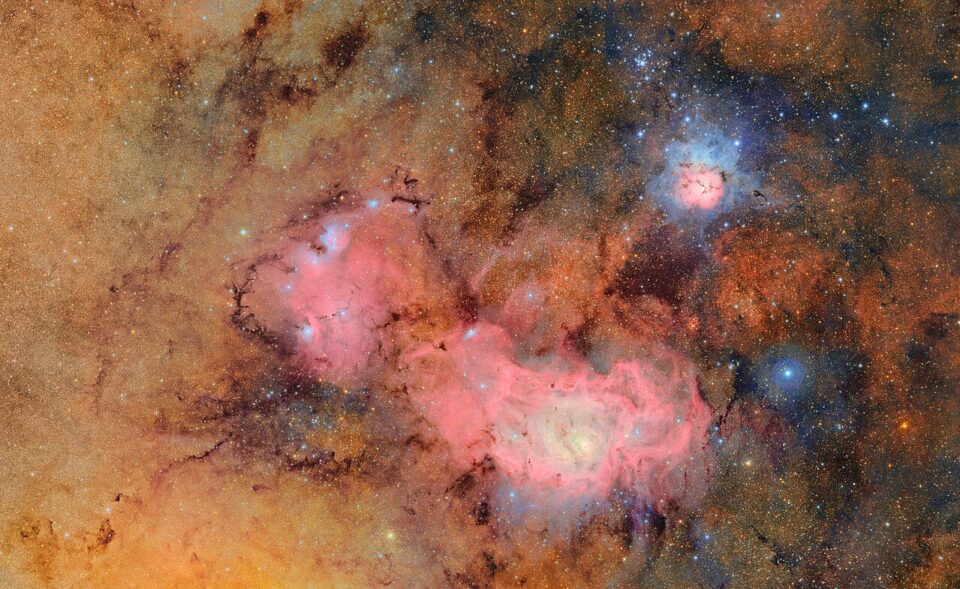
In closing, I’ll leave you with this image taken by the giant CCD camera of the Vera C. Rubin Observatory. Made up of 678 separate images taken in just over seven hours of observing time and then stitched together, it shows beautiful details in two objects well-known to amateur astronomers in Sagittarius. To the left is the pink-colored Lagoon nebula, while at the upper right is the blue and pink Trifid nebula. Both, several thousand light-years from Earth, are large clouds of gas and dust. Here, stars are in formation, the pink color caused by energetic ultraviolet light coming from hot young stars interacting with hydrogen gas and making it glow. The Trifid’s blue areas are where starlight is reflecting off of the same materials.
Postscript: Goodbye summer, and happy autumn, which begins on the Autumnal Equinox, 23 September, at 02:05 CEST!
By: Tom Callen