Long Distance Voyager!
An old space probe from the 1970s sets a new record
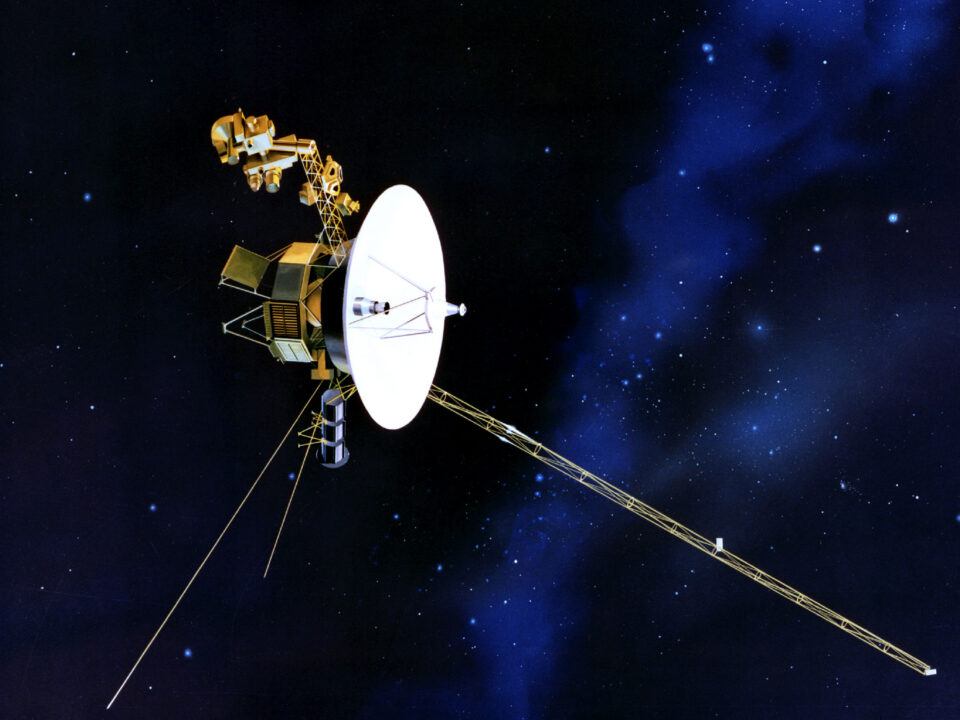
Voyager 1 planetary probe has now passed the one-light-day-from-Earth distance mark, something no other humanmade object has ever done, or perhaps ever will again.
Keeping in mind that light travels at a speed of 299,792,458 meters per second, or 1 billion kilometers per hour, our Moon is at an average distance of 1.3 light seconds, with the Sun at 8 light minutes from Earth. There are 86,400 seconds in a regular 24-hour day, which means that Voyager 1 is some 26 billion kilometers from the planet it and its twin, Voyager 2, were sent from towards the four largest planets of the solar system. This was back in September and August 1977, respectively. At such a distance, it means that, even though radio signals travel at the speed of light, it takes 24 hours for commands from NASA to reach this spacecraft, and another 24 hours for its reply to come back to us on Earth.
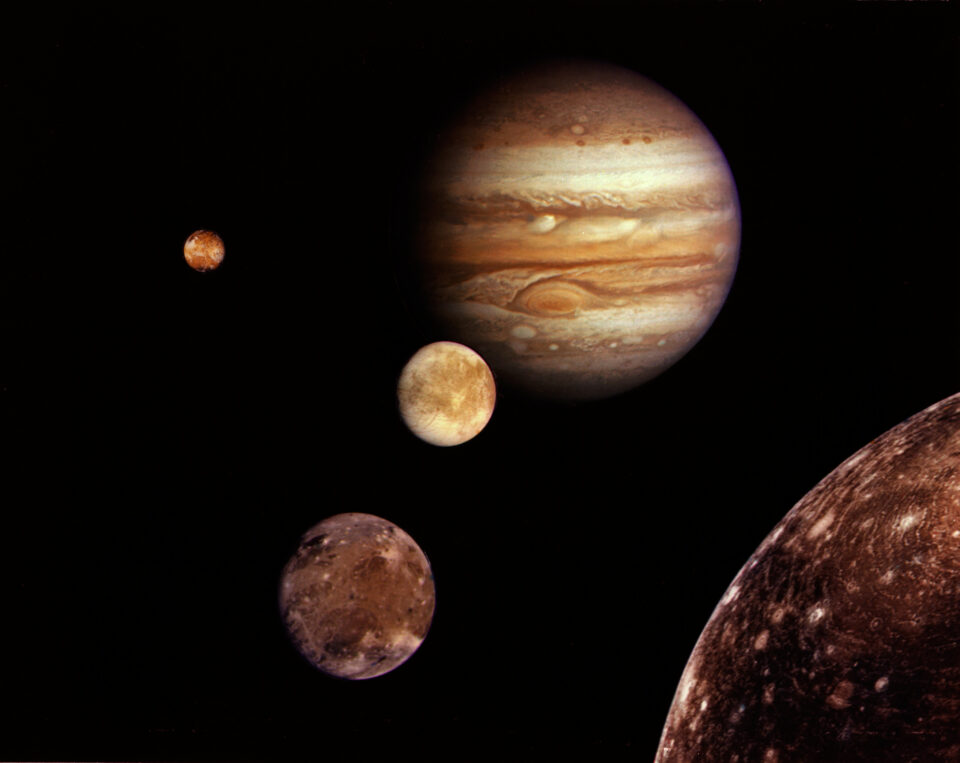
Both spacecraft visited Jupiter and Saturn at different times between 1979 and 1981. In this montage of Voyager 1 pictures of Jupiter and its four largest moons, the Galilean satellites, we can see (from upper left diagonally to lower right, not to scale, but in their order from the planet) volcanic Io, and ice bodies Europa, Ganymede and Callisto.
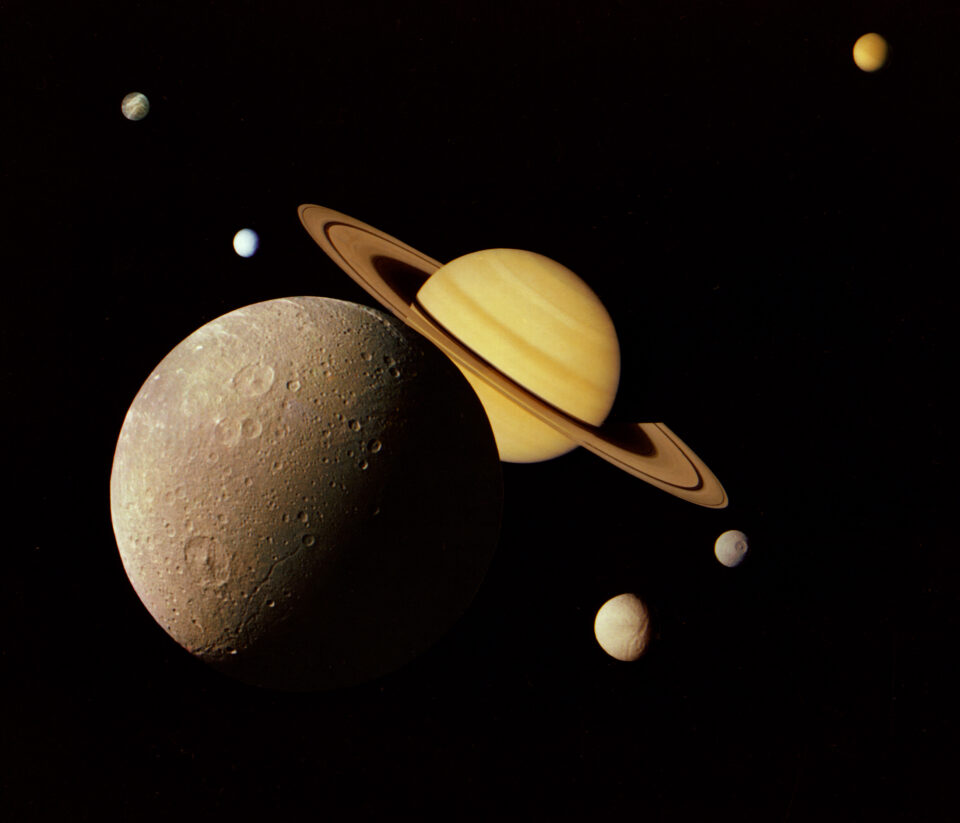
In this second Voyager 1 grouping, again not to scale nor in order, it’s Dione in the forefront, Saturn rising behind, Tethys and Mimas fading in the distance to the right, Enceladus and Rhea off Saturn’s rings to the left, and Titan, the only moon in the solar system known to have a dense atmosphere, in its distant orbit at the top right.
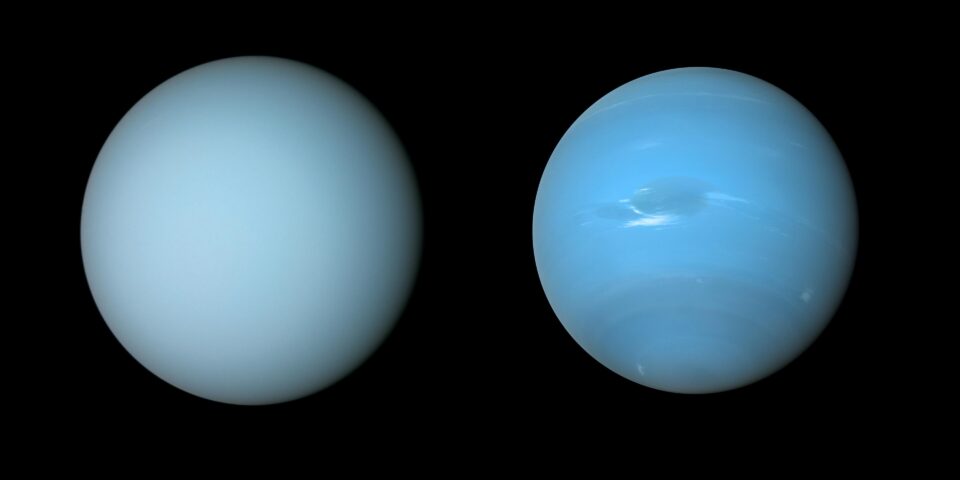
Voyager 2 continued to give us our first, close-up fly-by looks of blue-colored gas giants Uranus (left, January, 1986), and Neptune (right, August 1989). Neither are to scale with one another as Neptune is the larger of the two. Prior to this we had had views of both the first two such planets from the earlier Pioneer 10 (Jupiter in 1973) and 11 (Jupiter 1974 and Saturn 1979) probes, but the quality of the Voyager images were made from much closer and at greater resolution.
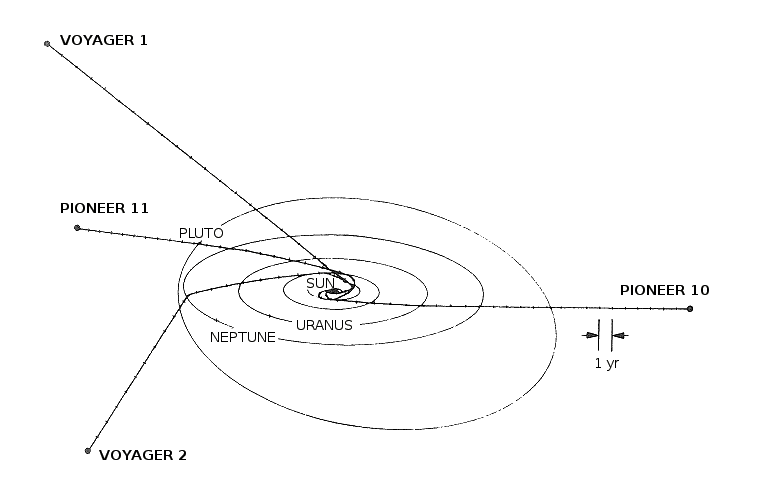
This NASA diagram shows the paths that all four of these robotic spacecraft, the two earlier Pioneers and the later Voyagers, took after their main missions of photographing the four outer gas giants were complete. Voyager 1’s path varied after its Saturn flyby, making its way outward from the Sun at an upward angle from the plane of the solar system to explore the outermost reaches of the solar system.
While we no longer had any contact with Pioneer 10 or 11 since the late 1990s, both of the Voyagers are still in communication with Earth, though in very limited capacities. In order to be able to conserve the electrical power made by their aging radioisotope thermoelectric generators, most of their main research instruments are turned off. Their main task for the foreseeable future is the ability to provide researchers information about their surroundings, be able to radio it back, and to maintain a safe operating temperature in the deep, dark cold of space.
By: Tom Callen