What’s (not) up with Artemis II?
The first manned moonshot in 54 years is delayed
Back on 20 January, I wrote that NASA’s planned first return to the Moon with a crew in 54 years was scheduled for as early as 6 February. It being 9 March, we now also know the 10-day-long mission didn’t happen as scheduled. This was due to a problem showing up during a pre-launch “wet dress rehearsal,” which included a simulated countdown (10… 9… 8… etc.) held on 2 February. A what?
Such a test is called so because the Space Launch System (SLS) rocket is filled up with the liquid gases it will be using for fuel, like liquid oxygen and liquid hydrogen, to check everything functions as it should on the actual day of the launch. The rocket’s motors were not actually fired while it was held in position on the launch pad. If they had been, it would be a “static launch” test. In this early February test, it turned out there was a leak associated with the liquid hydrogen, so the mission was delayed to around 6 March following another wet dress rehearsal test before then. There was also an issue discovered with a leak in the Orion space capsule’s hatch pressurization, which also needed attention. A second wet dress rehearsal was held on 19 February, and everything went as planned.
However, the 6 March launch was also missed because of a helium flow issue found with one of the rocket’s stages on 21 February. This was more serious, meaning that the whole SLS assembly had to be rolled back to the giant Vehicle Assembly Building (a.k.a., the VAB) on 25 February, taking a little over 10 hours(!) to do so.
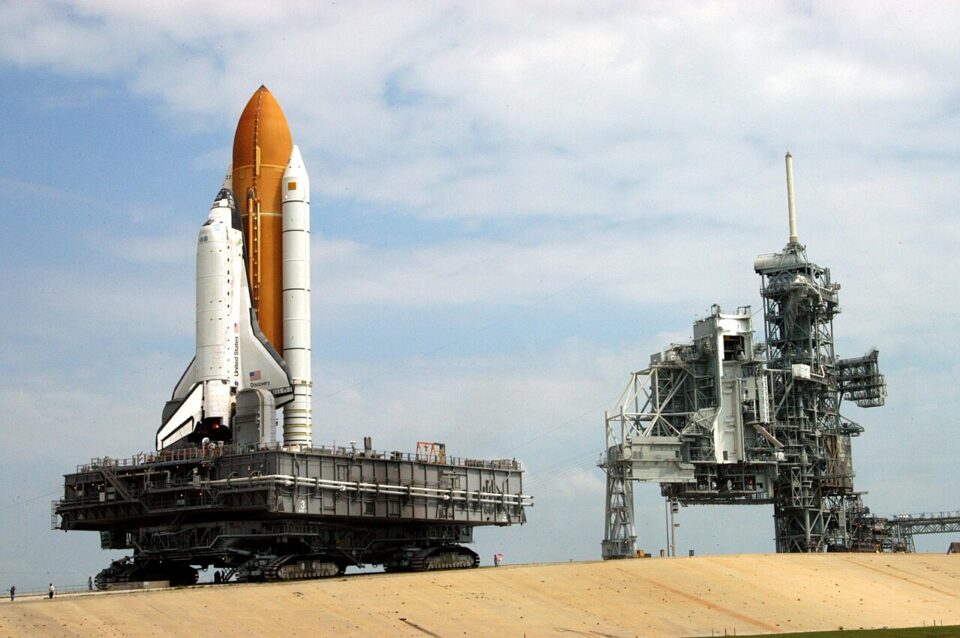
This was performed by the same type of giant Crawler-Transporters—there are two of these, nicknamed Hans and Franz—which have been used for over 50 years; all the way back to get the Apollo Saturn Vs and the more recent space shuttles out to their launch pads, and now today’s Artemis SLS rockets. “Giant” is an understatement as I have stood next to one of these massive, tank tread-tracked, self-propelled vehicles during a visit to the Kennedy Space Center. The space shuttle Discovery is shown here on the back of one of the C-Ts while on its way to Launch Pad 39B prior to mission STS-114 (26 July 2005 – the first such mission after the Columbia accident in February 2003). Since the transporter has to slowly crawl up a slight inclined ramp, the back-halves of both Hans and Franz can be raised in order to keep the spacecraft on top of them level and vertical the whole time.
As of this date, there is as yet no new launch date set for Artemis II, but one will be once it has passed an additional wet dress rehearsal and its results have been analyzed.
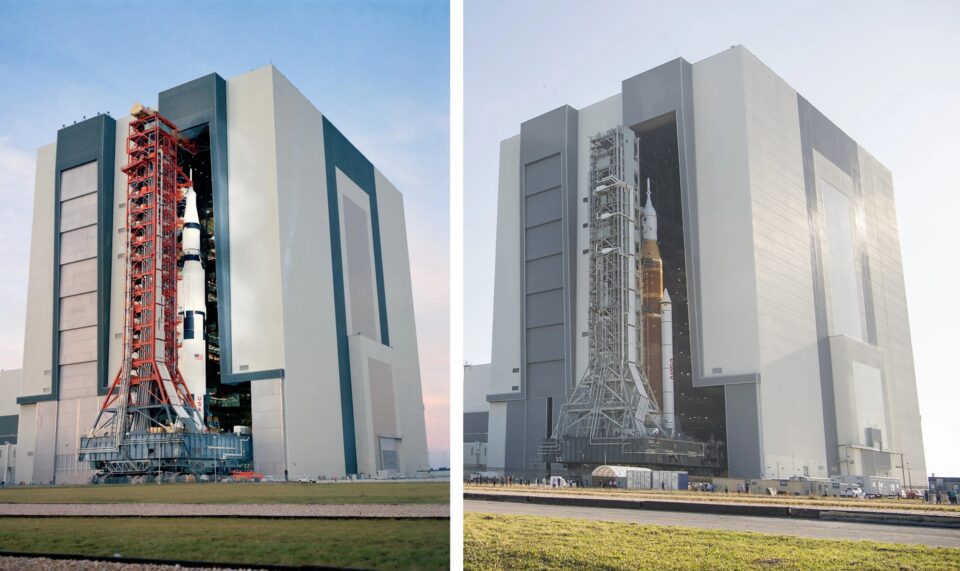
As long as I’ve mentioned the VAB, now is a good a time as any to use it to help compare the size of the original Moon rockets, the Saturn V, with today’s Space Launch System. The building where they’re put together is still the same, but the rockets themselves are different. The one sending astronauts to lunar landings over half-a-century ago (on the left) is a single, self-contained stack, straight as a meter stick. The SLS, on the other hand, has two additional SRBs, or Solid Rocket Boosters, strapped to the sides of the orangish-colored main liquid fuel tank at the rocket’s center. If they look familiar, they are similar to those used with NASA’s space shuttle fleet. Instead of using liquid fuel, these two are tightly packed with a solid propellent fuel.
Another thing borrowed from the shuttles is the fact that the SLS’ liquid fuel tank is not painted white. Fun fact: you can tell the earlier space shuttle mission launch pad photos from the later ones because NASA discovered they could save some unnecessary weight on the whole pre-launch shuttle by not painting that tank white. Take a look at the previous picture showing Discovery on its way to the launch pad as an example. It was originally thought making the shuttle’s liquid fuel tank light-colored would help it keep its temperature lower from heating by the Sun when filled with its liquid gas fuels. Turns out, it wasn’t a significant problem after all.
Last, but certainly not least, NASA has decided to add another Artemis mission to the schedule. Originally, Artemis III was supposed to be the first crewed Moon landing since Apollo 17 in December 1972, but this is now going to be a flight in low Earth orbit to test the Human Landing System (HLS) for the Moon. This is due in part with problems with the Orion crew module (life support systems and heat shield issues found after the unmanned Artemis I returned to Earth in December 2022) and delays in developing SpaceX’s Starship heavy-lift launch vehicle. If all goes well, Artemis III will take place sometime in 2027, which means the first scheduled Moon landing via Artemis IV could take place no earlier than 2028.
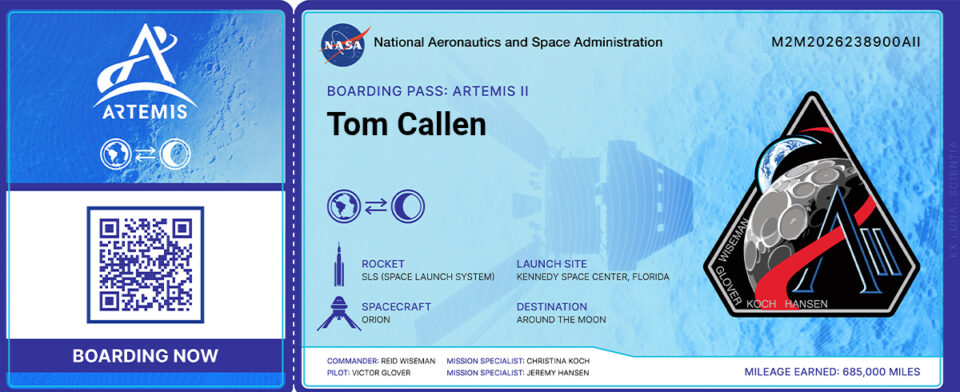
With things being delayed as they are, this means you can still get your name registered (like I did) to get a FREE digital “boarding pass” for Artemis II and have it stored with tens of thousands of others on an SD digital memory card onboard the Orion Crew Module for when(ever) it flies around the Moon!
By: Tom Callen