Of planets and stars
An exoplanet larger than Jupiter was recently observed by the James Webb Space Telescope
I often talk about stars and planets in these ESERO articles, treating them, for the most part as if they’re completely separate kinds of objects. Which is exactly the case in most examples. There are, however, some objects which fall into a kind of gray area between the two; essentially very large, gassy planets that are so big they actually give off their own heat.
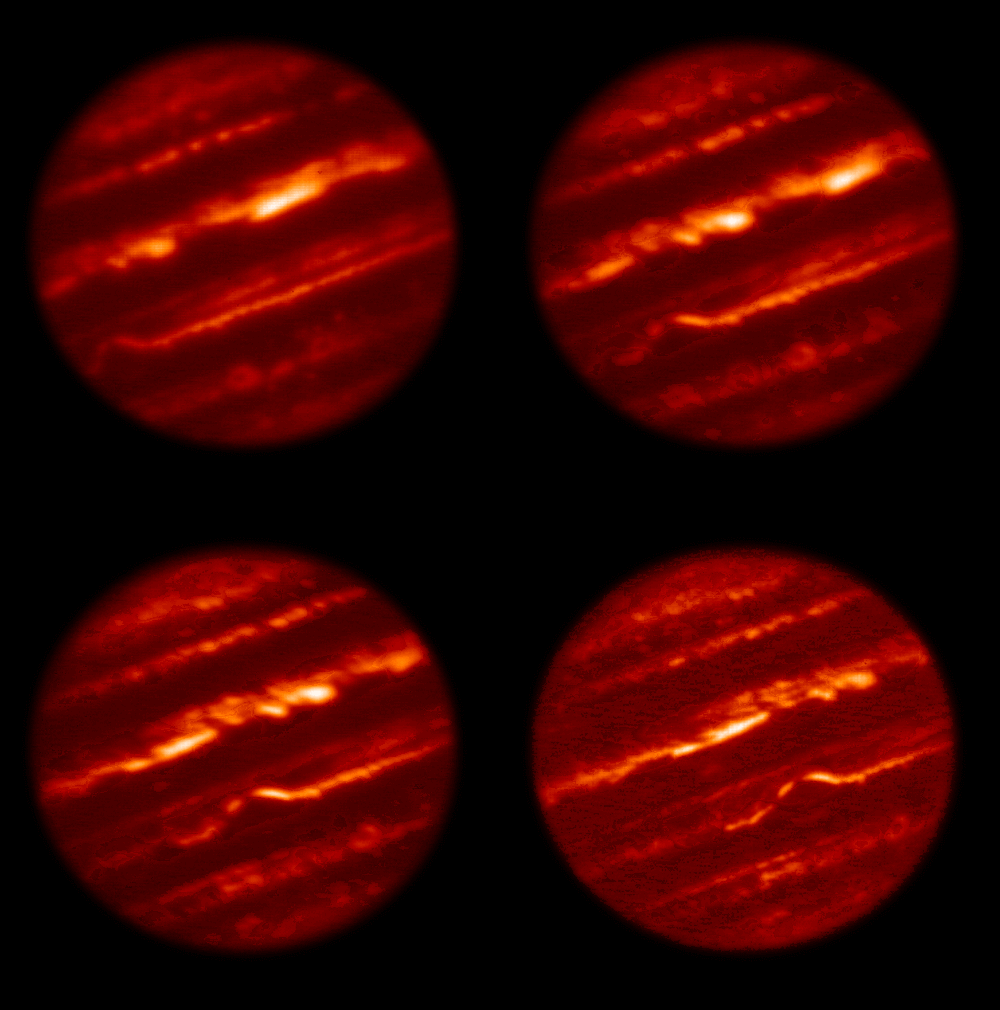
Whether you know it or not, but our solar system’s own Jupiter is an example of this phenomena. The largest planet orbiting the Sun, it gives off more heat from its contracting interior than it receives from our star. Shrinking about 1 mm per year, this gas giant was once both hotter and about twice its current diameter. This looping GIF clip, made from four individual images of Jupiter taken in infrared light, show it in a way completely different from what we would normally see with our eyes.
Sometimes referred to as a “failed star,” Jupiter would have needed about 75% more mass in order to undergo hydrogen fusion to helium, becoming a star. Even at its present size, it’s at the very low range of the smallest, cooler red dwarf stars whose diameters are believed to be about the size of Saturn, or some 84 – 90% that of Jupiter.
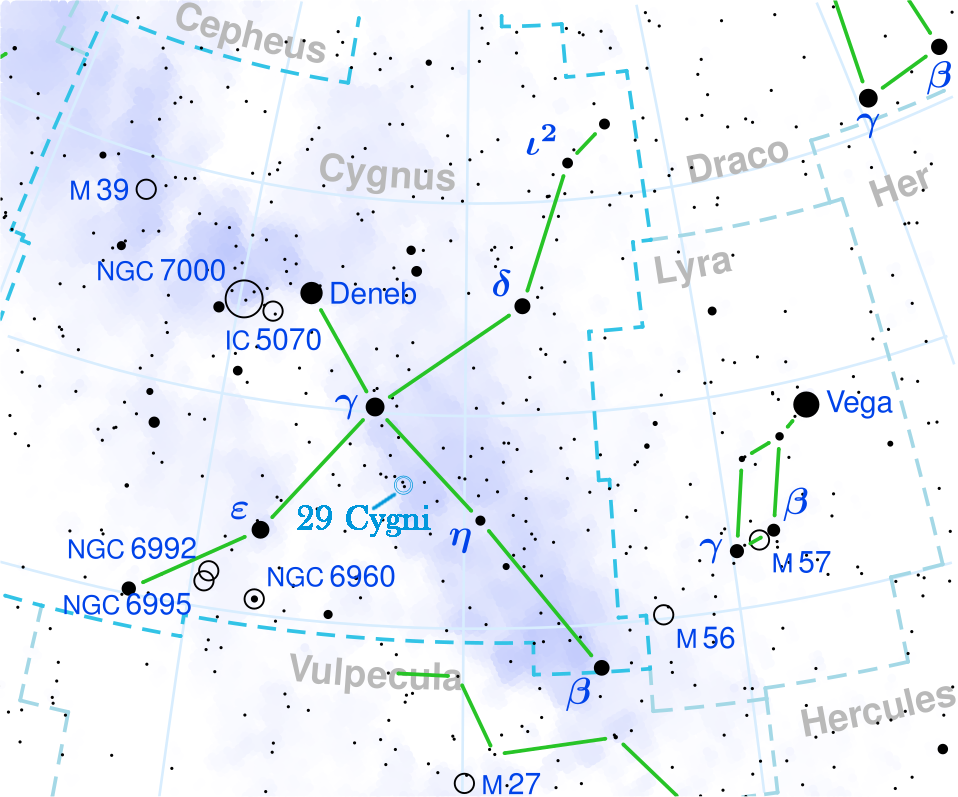
It also happens that many of the things I’ve written about are not necessarily the kinds that can be seen with the naked eye let alone amateur-sized telescopes. In this case, our subject is associated with a just-barely-visible naked eye star seen under dark skies in the late summer-autumn constellation of Cygnus, the Swan. One of the few classical constellations really resembling what it’s named for, the Swan can be seen in this negative, black-stars-on-white map flying toward the southern horizon of the purplish summer band of the Milky Way. The star in question, 29 Cygni, is shown partway down the bird’s long neck and has a blue-colored, double circle around it. While we can’t tell it’s so by just looking at it, this star is an example of one actually traveling towards Earth at a speed of 17 kilometers-per-second. How fast is this? It would be able to travel the entire north-to-south length of Sweden in just over a minute-and-a-half!
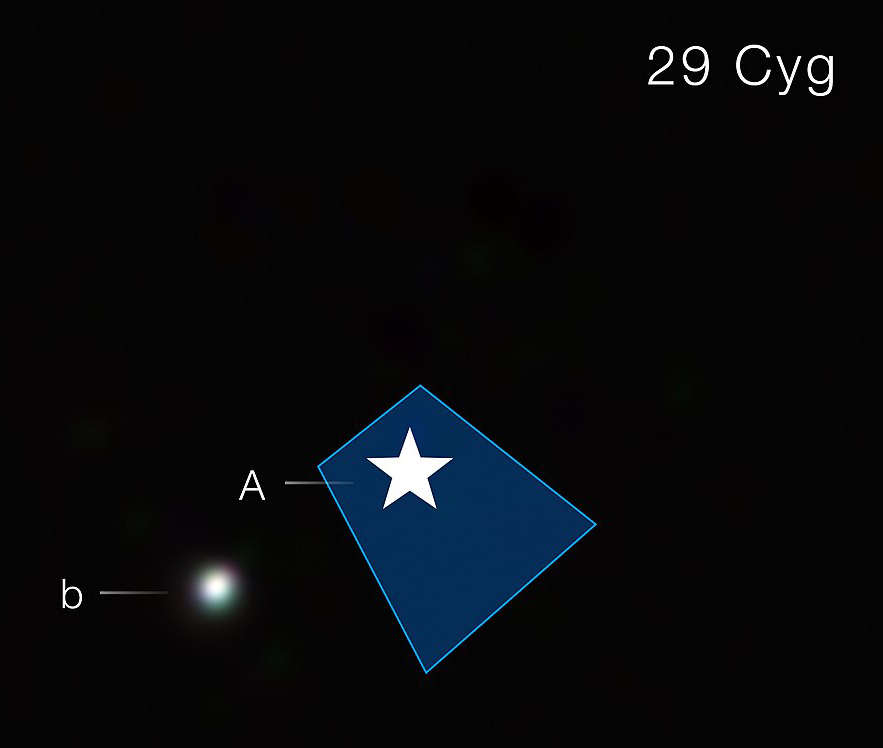
Back in 2022 an exoplanet weighing 15 time more than Jupiter, making it superjovian, was discovered with the ESA’s Gaia and Hipparchos direct imaging and astrometric satellites. At its parent star 29 Cygni’s distance of 133 light years, HIP 99770 b would be pretty hard to resolve into a planet. The NASA/ESA/CSA James Webb Space Telescope (JWST) has done that which would almost seem to be impossible; it has directly imaged this object.
A camera on Webb able to see in the near-infrared part of the electromagnetic spectrum was used in a special mode allowing it to block the light of the star 29 Cygni with a little opaque wedge. That’s the blue box, labeled “A,” with the white cartoon star seen in this picture. The exoplanet, HIP 99770 b (a.k.a. 29 Cygni b), has a letter “b” next to its small, off-white sphere.
Astronomers know there are two ways in which a planet can form; either from a disc of gas and dust surrounding a star (like Earth and the other solar system planets are believed to have done 4½ billion years ago), or from a giant cloud of similar materials that fragmented into pieces, which merged into planets. While some of them are rocky—think Mercury, Venus, Earth, and Mars—new, heavier planets in the outer part of a star’s family—like Jupiter, Saturn, Uranus, and Neptune—acquire gases that were driven away from the star when it became active.
JWST found evidence that this exoplanet had heavier chemical elements, like carbon and oxygen, favoring forming via accretion in the protoplanetary disc surrounding its parent star rather than through fragmentation as a star would have done. Additionally, given HIP 99770 b’s mass, the amount of heavy elements it contains would be equal to about 150 times those of Earth. One of the best places to acquire such solids containing metals is in a star’s developing protoplanetary disc.
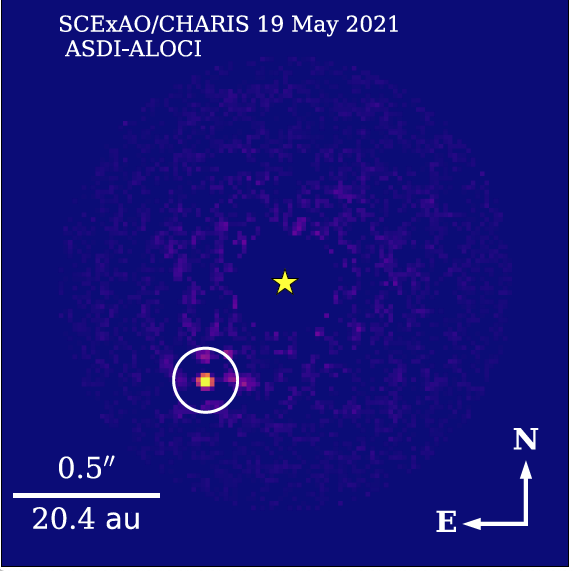
By way of corroborating evidence of such a disc, there is this image, made by Japan’s giant, 8.2 meter ground-based Subaru Telescope sitting high atop Mauna Kea in Hawaii. The exoplanet is the collection of pixels to the lower left, and star 29 Cygni is hidden again by something blocking its light, marked again by another cartoon star showing its location. Note the “doughnut,” made up of purple-colored pixels, surrounding the star. That’s the protoplanetary disc encircling it.
The ”cherry on the top” of whether or not HIP 99770 b formed from this disc came from an array of six, ground-based, 1-meter optical telescopes called CHARA (Center for High Angular Resolution Astronomy). Located on Mount Wilson in California, their light is combined together over a wide baseline to make a final, high-resolution image as if coming from a much larger instrument. CHARA was able to confirm the orbit of the exoplanet is aligned with the spinning of 29 Cygni. This is exactly what would be expected if HIP 99770 b had formed from the protoplanetary disc and not as a star through cloud fragmentation.
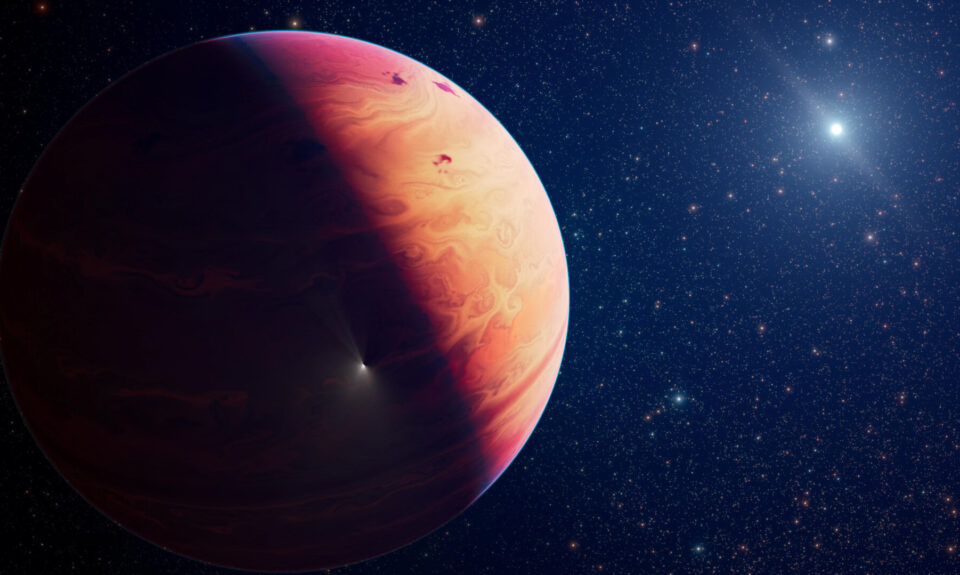
By combining all of these various lines of evidence, astronomers believe this exoplanet really did formed from 29 Cygni’s protoplanetary disc, helping them to better understand how the heaviest planets came to exist. This artist’s view shows HIP 99770 b in the foreground, with the parent star it orbits in the background at the upper right.
We’re not quite done yet as the researchers doing this study have three more stars to analyze, and one of the things they’ll be looking for will be differences in the compositions of their lower- and heavier-mass exoplanets, bringing even more clarity to understanding planetary formation.
For the official ESA press release about the James Webb Space Telescope’s discovery about 29 Cygni b, follow this link.
By: Tom Callen