From Earth to the Moon… and back again
Artemis II finally makes its historic flight
Many of Sweden’s primary school students were on their Easter break these past weeks. This often includes a trip of some sort whether it be inside the realm or elsewhere. While this was going on, four others were making one of their own, which has been hoped for for 54 years.
After several cancelled launches due to a variety of technical issues, Artemis II set off for its roundtrip to Earth’s only natural satellite, the Moon, on 1 April.
As a person who can easily remember the original Apollo voyages to the Moon and the six lunar landings between July 1969 and December 1972, this feels both familiar and different. Perhaps it’s the result of the pictures Artemis II’s crew has been sending back. One thing particularly striking is the clarity of these new pictures, which is probably due more than anything to the changes in photographic technology over the decades. While the Apollo Era images were taken with Swedish-built Hasselblad cameras shooting analog film, those seen now are made with digital cameras having higher resolution. Some of them have apparently been taken even by a crew member’s smartphone! Let’s take a look at a selection of some of these photos from Artemis II.
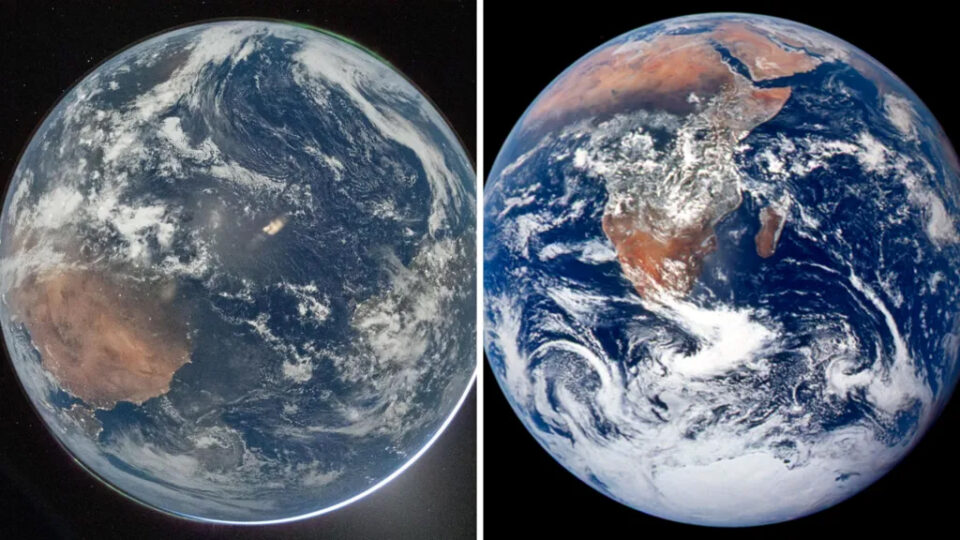
Just to show the difference between then and now, in this first picture we can see a comparison between an Artemis II picture of Earth taken now (left), and one taken by the crew of Apollo 17, during the last lunar landing mission, (right) in December 1972. The one on the left is clearer, sharper, because it’s digital vs. the one from 54 years ago made with analog film.
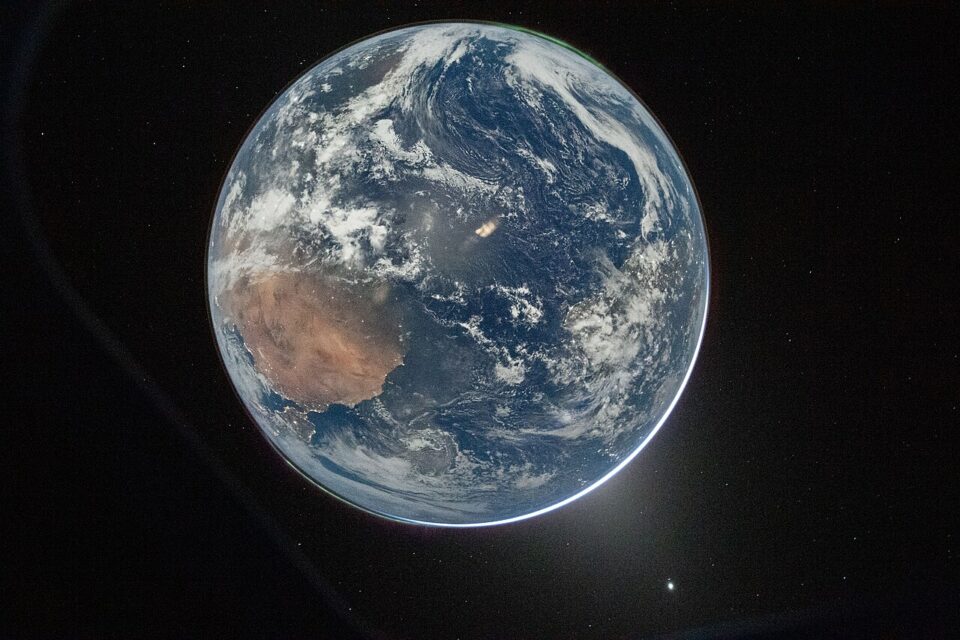
This picture, taken on the way from Earth has become known as “Hello, World.” The glowing white edge at the bottom right is caused by the Sun, and if you look very carefully, you can see green-colored aurora borealis floating over the disk at the top right. Since this display happens within our planet’s atmosphere, you can get a feel for just how thin it is. Another way to put it, if you pointed your car straight up and drove away from the Earth’s surface at regular highway speeds, you would reach the outer edge of our atmosphere in about five minutes!
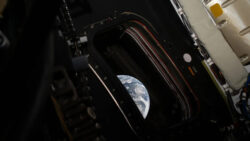
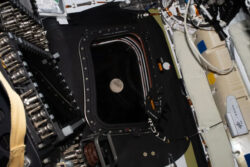
Any picture when you can superimpose foreground and background objects to give a sense of depth perception, it gives you a feeling of 3D. Here we can see the shrinking Earth out one of the Orion space capsule Integrity’s window as it heads toward the Moon.
One of the big differences between the Apollo spacecraft and Artemis II is that the former flew to the Moon tail-first, while the latter makes its way pointed nose-first. As a result, you won’t see any Apollo photos showing their spacecraft’s approach to the Earth’s only natural satellite until it’s about to go into orbit around it. Here we can once again see the Moon from out of one of Integrity’s windows while between it and Earth. The dark-colored lunar maria seen on much of the lunar surface, flows of once molten material from the Moon’s interior, are the same ones we can see on the side of our satellite, which is always facing toward Earth.
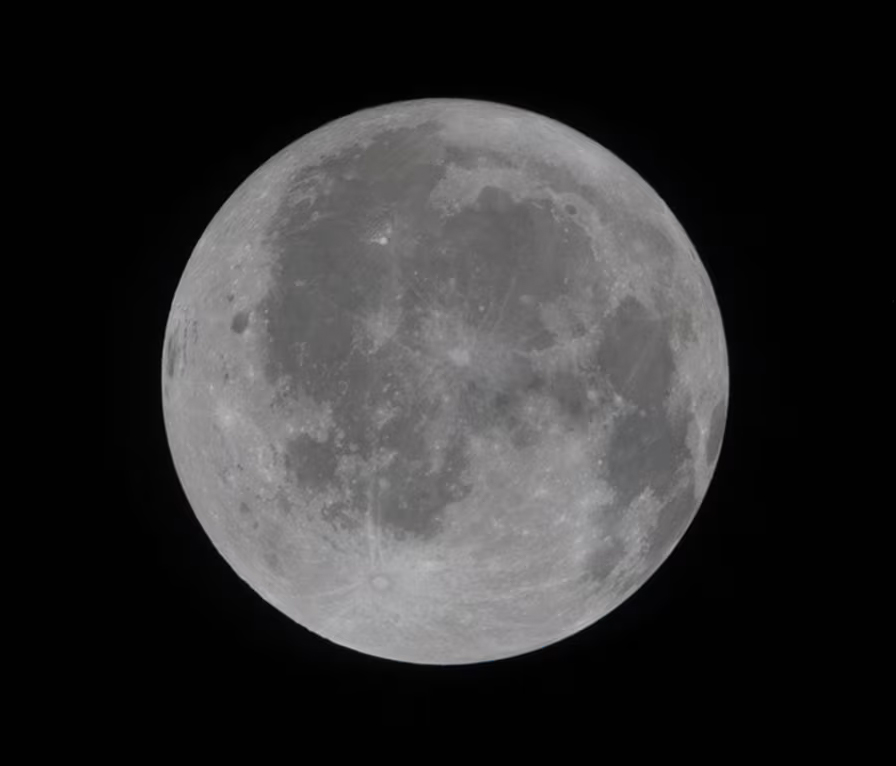
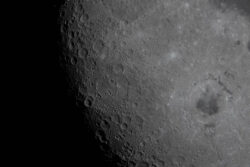
Artemis II’s first whole picture of the Moon, it looks very much like the view we see from Earth, though it’s rotated more counter-clockwise than we’re used to seeing it. The large crater Tycho, the one with the bright rays coming from it at between 06:00 and 07:00 positions on a clockface, can actually be seen naked eye from Earth. At the Moon’s left edge, at about the 09:00 position, is the Orientale Basin, which is an impact feature formed by an asteroid-sized object, and later flooded by dark, sub-surface lava. Believed to be about 900 km in diameter, it’s the Moon’s most recent structure of this type, forming some 3.7 to 3.8 billion years ago. Sitting right on the western border between the front half we can see and where we can’t see around the lunar edge, it can be seen a little bit depending on how the Moon is seen via something called libration.

Part of Integrity’s EU-built European Service Module (ESM), located behind the manned Orion capsule, is seen to the left as well as one of the spacecraft’s four solar panels. We are now looking at the back side of the Moon, the part we can’t normally see from Earth. The first such view of this side was provided by the Soviet Union’s robotic Luna 3 on 7 October 1959, though with very low resolution. While this isn’t the first time we humans have seen this side from lunar orbit, what’s different here is that it includes parts not seen as they might not have been illuminated at the time. Mare Orientale is the dark circular feature at the 05:00 position. Note that it has another circular feature around it, the Orientale Bassin, which makes it look like a bullseye target.
This button will take you to an animated simulation of what the approach to the Moon’s other side would look like if we were also onboard Integrity. You will see Mare Orientale rotate away to the lower right, blue crescent Earth (with a bright spot, which is the Sun’s light reflecting off of an ocean) will come into view from the right side at about 4,25” into the clip, disappear behind the Moon and reappear on the other side. The same thing happens with the Sun, the very bright “star,” at about 6,06”.
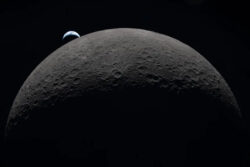
At first glance you might think it’s the Moon in the distance and Earth in the foreground of the first image above, but it’s the opposite. Stop and think about it for a minute, but where would Ingenuity have to be in order to capture this view? On the opposite side of the Moon from our planet, with nothing behind the camera’s point of view but the rest of the solar system, our Milky Way Galaxy, and the universe itself. One of the highlights of the Artemis II mission was to go farther away from Earth than any other crewed spacecraft in the past, with the previous record-holder Apollo 13 in 1970. This previous distance set 56-years-ago by Jim Lovell, Jack Swigert and Fred Haise was 400,171 km beyond Earth, while Artemis II’s was 406,771 km, or an increase of 6,600 km for this 2026 mission.
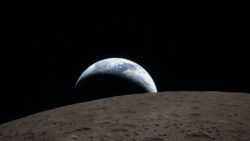
Another titled image from Artemi II, “Earthset” this better view shows Earth about to dip down behind the farside edge as Ingenuity orbits the Moon. In a way it is similar to Apollo 8’s well-known “Earthrise” photo taken by astronaut Bill Anders, which played a part in helping kick-start the environmental movement on that frail, blue ball of a spaceship hanging in the cold blackness of space.
The Orientale Basin with its dark, lava-filled central feature, Mare Orientale, can now be seen almost face-on in this picture from Integrity. Ripples in the lunar crust caused by the asteroid collision forming it resulted in the three concentric rings of different sizes seen today. Orientale’s rings and mountain ranges are still visible and not covered over because it’s not as filled-in as with examples of other lunar basins. This would have normally happened while the lava was still in a hot, liquid form.
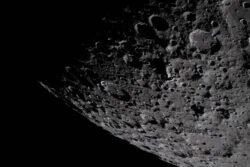
A low sunlight angle brings the craters of the Moon’s South Pole-Aitken basin into sharp relief. A gigantic impact crater some 2,500 km wide and between 6.2 and 8.2 km deep, it is the largest, oldest, and deepest basin known on the lunar surface. Forming some 4.2 to 4.3 billion years ago—very early in the solar system’s 4.5-billion-year history—the outer edge of this basin can be seen telescopically on the Moon’ southern rim as a large mountain chain from Earth.
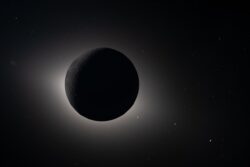
When you just happen to be in a spacecraft in the area, you can even go ahead and make your own total solar eclipse if you place yourself in the right place. Certainly both a fascinating and unusual picture, here we can see the dark sphere of the Moon between Integrity and the Sun, causing our star to be blocked from view. The faint glow surrounding the Moon is our star’s outer atmosphere, or corona, which can only be seen without special equipment during such an eclipse. Looking at the upper left limb of Earth’s satellite, you can still make out some craters spill being lit.
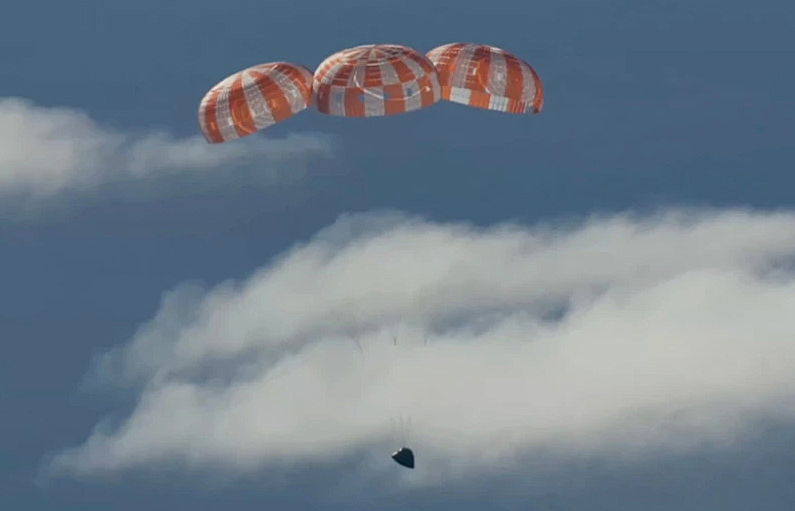
Like all crewed space missions in the past, one of the most critical moments—no matter how long it was or where they went—is returning back to Earth again. Which always means re-entering through our planet’s atmosphere. Artemis II was no exception, landing in the Pacific Ocean off of the coast of San Diego, California, in the middle of Sweden’s night on 11 April. Here we can see the deployed parachutes, which lowered Integrity’s Orion capsule to the impact-cushioning water below.
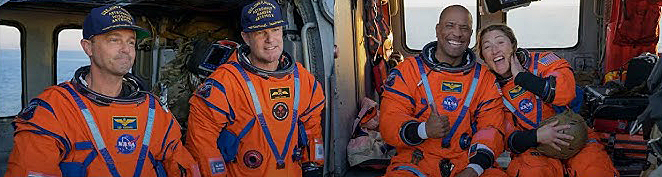
It wouldn’t be a successful mission without a traditional crew group photo now that they’re safe-and-sound back on planet Earth again. Onboard the recovery ship USS John P. Murtha, we can see, from left to right, Commander Reid Wiseman, Mission Specialist 2, Canadian Jeremy Hansen Pilot Victor Glover, and Mission Specialist 1 Christine Koch.
It still won’t be until Artemis IV in 2028, perhaps even later, before there is a first attempt to land on the Moon’s surface. But at least so far Artemis II has proven that the Space Launch System rocket and the Orion/European Service Module spacecraft carrying the astronauts there and back again proved themselves on this historical flight.
By: Tom Callen