The return of Odin
Sweden’s long-serving satellite re-enters through Earth’s atmosphere
After 25-years orbiting Earth, Sweden’s Odin scientific research satellite re-entered our atmosphere, burning up as it did, on 3 August. What would make such an object to do so? Frictional drag caused by that same atmosphere, which can expand farther from our planet with input from the Sun. Without a way to re-boost it to a higher position, that friction from the gases in the upper atmosphere causes a satellite to lose speed, dropping into a lower and lower orbit, until it becomes inevitable that it re-enters in a fiery end. In the case of Odin, this was predicted to happen at some time in the third quarter of 2026, but there was no real way to know for sure when it would happen.
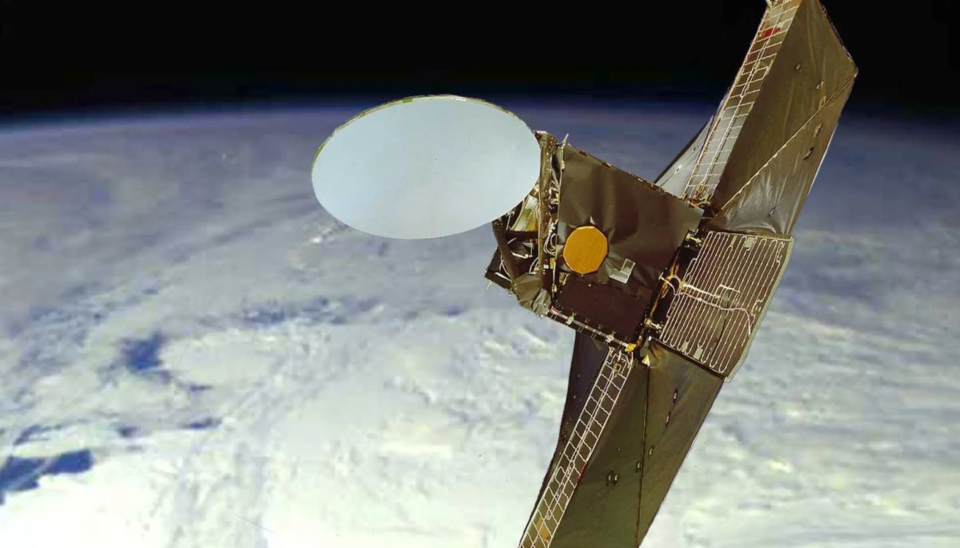
A joint international project involving the space agencies of Sweden (SNSB), Finland (TEKES), Canada (CSA), and France (CNES), Odin was launched to orbit on a START-1 rocket on 20 February 2001 from Svobodny, Russia. Weighing in at 250 kilos and around 2.0 meters by 3.8 meters in size, the satellite itself was developed by the Space Systems Division of what was then the Swedish Space Corporation, now known as SSC Space. Its main objectives were in the scientific areas of both astrophysics, applying the methods and principles of physics and chemistry to astronomical objects, and aeronomy. This latter is the study of Earth’s upper atmosphere, and the corresponding regions in those of other planets, including both atmospheric chemistry and atmospheric physics.
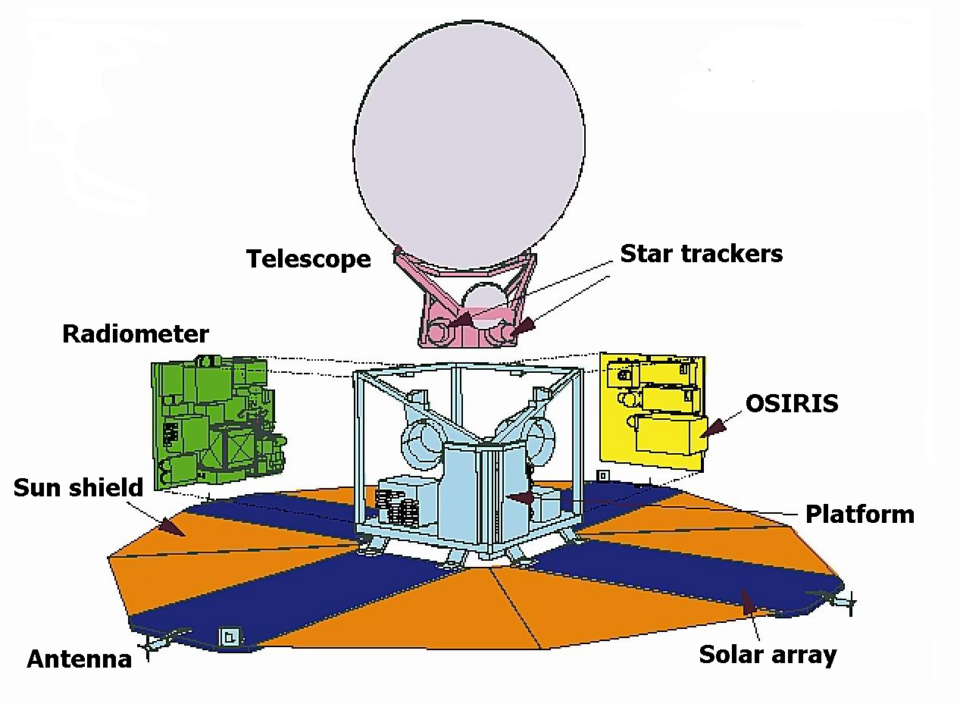
In order to accomplish this, Odin used two instruments. The main one, a Swedish-built radiometer (on the left in the diagram), was used to measure electromagnetic energy via a 1.1 meter telescope, which could be used for both the astronomy and atmospheric parts of the mission. OSIRIS (Optical Spectrograph and InfraRed Imager System, built in Canada and seen on the right), the second instrument on board, conducted Earth atmosphere studies, like tracking ozone depletion. Odin’s research between astronomy and aeronomy was split 50:50 on a “1-day astronomy,1-day aeronomy” basis until June 2007, when the former ended, leaving just the atmospheric studies to continue.
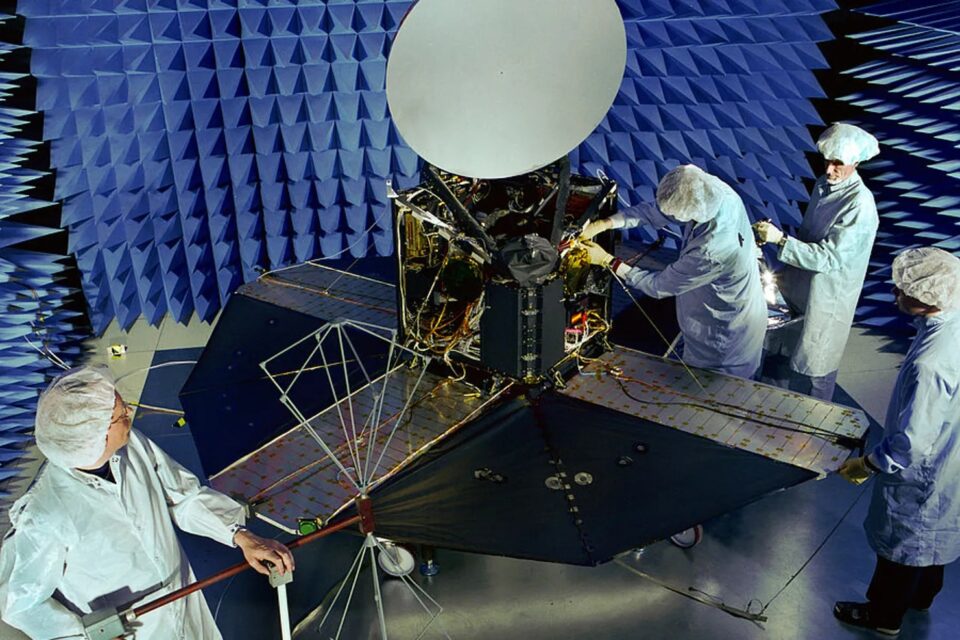
In this photo we can see just how large Odin was in comparison to those building it. The flat solar panels provided the spacecraft with 340 watts of power, and the star trackers seen in the diagram, often found in all-variety of satellites both in Earth-orbit and elsewhere, are used for determining Odin’s attitude along with high-performance gyroscopes and magnetic field-sensing magnetometers.
Another way to put this was that Odin didn’t have any active rocket thrusters or use any form of chemical or electrical propellant for its pointing and maneuvering. This was good for three reasons. The exhaust from firing thrusters could have contaminated the spacecraft’s instruments, and, due to its low weight, more of it could be devoted to the instruments for the science part of the mission rather than all the fuel tanks and other hardware associated with maneuvering. And, with no consumables, like thruster fuel onboard, Odin could easily outlast its originally planned two-year-lifespan, eventually reaching 25 years. The last date of active operations for the satellite was on 30 April 2026, and thus began the wait for its eventual uncontrolled atmospheric re-entry in August.
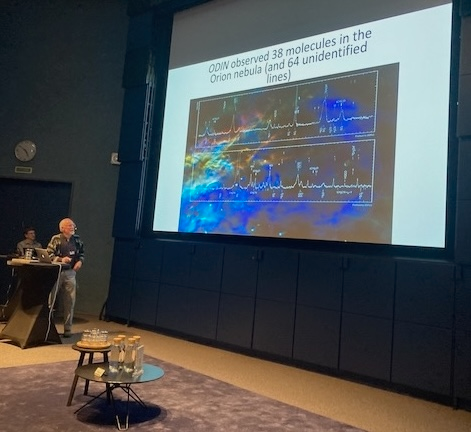
Some of Odin’s results in astrophysics centered around interstellar clouds, stellar evolution, comets, and our solar system’s planets. Two of the most important were the discovery of molecular oxygen (O2) in giant gas and dust clouds (nebulae), like Rho Ophiuchi, and water in comets. In this picture we can see Stockholm University’s late astronomy professor emeritus, Aage Sandqvist, talking about the satellite’s detection of nearly 40 different, identifiable molecules (plus others unknown) in the Orion Nebula, one of the most well-known, naked-eye features of the winter sky. In other regions where stars were forming, Odin detected evidence of both water (H₂O) and ammonia (NH₃). As in the case of other missions, these results were used to helped optimize observing programs for later missions, like the ESA’s Herschel Space Observatory.
When it came to aeronomy, results from Odin included mapping ozone layer depletion in detail never seen before, and tracked important chemical tracers, like chlorine monoxide (ClO), nitrous oxide (N₂O)and their motions through Earth’s atmosphere. It also provided global water mapping of water vapor in the stratosphere and mesosphere to better model water cycles. Canada’s OSIRIS instrument provided data on how events on the Sun effected the area around Earth, including a massive eruption of protons from our star that directly caused a depletion of surface-protecting ozone over the south polar region. Last, but certainly not least in these days of global warming, this same instrument studied noctilucent clouds in the mesosphere, which act as sensitive indicators of climate change and temperature fluctuations in the upper atmosphere.

Following in the footsteps of two other major Swedish satellites, Viking (1986 – 1987) and Freja (1992 – 1996), Odin was a good choice for a name, but there’s more to it than following a Norse-inspired lineage. Is there a connection between this chief god of old and both astronomy and aeronomy? Actually, there is on both counts.
In Norse cosmology, Odin and his brothers place the stars in the heavens, which gives him a role in organizing the cosmos rather than being a planet or star himself. He is also associated with wisdom, knowledge, and seeing far beyond ordinary sight. Odin is also sometimes described as a sky-father or storm-associated figure, connected with wind, storms, or tempest imagery, though the more commonly recognized weather god in Norse tradition is Thor, not Odin. Perhaps the best way to think about it is that while Odin is connected to the sky and cosmic order, and sometimes to storms or wind, he’s not directly an astronomy or atmosphere god like other specific deities identified with the forces of nature.
Even though Odin (the satellite) returned via a fiery end after 25 long years of useful research, it doesn’t mean this is the end of its story. There is still useful data remaining to go through, which will no doubt provide valuable new information about both the universe, but also regarding Earth’s atmosphere. And that’s not even counting future data analysis techniques and what they can yield from Odin’s results.
To read more about Odin’s story in more detail than what’s been covered here, see here at Rymdstyrelsen, and for a more personal account by one of the Stockholm University researchers who actually worked with the satellite, check out this account.
By: Tom Callen